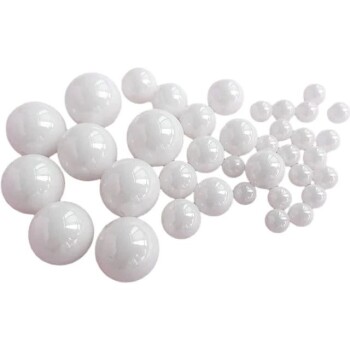
Alumina grinding balls are the standard choice for mixing nanostructured eutectic steel reactants because they offer a critical balance of high mechanical hardness and chemical inertness. Their physical properties allow them to deliver the necessary shear force to mix reactants thoroughly without degrading and contaminating the steel matrix with foreign metallic particles.
The core value of alumina lies in its ability to maintain the chemical purity of the steel matrix. While other media might offer higher density, alumina's superior wear resistance prevents the introduction of impurities that would compromise the structural integrity of the final nanostructured material.
The Critical Priority: Purity of the Matrix
Preventing Metallic Contamination
In the production of nanostructured steel, maintaining the exact chemical composition is paramount.
Alumina (aluminum oxide) is a ceramic material, not a metal. This distinguishes it from hardened steel or chrome grinding balls, which wear down over time and shed metallic particles into the mixture.
Chemical Stability
Alumina is chemically stable and inert.
This ensures that the grinding media does not react with the steel reactants during the milling process. By preventing chemical cross-contamination, alumina preserves the specific stoichiometry required for the eutectic reaction.
Superior Wear Resistance
Long milling processes are often required to achieve nanostructured states.
Alumina balls possess exceptional wear resistance. This durability ensures that the balls retain their shape and mass over extended periods, minimizing the amount of "media debris" that enters the sample matrix.
Mechanical Efficiency in Milling
Sufficient Shear Force
Despite being lighter than some metallic media, alumina provides high hardness.
This hardness allows the balls to generate sufficient shear force and impact energy during collisions. This energy is essential for fracturing powder particles and facilitating the mechanical alloying process required for nanostructured steel.
Effective Energy Transfer
The hardness of the media ensures that the kinetic energy of the mill is transferred effectively to the reactants.
Rather than deforming upon impact, the alumina balls remain rigid, directing the energy into mixing and reducing the particle size of the steel reactants.
Operational Considerations
The Role of Density
For grinding to be effective, the media must be denser than the material being ground.
If the media is too light, it will float on top of the reactants, rendering the process ineffective. Alumina provides sufficient density to stay immersed in the reactant powder, ensuring consistent grinding action.
Impact of Media Size
The physical size of the alumina balls dictates the final outcome.
Smaller media are generally used to achieve a finer final particle size. However, the media must always remain substantially larger than the largest pieces of reactant material to ensure effective crushing and mixing.
Understanding the Trade-offs
While alumina is the optimal choice for purity, it is important to recognize the mechanical constraints of the system.
Mill Liner Wear
Hardness is a double-edged sword. The media must be hard enough to grind the reactants, but not so hard that it destroys the mill's inner lining.
Because alumina is extremely hard, operators must ensure the mill's lining (the tumbler) is constructed of a material capable of withstanding the abrasion caused by the alumina balls to avoid contaminating the sample with liner debris.
Density vs. Kinetic Energy
Alumina is less dense than metallic media like steel or tungsten carbide.
While this is beneficial for purity, lower density means less kinetic energy per impact. Consequently, achieving the same particle reduction might require longer milling times compared to using heavier, metallic media.
Making the Right Choice for Your Goal
When setting up your milling protocol for nanostructured steel, align your media selection with your primary objective.
- If your primary focus is Chemical Purity: Prioritize alumina grinding balls to eliminate the risk of metallic contamination and ensure the structural integrity of the steel matrix.
- If your primary focus is Particle Size Control: Select the smallest practical media diameter that is still larger than your feed material to maximize surface area contact and achieve finer powders.
- If your primary focus is Equipment Longevity: Ensure your mill's lining material matches the hardness of the alumina media to prevent excessive wear and secondary contamination.
Success in mixing nanostructured reactants relies on prioritizing the purity of the end product over the speed of the grind.
Summary Table:
| Feature | Alumina Grinding Media Benefit |
|---|---|
| Material Composition | High-purity ceramic (Aluminum Oxide) |
| Primary Advantage | Prevents metallic contamination in steel matrix |
| Chemical Property | Inert and stable; won't react with reactants |
| Mechanical Property | High hardness for effective shear force and fracturing |
| Wear Resistance | Exceptional durability minimizes media debris |
| Density | Sufficient to remain immersed in reactant powders |
Elevate Your Nanostructured Material Research with KINTEK
Precision in milling starts with the right media. KINTEK specializes in high-performance laboratory equipment and consumables designed for the most demanding research applications. Whether you are mixing nanostructured eutectic steel or developing advanced batteries, our high-purity alumina grinding balls and crushing and milling systems ensure the chemical integrity of your samples.
Our comprehensive portfolio includes:
- Milling Solutions: Advanced planetary ball mills and wear-resistant grinding media.
- High-Temperature Systems: Muffle, vacuum, and CVD furnaces for sintering and heat treatment.
- Specialized Labs: Hydraulic presses, high-pressure reactors, and electrochemical cells.
Protect your research from contamination. Contact KINTEK today to discover how our expert-grade consumables and laboratory systems can optimize your workflow and deliver consistent, high-quality results.
References
- Zhengning Li, Yupeng Wei. Enhancing Ductility of 1045 Nanoeutectic Steel Prepared by Aluminothermic Reaction through Annealing at 873 K. DOI: 10.1155/2017/5392073
This article is also based on technical information from Kintek Solution Knowledge Base .
Related Products
- Laboratory Jar Ball Mill with Alumina Zirconia Grinding Jar and Balls
- High Purity Alumina Granulated Powder for Engineering Advanced Fine Ceramics
- Advanced Engineering Fine Ceramics Low Temperature Alumina Granulation Powder
- Laboratory Jar Mill with Agate Grinding Jar and Balls
- Laboratory Ball Mill Jar Mill with Metal Alloy Grinding Jar and Balls
People Also Ask
- What are the primary functions of using a ball mill for BZCY72 powder? Achieve High Purity and Enhanced Sintering
- In what way does a laboratory ball mill affect material properties when modifying PHBV/pulp fiber composites?
- Why is a laboratory ball mill required for ultra-fine fly ash? Unlock Nano-Scale Adsorption Power
- What is the function of a laboratory ball mill in the preparation of AMMCs? Optimize Dispersion & Grain Refinement
- What is the function of a laboratory ball mill in the pretreatment of waste tire char (WTC)? Optimize Material Reactivity