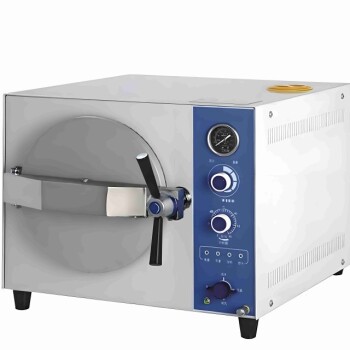
Stainless steel autoclaves are the critical enabler for the synthesis of thermoplastic polyester elastomers (PCL-TPE) because they provide the only viable environment for the harsh conditions required by polycondensation. Specifically, these vessels are engineered to withstand temperatures up to 240 degrees Celsius while simultaneously maintaining an extremely high vacuum of less than 25 Pa.
Core Insight The production of PCL-TPE relies on a dual-constraint environment: extreme heat to activate the reaction and deep vacuum to drive it. Stainless steel autoclaves are essential because they combine the structural rigidity to hold this vacuum with the mechanical capability to mix complex polymer segments uniformly.
Creating the Necessary Reaction Environment
To synthesize PCL-TPE effectively, the equipment must overcome significant physical challenges. The stainless steel autoclave addresses these through its specialized thermal and atmospheric capabilities.
Withstanding High Temperatures
The polycondensation stage of this synthesis is thermally aggressive, requiring sustained heat up to 240 degrees Celsius. Stainless steel is used because it retains its mechanical integrity and chemical neutrality at these elevated temperatures. It ensures the vessel does not warp, degrade, or react with the polymer melt.
Maintaining Deep Vacuum
Achieving a high molecular weight in PCL-TPE requires a vacuum environment of less than 25 Pa. This low pressure is critical for removing volatile byproducts generated during the reaction. The rigid construction of the stainless steel autoclave prevents the vessel from collapsing under this pressure differential.
Ensuring Process Stability and Uniformity
Beyond simply holding pressure and heat, the equipment must actively manage the internal chemistry of the polymer.
Robust Sealing Structure
The success of the vacuum relies entirely on the autoclave's sealing architecture. A robust sealing structure is necessary to isolate the reaction system completely from the outside atmosphere. This ensures that the vacuum remains stable throughout the process, preventing oxygen ingress or pressure fluctuations that could ruin the batch.
Efficient Component Mixing
PCL-TPE synthesis involves the chemical bonding of distinct "soft" and "hard" segment components. The autoclave’s built-in stirring system is essential for homogenizing these different materials. Thorough mixing facilitates efficient polycondensation, ensuring the final elastomer has consistent physical properties.
Operational Trade-offs and Considerations
While stainless steel autoclaves are the standard solution, relying on them for such extreme conditions introduces specific operational challenges.
Sealing Sensitivity
The requirement to hold a vacuum under 25 Pa while heating to 240°C places immense stress on seals and gaskets. Even a microscopic failure in the sealing mechanism can result in a loss of vacuum. This makes regular maintenance and integrity testing of the sealing structure a non-negotiable operational cost.
Viscosity Management
As the polycondensation progresses and molecular weight increases, the viscosity of the melt rises significantly. The built-in stirring system must be powerful enough to handle this resistance. If the stirrer lacks sufficient torque, it may result in poor mixing or mechanical failure during the critical final stages of synthesis.
Making the Right Choice for Your Goal
Selecting and operating the right autoclave is about matching equipment capabilities to your specific quality parameters.
- If your primary focus is reaction kinetics: Prioritize the vacuum pump integration and sealing integrity to ensure you can consistently hold pressures below 25 Pa.
- If your primary focus is material homogeneity: Ensure the built-in stirring system produces high torque to mix soft and hard segments thoroughly as viscosity increases.
The right stainless steel autoclave transforms a volatile, high-energy chemical process into a controlled and reproducible manufacturing capability.
Summary Table:
| Feature | Requirement for PCL-TPE | Role of Stainless Steel Autoclave |
|---|---|---|
| Temperature | Up to 240°C | Maintains structural integrity and chemical neutrality under high heat. |
| Pressure | < 25 Pa (Deep Vacuum) | Rigid construction prevents collapse and removes volatile byproducts. |
| Atmosphere | Oxygen-free / Isolated | Robust sealing structure prevents ingress and ensures process stability. |
| Viscosity | High (during polymer growth) | High-torque stirring systems ensure homogeneity of soft and hard segments. |
Elevate your polymer research with KINTEK’s precision engineering. As specialists in laboratory equipment, KINTEK provides industry-leading high-temperature high-pressure reactors and autoclaves designed to maintain the extreme vacuum and thermal conditions essential for PCL-TPE synthesis. Whether you are developing advanced elastomers or scaling up battery research, our comprehensive range of crushing systems, hydraulic presses, and cooling solutions ensures your lab achieves reproducible, high-quality results. Contact KINTEK today to optimize your synthesis process!
References
- Chinh Hoang Tran, Il Kim. Heterogeneous Double Metal Cyanide Catalyzed Synthesis of Poly(ε-caprolactone) Polyols for the Preparation of Thermoplastic Elastomers. DOI: 10.3390/catal11091033
This article is also based on technical information from Kintek Solution Knowledge Base .
Related Products
- Mini SS High Pressure Autoclave Reactor for Laboratory Use
- Portable High Pressure Laboratory Autoclave Steam Sterilizer for Lab Use
- Desktop Fast Laboratory Autoclave Sterilizer 35L 50L 90L for Lab Use
- Desktop Fast High Pressure Laboratory Autoclave Sterilizer 16L 24L for Lab Use
- Laboratory High Pressure Steam Sterilizer Vertical Autoclave for Lab Department
People Also Ask
- Why use high-pressure reactors for molecular sieve synthesis? Unlock Superior Crystallinity and Framework Control
- What is the function of a high-pressure reactor autoclave? Enhancing Cu/N Co-Doped Carbon Catalyst Synthesis
- What are the advantages of using a high-pressure reactor like an autoclave? Maximize Liquefaction Speed & Yield
- Why are high-pressure reactors or autoclaves necessary for the synthesis of new functional materials? Unlock Precision.
- How are high-pressure reactors used to prepare metaphosphate electrocatalysts? Master In-Situ Precursor Growth