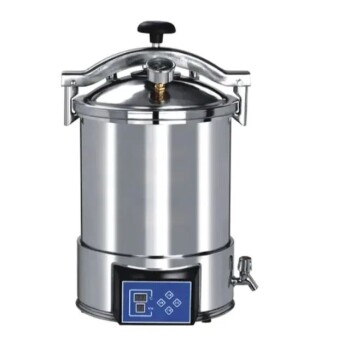
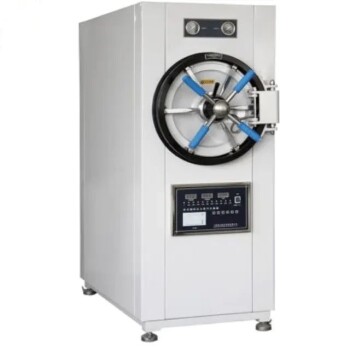
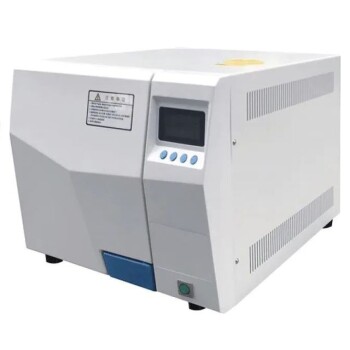
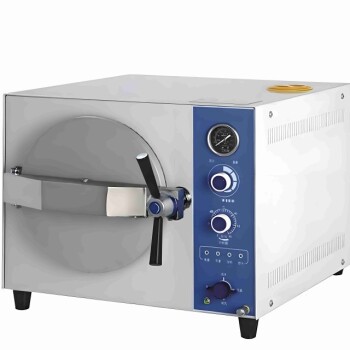
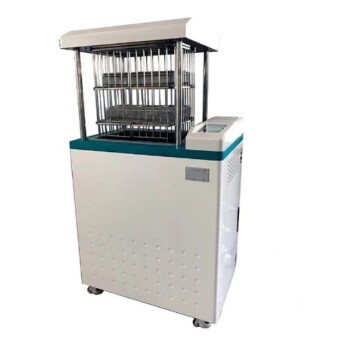
The primary function of a high-pressure static autoclave in biomass hydrothermal liquefaction (HTL) is to serve as a robust, sealed reaction chamber. It creates and maintains the extreme thermodynamic conditions—specifically temperatures ranging from 310°C to 365°C and high pressures—required to achieve subcritical or supercritical water states necessary for the liquefaction process.
The autoclave provides more than just containment; it creates a controlled "stress test" environment. This allows researchers to isolate variables and accurately simulate how reactor materials withstand corrosion under the harsh conditions of biomass conversion.
Creating the Necessary Reaction Environment
Achieving Subcritical and Supercritical States
To convert biomass effectively, water must act as a solvent, which requires it to be in a subcritical or supercritical state.
The high-pressure static autoclave is engineered to facilitate this phase change.
It creates a sealed space that can safely sustain the high pressures and temperatures (310°C–365°C) needed to reach these specific states.
Providing a Controlled Variable Space
Successful experimentation requires the isolation of specific factors.
This equipment allows researchers to precisely manipulate temperature and pressure levels within the vessel.
By locking these variables, scientists can observe the direct cause-and-effect relationship between thermodynamic conditions and the liquefaction process.
Evaluating Material Durability and Corrosion
Simulating Reactor Alloy Stress
A major challenge in HTL is the degradation of the equipment itself.
The autoclave is essential for testing the corrosion performance of reactor alloy materials.
It exposes these materials to the exact simulated conditions of an operational plant, revealing how they will hold up over time.
Assessing the Impact of Catalysts
Catalysts are often introduced to improve the efficiency of biomass conversion, but they can also accelerate material degradation.
The autoclave enables researchers to introduce various catalysts into the sealed environment.
This allows for the observation of how specific chemical interactions impact the corrosion rate of the reactor alloys under high heat and pressure.
Understanding the Trade-offs
The "Static" Nature of the Experiment
While this equipment offers excellent control, it operates as a static (batch) system.
This means the environment is sealed and does not involve the continuous flow of materials found in some industrial applications.
Researchers must account for this fixed volume when extrapolating data to continuous-flow systems.
High-Stakes Containment
Operating at pressures and temperatures of up to 365°C requires rigorous safety protocols.
The autoclave must be significantly more robust than the materials being tested.
If the vessel's integrity is compromised, the release of high-pressure subcritical water presents a significant safety hazard.
Making the Right Choice for Your Goal
Depending on the specific focus of your research, the autoclave serves different critical roles.
- If your primary focus is Process Chemistry: Use the autoclave to precisely map the temperature and pressure thresholds required to achieve supercritical water states.
- If your primary focus is Material Engineering: Utilize the sealed environment to test the corrosion resistance of new alloy compositions against specific catalysts.
The high-pressure static autoclave is the bridge between theoretical biomass chemistry and the physical reality of reactor durability.
Summary Table:
| Feature | Function in HTL Simulation | Impact on Research |
|---|---|---|
| Phase Control | Reaches subcritical/supercritical states (310°C–365°C) | Ensures water acts as an effective solvent for liquefaction. |
| Variable Isolation | Provides a sealed, controlled thermodynamic space | Allows precise observation of temperature and pressure effects. |
| Material Testing | Exposes alloys to harsh simulated conditions | Evaluates corrosion resistance and durability of reactor materials. |
| Catalyst Analysis | Monitors chemical interactions in a closed system | Determines how specific catalysts affect material degradation. |
Elevate Your Biomass Research with KINTEK Precision
Transitioning from theoretical chemistry to industrial reality requires equipment that can withstand the most demanding environments. KINTEK specializes in high-performance laboratory solutions, providing the high-temperature high-pressure reactors and autoclaves essential for biomass HTL and material durability testing.
Our extensive portfolio—ranging from robust crushing and milling systems to advanced cooling solutions and precision ceramic consumables—is designed to support every stage of your workflow. Whether you are engineering new alloys or optimizing supercritical processes, KINTEK delivers the reliability your laboratory demands.
Ready to upgrade your research capabilities? Contact KINTEK Today for Expert Consultation
References
- Minkang Liu, Yimin Zeng. Key Processing Factors in Hydrothermal Liquefaction and Their Impacts on Corrosion of Reactor Alloys. DOI: 10.3390/su15129317
This article is also based on technical information from Kintek Solution Knowledge Base .
Related Products
- Stainless High Pressure Autoclave Reactor Laboratory Pressure Reactor
- Mini SS High Pressure Autoclave Reactor for Laboratory Use
- High Pressure Laboratory Autoclave Reactor for Hydrothermal Synthesis
- Laboratory High Pressure Horizontal Autoclave Steam Sterilizer for Lab Use
- Desktop Fast High Pressure Laboratory Autoclave Sterilizer 16L 24L for Lab Use
People Also Ask
- Why is a laboratory high-pressure reactor used in the hydrothermal synthesis of hydroxyapatite catalysts?
- What role does a laboratory high-pressure reactor play in the leaching process of spent cathode materials? Optimize Recovery
- Why is a laboratory high-pressure reactor necessary for synthesizing fly ash-based zeolite? Achieve Pure Crystallization
- What conditions do laboratory high-pressure reactors provide for HTC? Optimize Your Biochar Production Processes
- What is the function of a high-pressure reactor autoclave? Enhancing Cu/N Co-Doped Carbon Catalyst Synthesis