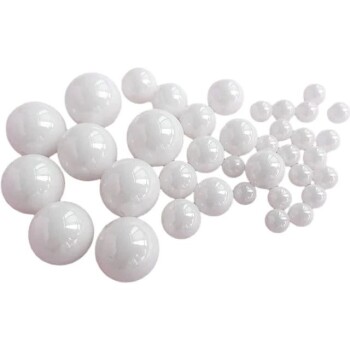
Zirconia grinding balls are the superior choice for this application primarily due to their high density and exceptional wear resistance. When mixing copper and zirconium powders, the high density of the media generates the necessary impact energy to ensure thorough blending, while its durability prevents the grinding balls from degrading and contaminating the copper matrix with impurities.
The use of zirconia balances mechanical efficiency with chemical purity; it provides the heavy impact force required to mix metal powders without introducing foreign contaminants that would compromise the final composite.
The Physics of Efficient Mixing
High Density Generates Kinetic Energy
Effective mixing in ball milling relies on the impact force of the grinding media. Because zirconia has a high density, the balls carry significant mass.
Transforming Impact into Mixing Power
When these heavy balls collide with the powder, they deliver high impact kinetic energy. This energy is essential to deform, fracture, and cold-weld the copper and zirconium particles into a uniform composite.
Optimization of Process Time
Lighter media, such as alumina or glass, would require significantly longer milling times to achieve the same degree of mixing. Zirconia’s density ensures the mechanical alloying process is both time-efficient and energetic enough to refine the powders.
Preserving Material Purity
The Danger of Impurities
In composite materials, purity is paramount. Any foreign material introduced during milling can act as a defect, reducing electrical conductivity or mechanical strength.
Superior Wear Resistance
Zirconia is extremely hard and resistant to abrasion. Unlike softer media that might shed material into the batch, zirconia retains its integrity throughout the vigorous milling process.
Chemical Stability
Zirconia is chemically inert. This stability prevents side reactions between the grinding media and the reactive metal powders, ensuring the chemical composition of the copper and zirconium remains unaltered.
Understanding the Trade-offs
Cost vs. Performance
Zirconia grinding media is generally more expensive than steel or alumina alternatives. However, this upfront cost is often justified by the prevention of batch contamination and the longevity of the beads.
Hardness vs. Brittleness
While zirconia is tough (fracture resistant) compared to other ceramics, it is still a ceramic. Extreme thermal shock or operating the mill at high speeds without sufficient powder (running dry/empty) can lead to media fracture, though this is less common with zirconia than with alumina.
Making the Right Choice for Your Goal
- If your primary focus is Material Purity: Zirconia is essential because its high wear resistance eliminates the risk of introducing metallic or ceramic impurities into your copper matrix.
- If your primary focus is Process Efficiency: Zirconia is the ideal candidate because its high density delivers the maximum kinetic energy to mix powders rapidly and thoroughly.
By selecting zirconia, you ensure the structural integrity of your composite material is not compromised by the very process used to create it.
Summary Table:
| Feature | Zirconia Grinding Media Benefit | Impact on Copper/Zirconium Composites |
|---|---|---|
| High Density | Delivers maximum kinetic energy | Ensures thorough blending and mechanical alloying |
| Wear Resistance | Minimal media degradation | Prevents contamination of the copper matrix |
| Chemical Inertness | No reaction with metal powders | Preserves the chemical integrity of the composite |
| Process Efficiency | Faster milling cycles | Reduces production time compared to lighter media |
Elevate Your Materials Research with KINTEK
Precision in composite material synthesis starts with the right equipment and media. At KINTEK, we specialize in providing high-performance laboratory solutions—from crushing and milling systems and premium zirconia grinding media to advanced high-temperature furnaces and hydraulic presses for pellet preparation.
Whether you are refining copper-zirconium alloys or exploring new battery research frontiers, our comprehensive range of tools, including high-pressure reactors and crucibles, ensures your results are consistent and contamination-free.
Ready to optimize your milling process? Contact our technical experts today to find the perfect equipment for your laboratory's unique needs.
Related Products
- Laboratory Jar Ball Mill with Alumina Zirconia Grinding Jar and Balls
- Precision Machined Zirconia Ceramic Ball for Engineering Advanced Fine Ceramics
- Laboratory Jar Mill with Agate Grinding Jar and Balls
- Laboratory Ball Mill Jar Mill with Metal Alloy Grinding Jar and Balls
- Laboratory Micro Tissue Grinding Mill Grinder
People Also Ask
- What are the primary functions of using a ball mill for BZCY72 powder? Achieve High Purity and Enhanced Sintering
- In what way does a laboratory ball mill affect material properties when modifying PHBV/pulp fiber composites?
- Why is a laboratory ball mill required for ultra-fine fly ash? Unlock Nano-Scale Adsorption Power
- What is the function of a laboratory ball mill in the preparation of AMMCs? Optimize Dispersion & Grain Refinement
- What is the function of a laboratory ball mill in the pretreatment of waste tire char (WTC)? Optimize Material Reactivity