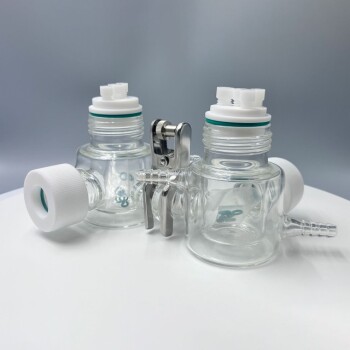
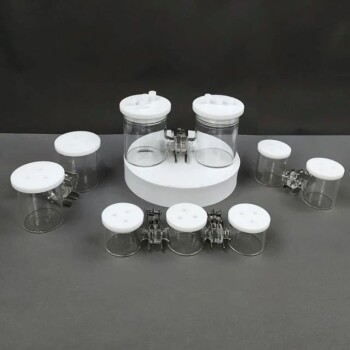
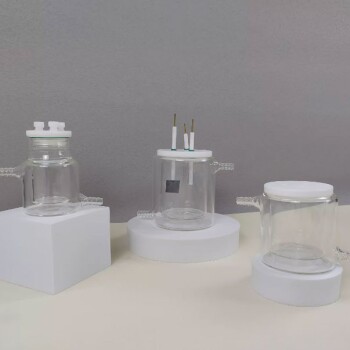
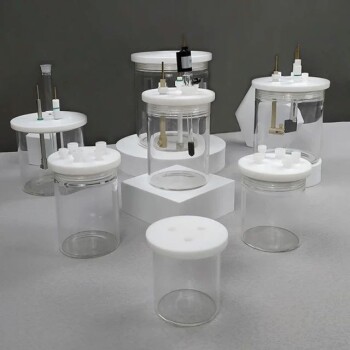
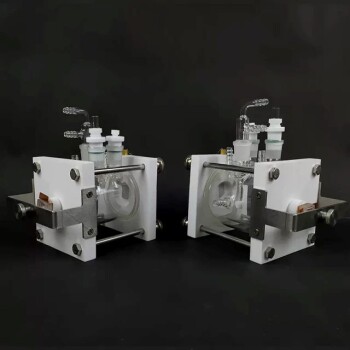
The dual-chamber H-type electrolytic cell is required to physically isolate the oxidation and reduction environments while allowing ion exchange. This configuration uses a composite membrane to separate the anolyte and catholyte, enabling the independent measurement of hydrogen evolution and triiodide generation without the interference of external electrical bias.
Core Takeaway The H-type cell is not merely a vessel; it is a simulation tool that replicates the internal architecture of practical photoelectrochemical converters. Its primary function is to decouple the half-reactions, ensuring that the kinetics of light-driven decomposition are evaluated accurately and efficiently.
The Mechanics of Physical Separation
Isolating Reaction Environments
The defining feature of the H-type cell is the physical separation of the anolyte (where oxidation occurs) and the catholyte (where reduction occurs).
The Role of the Composite Membrane
This separation is achieved using a composite membrane placed between the two chambers. This barrier prevents the bulk mixing of the electrolytes while still permitting necessary ionic transport to complete the circuit.
Simulating Practical Systems
This configuration is designed to mimic the environment of a practical photoelectrochemical converter. It provides a realistic testing ground for how a scalable device would manage internal chemical separation.
Ensuring Data Integrity
Independent Kinetic Monitoring
In a single-chamber setup, reaction products could mix or interfere with detection. The dual-chamber design allows researchers to monitor hydrogen evolution and triiodide generation kinetics independently.
Accurate Efficiency Evaluation
By isolating the products, you can precisely quantify the output of each half-reaction. This is essential for accurately evaluating the overall efficiency of the light-driven total decomposition reaction.
Unassisted Operation
The design specifically facilitates experiments performed without external bias. It proves that the decomposition is driven solely by the photo-active materials, validating the "unassisted" nature of the reaction.
Understanding the Trade-offs
Complexity vs. Simplicity
While a single-cell setup is simpler to construct, it fails to prevent product recombination or cross-contamination. The H-type cell introduces mechanical complexity to ensure chemical isolation.
The Necessity of the Membrane
The accuracy of this setup relies entirely on the integrity of the composite membrane. If the membrane allows for product crossover, the kinetic data will be compromised, rendering the efficiency calculations invalid.
Making the Right Choice for Your Goal
To determine if this configuration matches your experimental needs, consider your specific objectives:
- If your primary focus is fundamental kinetics: Use the H-type cell to isolate half-reactions and obtain precise, independent data on hydrogen and triiodide production rates.
- If your primary focus is device prototyping: Use this configuration to validate that your materials can function efficiently in an environment that simulates a practical, separated converter.
The H-type cell is the standard for proving that an unassisted system is chemically efficient and practically viable.
Summary Table:
| Feature | Single-Chamber Cell | Dual-Chamber H-Type Cell |
|---|---|---|
| Product Isolation | Mixed products (Hydrogen & Triiodide) | Complete physical separation via membrane |
| Kinetic Accuracy | Low (interference from recombination) | High (independent monitoring of half-reactions) |
| Simulation Value | Basic material testing | Replicates practical photoelectrochemical converters |
| Operating Mode | Often requires external bias | Validates unassisted, light-driven decomposition |
| Electrolyte Mixing | Unrestricted bulk mixing | Prevented; permits only necessary ion transport |
Advance Your Electrochemical Research with KINTEK
Precise HI decomposition experiments demand superior chemical isolation and hardware integrity. KINTEK specializes in high-performance laboratory equipment, providing the electrolytic cells, electrodes, and high-temperature reactors essential for simulating real-world photoelectrochemical converters.
Whether you are focusing on fundamental kinetics or device prototyping, our comprehensive portfolio—including PTFE consumables, ceramic crucibles, and advanced cooling solutions—ensures your research is backed by accuracy and durability.
Ready to elevate your lab's efficiency and data integrity? Contact KINTEK experts today to find the perfect specialized equipment for your battery research, crushing, or high-pressure applications.
References
- Shane Ardo, Nathan S. Lewis. Unassisted solar-driven photoelectrosynthetic HI splitting using membrane-embedded Si microwire arrays. DOI: 10.1039/c5ee00227c
This article is also based on technical information from Kintek Solution Knowledge Base .
Related Products
- H-Type Double-Layer Optical Electrolytic Electrochemical Cell with Water Bath
- H Type Electrolytic Cell Triple Electrochemical Cell
- Double-Layer Water Bath Electrolytic Electrochemical Cell
- Double Layer Five-Port Water Bath Electrolytic Electrochemical Cell
- Electrolytic Electrochemical Cell with Five-Port
People Also Ask
- What is the overall structure of the H-type double-layer optical water bath electrolytic cell? Precision Design for Controlled Experiments
- How is the electrolyte managed in H-type electrolytic cells for specific reactions? Achieve Precise Control and High Purity
- What checks should be performed on the H-type electrolytic cell before use? Ensure Accurate Electrochemical Data
- What is important regarding temperature control for the H-type electrolytic cell? Ensure Precision and Data Integrity
- What is the overall structure of the H-type electrolytic cell? Understanding Dual-Chamber Electrochemical Designs