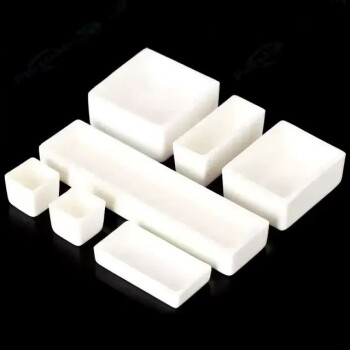
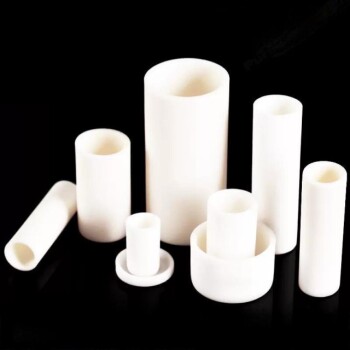
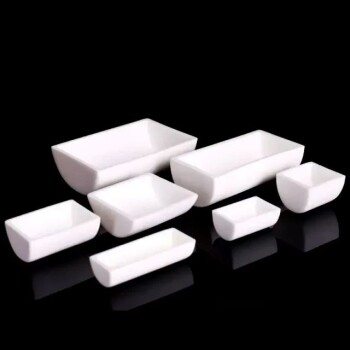
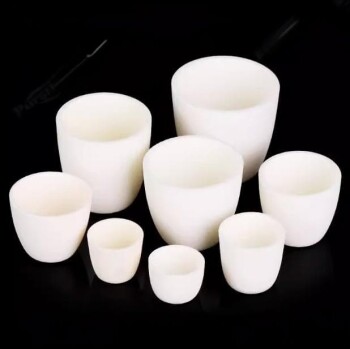
High-purity quartz crucibles are the industry standard for smelting GaZn alloys primarily because of their exceptional chemical inertness and thermal stability at smelting temperatures. These crucibles do not react with molten gallium or zinc at typical processing temperatures, such as 450°C, which prevents the leaching of impurity ions into the melt. This passivity is essential for maintaining the precise stoichiometric ratios and high purity levels required for downstream applications like Ga2O3/ZnO catalyst production.
The use of high-purity quartz ensures that the container remains a passive vessel rather than a reactive participant, preserving the chemical integrity and performance characteristics of the resulting GaZn liquid alloy.
Preserving Chemical Integrity through Inertness
Resistance to Molten Metal Interaction
High-purity quartz serves as an ideal barrier because it is chemically non-reactive with active metals like gallium and zinc in their molten state. This inertness ensures that the crucible does not introduce metallic impurities or "leach" elements into the alloy.
Maintaining Compositional Accuracy
By preventing chemical reactions between the vessel and the melt, quartz allows for extreme precision in the GaZn alloy's composition. This accuracy is critical when the alloy is used as a precursor for sensitive materials, such as catalysts or liquid metal anodes for electrochemical synthesis.
Prevention of Impurity Ions
Even trace amounts of impurities from a container can degrade the electronic or catalytic properties of the final product. High-purity quartz minimizes the risk of foreign ion contamination, ensuring the final chemical purity of inorganic non-metallic materials remains intact.
Thermal Performance and Durability
High-Temperature Stability
Smelting processes for GaZn alloys often occur at temperatures around 450°C, well within the stable operating range of quartz. The material maintains its structural integrity and resistance to chemical erosion even under sustained high-heat conditions.
Resistance to Thermal Shock
Quartz possesses an extremely low coefficient of thermal expansion, making it highly resistant to severe temperature fluctuations. It can withstand transitions from room temperature to high heat without cracking, providing a reliable environment for repeatable smelting cycles.
Protection Against Vapor Erosion
During high-temperature alloying, metal vapors can be corrosive to lesser materials. High-purity quartz effectively resists erosion from these vapors, further reducing the risk of vessel degradation contaminating the sample.
Understanding the Trade-offs and Alternatives
Quartz vs. Alumina Crucibles
While high-purity alumina is also used for its thermal stability and inertness, quartz is often preferred for specific liquid metal alloys due to its superior resistance to certain chemical environments. The choice often depends on the specific purity requirements and the potential for alumina to introduce aluminum traces in highly sensitive applications.
Physical Fragility
Despite its chemical and thermal robustness, quartz is physically brittle and susceptible to mechanical impact. Users must handle these crucibles with care to avoid physical fractures, even though the material can survive extreme heat.
Sensitivity to Specific Contaminants
Quartz is highly sensitive to certain chemicals, such as hydrofluoric acid or strong alkalis, which can etch the surface. It is vital to ensure that the smelting environment is free of these specific contaminants to maintain the crucible's longevity and purity.
How to Apply This to Your Project
When selecting a container for liquid metal processing, your choice should align with your specific purity and temperature requirements.
- If your primary focus is catalyst performance: Use high-purity quartz to ensure the Ga2O3/ZnO composition is accurate and free of interfering impurity ions.
- If your primary focus is electrochemical synthesis: Prioritize quartz for liquid metal anodes to prevent the introduction of foreign elements that could disrupt electrochemical reactions.
- If your primary focus is extreme thermal cycling: Leverage quartz's low thermal expansion to prevent crucible failure during rapid heating and cooling phases.
Selecting the right high-purity vessel is the most effective way to ensure the predictable and repeatable chemical behavior of your liquid alloys.
Summary Table:
| Key Feature | Benefit for GaZn Smelting | Performance Metric |
|---|---|---|
| Chemical Inertness | Prevents leaching and impurity ion contamination | Passive vessel integrity |
| Thermal Stability | Maintains structure at smelting temperatures (e.g., 450°C) | High-heat resistance |
| Low Thermal Expansion | Prevents cracking during rapid temperature changes | Exceptional shock resistance |
| Compositional Accuracy | Ensures precise stoichiometric ratios for catalysts | High purity preservation |
| Vapor Resistance | Protects against erosion from corrosive metal vapors | Long-term durability |
Elevate Your Material Synthesis with KINTEK
Precision in smelting requires more than just high temperatures; it demands the highest purity environments. KINTEK specializes in premium laboratory equipment and consumables designed for sensitive material research. Whether you are producing Ga2O3/ZnO catalysts or developing next-generation liquid metal anodes, our high-purity quartz and ceramic crucibles ensure your alloys remain uncontaminated.
Beyond consumables, KINTEK offers a comprehensive range of solutions for advanced labs:
- High-Temperature Furnaces: Muffle, tube, vacuum, and atmosphere furnaces for precise thermal control.
- Material Processing: Crushing, milling, and hydraulic presses (pellet, isostatic) for sample preparation.
- Specialized Reactors: High-temperature high-pressure reactors and autoclaves.
- Advanced Tools: Battery research tools, electrolytic cells, and cooling solutions like ULT freezers.
Don't compromise on chemical integrity. Contact KINTEK today to find the perfect high-purity vessels and equipment for your specific smelting and synthesis needs!
References
- Hongyu Xie, Chong Wei. Design of a Spherical Ga2O3/ZnO Composite with a Snakeberry-like Structure for Methyl Orange Degradation. DOI: 10.3390/w15050952
This article is also based on technical information from Kintek Solution Knowledge Base .
Related Products
- High Purity Pure Graphite Crucible for Evaporation
- Engineering Advanced Fine Alumina Al2O3 Ceramic Crucible for Laboratory Muffle Furnace
- Engineering Advanced Fine Ceramics Alumina Al2O3 Crucible With Lid Cylindrical Laboratory Crucible
- High Purity Pure Graphite Crucible for Electron Beam Evaporation
- Engineering Advanced Fine Ceramics Alumina Crucibles (Al2O3) for Thermal Analysis TGA DTA
People Also Ask
- Why are high-purity graphite crucibles preferred for sulfide solid electrolytes? Achieve Superior Material Purity
- Why is a high-purity graphite crucible required for Chromel-TaC composites? Ensure Peak Purity at 1400°C
- What role do high-purity graphite crucibles play in molten salt corrosion research? Ensure Reactor-Grade Precision
- Why are high-purity graphite crucibles used for magnesium distillation? Ensure 3N8 Purity & Thermal Stability
- Why is a high-purity graphite crucible ideal for nitrogen-doped graphene at 1500 °C? Maximize Purity and Stability