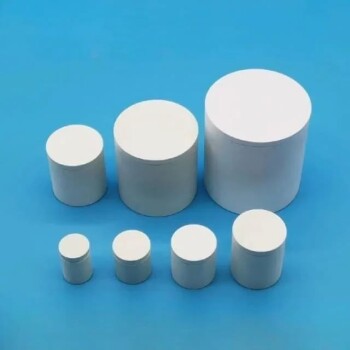
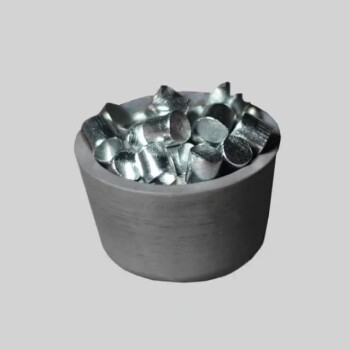
High-purity graphite is preferred primarily due to chemical compatibility, as sulfide solid electrolytes exhibit aggressive chemical activity at the high temperatures required for synthesis. Unlike standard oxide ceramics such as alumina, which readily react with sulfides and cause contamination, high-purity graphite offers superior chemical inertia. This prevents interface reactions, ensuring the final electrolyte retains its intended stoichiometry and purity.
The critical factor in crucible selection is not just heat tolerance, but chemical neutrality; while standard ceramics become reactive contaminants in sulfide synthesis, high-purity graphite acts as an inert barrier that preserves material integrity.
The Chemistry of Contamination
The Reactivity of Sulfides
Sulfide solid electrolytes are not passive materials. At the high temperatures required for melting or sintering, they exhibit strong chemical activity.
This heightened reactive state makes them prone to interacting with the vessel containing them.
The Failure of Standard Ceramics
Standard ceramic containers, particularly oxide-based crucibles like alumina, are chemically incompatible with these active sulfides.
When used, the sulfide material attacks the oxide structure, leading to interface reactions. This results in significant composition deviations and introduces impurities that degrade the electrolyte's performance.
Why Graphite is the Superior Solution
Unmatched Chemical Inertia
High-purity graphite (often 99.9% pure) provides a chemically stable environment.
It prevents the sulfide material from bonding with or leaching elements from the crucible walls. This inertness is the primary defense against the contamination that plagues oxide crucibles.
Extreme Temperature Resistance
Graphite crucibles are engineered to withstand extreme thermal environments, capable of enduring temperatures up to 3000 degrees Celsius.
This far exceeds the melting points of most sulfide electrolytes, providing a wide safety margin during processing.
Physical Durability and Conductivity
Beyond chemical stability, graphite offers superior thermal shock resistance.
It can withstand rapid temperature changes without cracking, a common failure mode in traditional clays or ceramics. Its excellent thermal conductivity also helps maintain even temperatures throughout the melt.
Operational Advantages
Minimizing Material Loss
High-purity graphite features a naturally smooth interior surface.
This prevents the melted material from adhering to the crucible walls. This "non-stick" quality minimizes the sticking of alloys and ensures higher yield recovery after the heat treatment.
Structural Integrity
The physical properties of high-purity graphite are robust, with high bending and compression strength.
This mechanical reliability ensures the crucible maintains its shape and integrity even under the stress of high-density loading and thermal cycling.
Understanding the Trade-offs
The Atmosphere Constraint
While graphite is superior for sulfides, it has a critical weakness: oxidation.
Graphite cannot be used in an air atmosphere at high temperatures, as it will burn. It requires a vacuum or an inert gas atmosphere (like Argon).
When Alumina is Actually Preferred
If your process requires heat treatment in an air atmosphere, such as with NMC (oxide) powders, graphite is unsuitable.
In these specific oxidizing environments, high-purity alumina becomes the necessary choice to prevent the crucible itself from degrading.
Making the Right Choice for Your Goal
To select the correct crucible, you must align the material properties with your specific synthesis environment:
- If your primary focus is Sulfide Solid Electrolytes: Choose high-purity graphite to ensure chemical inertness and prevent reaction-based contamination.
- If your primary focus is Oxide Powders (e.g., NMC) in Air: Choose high-purity alumina to withstand the oxidizing atmosphere where graphite would deteriorate.
Success in high-temperature synthesis depends on treating the crucible not just as a container, but as an active variable in your chemical equation.
Summary Table:
| Feature | High-Purity Graphite Crucible | Standard Oxide Crucible (Alumina) |
|---|---|---|
| Chemical Compatibility | Inert; no reaction with sulfides | Highly reactive; causes contamination |
| Max Operating Temp | Up to 3000°C (Inert/Vacuum) | Typically up to 1800°C |
| Thermal Shock Resistance | Excellent; resists cracking | Moderate; prone to cracking |
| Surface Properties | Smooth/Non-stick; high yield | Porous/Adherent; material loss |
| Atmosphere Limit | Vacuum or Inert Gas only | Air, Vacuum, or Inert Gas |
Elevate Your Materials Research with KINTEK
Don't let crucible contamination compromise your sulfide electrolyte performance. KINTEK specializes in premium laboratory equipment and high-purity consumables designed for rigorous R&D. Our high-purity graphite crucibles and high-temperature furnaces (vacuum, tube, and atmosphere) provide the precise, inert environment necessary for advanced battery research.
From high-pressure reactors to PTFE consumables and ceramics, we empower researchers with the tools needed for next-generation energy storage.
Ready to optimize your synthesis process? Contact KINTEK today for expert guidance and a custom quote!
Related Products
- High Purity Pure Graphite Crucible for Evaporation
- High Purity Pure Graphite Crucible for Electron Beam Evaporation
- Carbon Graphite Boat -Laboratory Tube Furnace with Cover
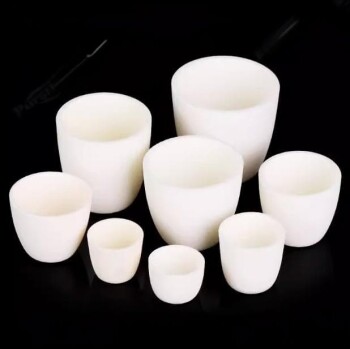
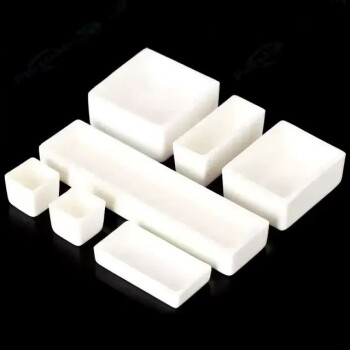
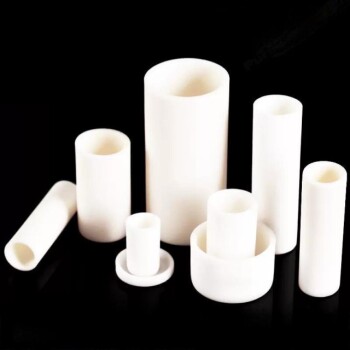
- Arc-Shaped Alumina Ceramic Crucible High Temperature Resistant for Engineering Advanced Fine Ceramics
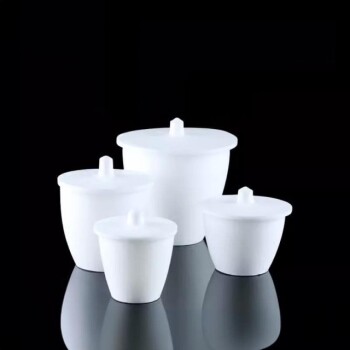
- Custom Machined and Molded PTFE Teflon Parts Manufacturer with PTFE Crucible and Lid
People Also Ask
- Why is a high-purity graphite crucible required for Chromel-TaC composites? Ensure Peak Purity at 1400°C
- What role do high-purity graphite crucibles play in molten salt corrosion research? Ensure Reactor-Grade Precision
- Why are high-purity graphite crucibles used for magnesium distillation? Ensure 3N8 Purity & Thermal Stability
- Why is a high-purity graphite crucible ideal for nitrogen-doped graphene at 1500 °C? Maximize Purity and Stability
- What role does a high-purity graphite crucible play in CaO-MgO-Al2O3-SiO2 system equilibrium experiments? Maximize Accuracy