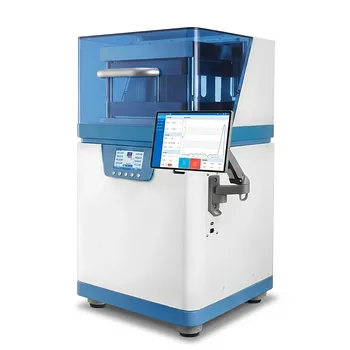
The synthesis of nickel-coated carbon cotton (Ni/CW) requires a high-temperature high-pressure reactor to overcome the physical and chemical barriers inherent in porous carbon structures. By creating a sealed, supercritical-like environment, the reactor forces the nickel-bearing solution into the carbon's microscopic architecture, ensuring a dense and uniform metallic coating that is impossible to achieve at atmospheric pressure.
The high-pressure reactor (autoclave) acts as a mechanical and thermal catalyst, driving the infiltration of nickel precursors into carbon micropores to facilitate uniform nucleation. This process is essential for creating the dense nickel layer required for high-performance electrode fabrication and subsequent microtubule growth.
Overcoming Physical Barriers in Microporous Carbon
Driving Solutions into Sub-Micron Pores
Carbonized cotton possesses a complex, hydrophobic network of micropores that naturally resist liquid infiltration. The high-pressure environment within the reactor provides the necessary mechanical force to overcome surface tension, pushing the nickel source and reducing agents deep into these internal voids.
Enhancing Mass Transfer Efficiency
In a standard open-air vessel, mass transfer is limited by diffusion at the surface of the carbon fiber. The reactor’s pressurized state accelerates the kinetic movement of ions, ensuring that the nickel precursors are not just coating the outer surface but are distributed throughout the entire fiber matrix.
Facilitating Uniform Chemical Transformation
Controlling Nucleation and Growth Kinetics
The high-temperature setting provides the activation energy required for the reducing agent, such as sodium hypophosphite, to effectively convert nickel ions into metallic nickel. Precise temperature control within the sealed vessel ensures that nucleation occurs simultaneously across all surfaces, preventing clumping or uneven deposition.
Creating a Stable, Sealed Micro-Environment
By maintaining a sealed environment, the reactor prevents the evaporation of volatile components and keeps the concentration of the reducing agents constant. This stability is critical for growing a continuous, dense nickel layer that serves as a robust precursor for the fabrication of hollow microtubules.
Understanding the Trade-offs and Challenges
Technical Complexity and Safety
Utilizing high-pressure autoclaves increases the operational complexity and safety requirements of the synthesis process. Unlike open-bench chemistry, this method requires specialized equipment capable of withstanding extreme thermal and mechanical stress, which increases initial capital costs.
Throughput and Scalability Constraints
Batch processing in a pressurized reactor can be slower than continuous atmospheric methods. While the quality of the Ni/CW electrode is significantly higher, the cycle time for heating, pressurizing, and cooling the reactor can limit the speed of large-scale production.
How to Apply This to Your Project
When deciding whether to utilize a high-pressure reactor for your electrode synthesis, consider your final performance requirements and material characteristics.
- If your primary focus is Maximum Conductivity and Surface Area: Use a high-pressure reactor to ensure the nickel coating penetrates the deepest pores of the carbon cotton, maximizing the active electrochemical surface.
- If your primary focus is Rapid Prototyping or Low Cost: Consider atmospheric electroless plating, though you must accept a less uniform coating and potentially lower mechanical stability in the nickel layer.
- If your primary focus is Hollow Microtubule Fabrication: A high-pressure reactor is mandatory, as the density of the nickel precursor layer determines the structural integrity of the resulting microtubules.
The high-pressure reactor is not merely a container, but a critical tool for engineering the interface between metal and carbon at the molecular level.
Summary Table:
| Key Requirement | Role of HTHP Reactor | Impact on Ni/CW Electrode |
|---|---|---|
| Pore Infiltration | Overcomes surface tension via mechanical force | Ensures nickel source reaches sub-micron internal voids |
| Mass Transfer | Accelerates ion kinetics under pressure | Prevents surface-only coating; ensures full fiber matrix distribution |
| Nucleation Control | Provides activation energy for reduction | Achieves simultaneous, uniform nickel deposition across all surfaces |
| Structural Integrity | Maintains stable chemical concentration | Creates dense precursors necessary for hollow microtubule growth |
Elevate Your Electrode Synthesis with KINTEK’s HTHP Solutions
Achieving a uniform nickel coating on complex, porous carbon structures requires precision engineering. KINTEK specializes in high-performance laboratory equipment, providing the advanced high-temperature high-pressure reactors and autoclaves necessary to overcome physical barriers in material synthesis.
Our HTHP solutions are designed to help researchers and manufacturers achieve:
- Superior Conductivity: Deep infiltration for maximum electrochemical surface area.
- Process Consistency: Sealed environments that maintain stable chemical kinetics.
- Versatile Application: Ideal for battery research, microtubule fabrication, and advanced catalyst development.
From muffle and vacuum furnaces to hydraulic pellet presses and electrolytic cells, KINTEK offers a comprehensive portfolio to support your entire workflow.
Contact KINTEK today to optimize your laboratory performance!
References
- Guangya Hou, Yiping Tang. Electrooxidation Performance of a Cotton-Cloth-Derived, Ni-Based, Hollow Microtubular Weave Catalytic Electrode for Methanol and Urea. DOI: 10.3390/met13040659
This article is also based on technical information from Kintek Solution Knowledge Base .
Related Products
- Customizable Laboratory High Temperature High Pressure Reactors for Diverse Scientific Applications
- High Pressure Laboratory Autoclave Reactor for Hydrothermal Synthesis
- Stainless High Pressure Autoclave Reactor Laboratory Pressure Reactor
- Mini SS High Pressure Autoclave Reactor for Laboratory Use
- Customizable High Pressure Reactors for Advanced Scientific and Industrial Applications
People Also Ask
- How do high-pressure and high-temperature reactors ensure the effective treatment of lignocellulosic wastewater in WAO?
- What equipment is required for high-pressure high-temperature reactions? Master Extreme Chemistry Safely
- How do you control high pressure in a reactor? A Guide to Safe & Stable Operation
- Why is argon better than nitrogen for inert atmosphere? Ensure Absolute Reactivity & Stability
- How does initial oxygen pressure affect the wet oxidation of pharmaceutical sludge? Master Your Oxidation Depth