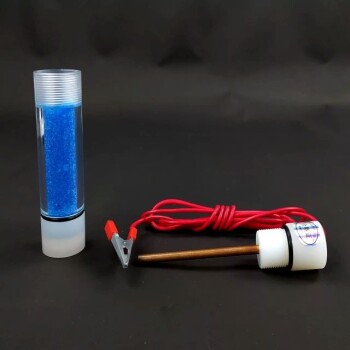
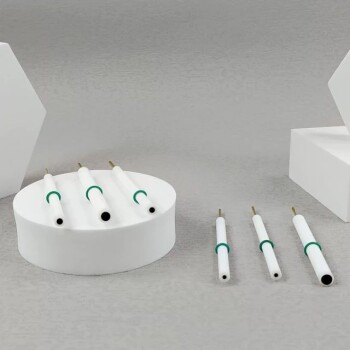
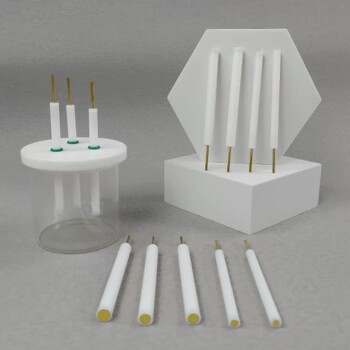
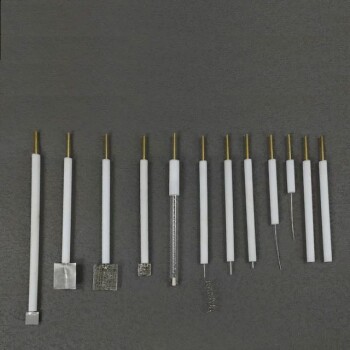
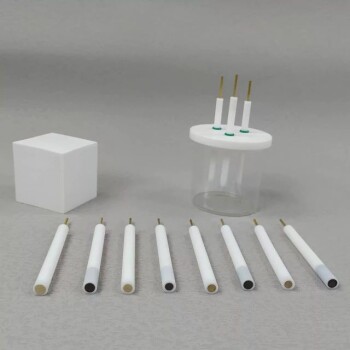
The reference electrode serves as the "ruler" of an electrochemical cell. It provides a highly stable, known electrode potential that acts as a constant benchmark for measuring the energy levels at the working electrode. Without this fixed point, it is impossible to accurately determine the voltage required to trigger the hydrogen evolution reaction (HER) or to compare the performance of different catalysts.
A reference electrode is essential because it isolates the electrical behavior of the catalyst, enabling the precise calculation of overpotential and the standardization of data through conversion to the Reversible Hydrogen Electrode (RHE) scale.
Establishing a Stable Potential Baseline
Providing a Known Benchmark
A reference electrode, such as Ag/AgCl, utilizes a specific redox system with constant concentrations of participating ions to maintain a fixed potential. This known value allows researchers to determine the unknown potential of the working electrode by measuring the difference between the two.
Preventing Measurement Drift
The stability of the reference electrode is maintained by ensuring its internal components remain at saturation or constant concentration. This prevents the reference potential from shifting during an experiment, which would otherwise lead to "ghost" fluctuations in the recorded data.
Isolating the Working Electrode
In a three-electrode setup, the reference electrode allows you to focus exclusively on the interface where the hydrogen evolution occurs. By decoupling the working electrode's behavior from the counter electrode, you ensure that the measured voltage reflects only the catalyst's performance.
Quantifying Catalytic Performance
Calculating Overpotential
Overpotential is the extra energy required beyond the thermodynamic limit to drive the HER. By using a stable reference like Ag/AgCl, researchers can accurately calculate this value, which is the primary metric for determining a catalyst's efficiency.
Conversion to the RHE Scale
Because reference potentials vary based on the internal chemistry of the electrode, data must be converted to the Reversible Hydrogen Electrode (RHE) scale for publication. This conversion depends entirely on the known, fixed potential of the reference electrode and the pH of the electrolyte.
Ensuring Scientific Comparability
A standardized reference potential ensures that a catalyst tested in one laboratory can be objectively compared to one tested elsewhere. Without this common language, the "onset potential" and "current density" would be arbitrary numbers with no scientific context.
Understanding the Trade-offs and Limitations
Electrolyte Compatibility
While Ag/AgCl is a standard choice, it is not universal; for instance, chloride ions can leak into the system and poison certain catalysts. In strong alkaline environments (1M KOH), researchers often switch to a Hg/HgO reference electrode because it offers superior stability in high-pH conditions.
Temperature Sensitivity
The potential of a reference electrode is precisely known only at a constant temperature. If the cell temperature fluctuates during high-current hydrogen evolution, the reference potential will shift, introducing errors into the overpotential calculations.
Junction Potential and Clogging
The "liquid junction" where the reference electrode meets the electrolyte can become clogged or develop a junction potential. This creates a small voltage error that can distort kinetic measurements like the Tafel slope if the electrode is not properly maintained.
How to Apply This to Your Research
When conducting electrocatalytic experiments, selecting and maintaining your reference electrode is as important as the catalyst itself. Accuracy here defines the credibility of your performance claims.
- If your primary focus is Acidic HER Testing: Use a saturated Ag/AgCl or Saturated Calomel Electrode (SCE), but ensure a double-junction setup if chloride contamination is a concern.
- If your primary focus is Alkaline HER Testing: Utilize a Hg/HgO reference electrode, as it is specifically designed to remain stable and repeatable in high-pH electrolytes like 1M KOH.
- If your primary focus is Long-term Stability Studies: Frequently calibrate your reference electrode against a "master" electrode to ensure no potential drift has occurred during extended cycling.
Precise potential control is the foundation of meaningful electrocatalysis, turning raw voltage data into actionable scientific insight.
Summary Table:
| Feature | Role in Hydrogen Evolution Reaction (HER) | Benefit to Researcher |
|---|---|---|
| Stable Potential | Provides a constant "ruler" for energy measurement. | Prevents data drift and "ghost" fluctuations. |
| Isolation | Decouples working electrode from counter electrode. | Ensures measured voltage reflects only catalyst performance. |
| Metric Accuracy | Enables precise calculation of overpotential. | Provides the primary metric for catalyst efficiency. |
| Standardization | Facilitates conversion to the RHE scale. | Allows objective comparison with global research data. |
| Compatibility | Specific electrodes for Acidic (Ag/AgCl) or Alkaline (Hg/HgO). | Prevents catalyst poisoning and electrode degradation. |
Achieve Unmatched Precision in Your HER Research
Elevate the accuracy of your electrocatalytic hydrogen evolution experiments with KINTEK’s premium electrochemical solutions. As specialists in laboratory equipment and consumables, we understand that a stable potential is the foundation of breakthrough research.
We offer a comprehensive range of electrolytic cells and electrodes (including Ag/AgCl, Hg/HgO, and specialized reference types) designed to eliminate measurement drift and ensure reliable RHE conversion. Our portfolio extends to high-temperature high-pressure reactors and autoclaves, battery research tools, and precision consumables like PTFE and ceramics, ensuring your entire lab setup is optimized for performance.
Whether you are focusing on acidic HER testing or alkaline catalyst development, KINTEK provides the high-quality tools necessary for repeatable, publishable results. Contact our technical experts today to discuss your specific catalyst needs and find the perfect electrode and reactor configuration for your laboratory.
References
- Lili Zhang, Guangfeng Wu. Charge Redistribution of Co9S8/MoS2 Heterojunction Microsphere Enhances Electrocatalytic Hydrogen Evolution. DOI: 10.3390/biomimetics8010104
This article is also based on technical information from Kintek Solution Knowledge Base .
Related Products
- Reference Electrode Calomel Silver Chloride Mercury Sulfate for Laboratory Use
- Copper Sulfate Reference Electrode for Laboratory Use
- Electrolytic Electrochemical Cell Gas Diffusion Liquid Flow Reaction Cell
- Glassy Carbon Electrochemical Electrode
- Graphite Disc Rod and Sheet Electrode Electrochemical Graphite Electrode
People Also Ask
- What is the function of a reference electrode? Master Precision in Three-Electrode Reactor Reconstruction
- What is the recommended maintenance for the filling solution of a reference electrode? A Guide to Stable & Accurate Readings
- Which electrode is used as a ground reference? Master the Key to Accurate Electrochemical Measurements
- What is the reference electrode in potentiometry? The Key to Stable & Accurate Measurements
- Which electrode is used as a reference? A Guide to Accurate Electrochemical Measurements