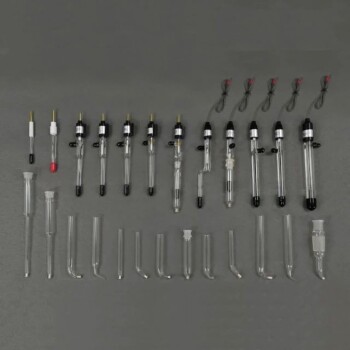
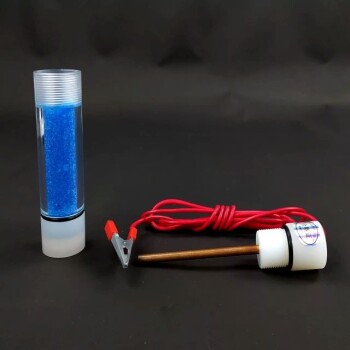
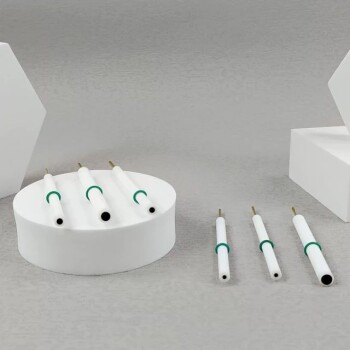
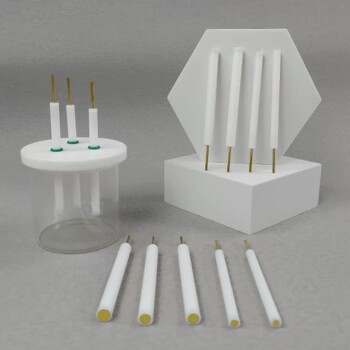
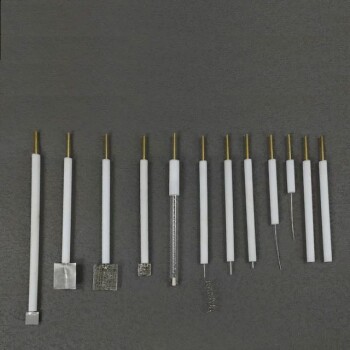
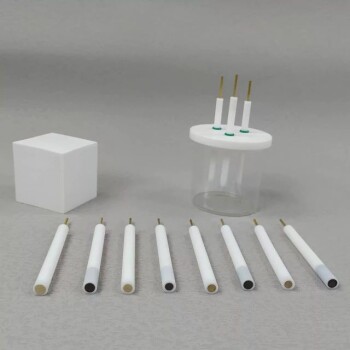
The Ag/AgCl electrode is used because it provides a highly stable, constant potential benchmark that allows researchers to isolate the electrochemical performance of the Co4N@NC catalyst. By maintaining a known reference point, any measured potential changes can be attributed directly to the reaction kinetics at the catalyst surface rather than system fluctuations or drift.
Core Takeaway: The saturated Ag/AgCl electrode acts as an "electrochemical ruler," providing the fixed baseline necessary to accurately measure a catalyst's overpotential and ensure that data is reproducible across different laboratories.
Ensuring Accuracy in Catalyst Evaluation
Elimination of Potential Drift
A reference electrode must maintain a fixed potential regardless of the environment in the electrochemical cell. The Ag/AgCl electrode is favored for testing materials like Co4N@NC because it minimizes "drift," ensuring that the recorded data reflects the true energy barriers of the reaction.
Precise Overpotential Calculations
For catalysts involved in reactions like the Hydrogen Evolution Reaction (HER) or Oxygen Evolution Reaction (OER), calculating overpotential is critical. A stable Ag/AgCl reference allows researchers to precisely determine how much extra energy is required to drive a reaction beyond its thermodynamic limit.
Guaranteeing Data Reproducibility
Because the potential of a saturated Ag/AgCl electrode is well-documented and globally recognized, it ensures experimental reproducibility. This allows the performance of Co4N@NC to be compared accurately against other state-of-the-art catalysts in the scientific literature.
Facilitating Standardized Comparisons
Conversion to the Reversible Hydrogen Electrode (RHE)
Most catalyst performance is reported relative to the Reversible Hydrogen Electrode (RHE) to account for pH variations. The Ag/AgCl electrode provides a reliable starting value that can be mathematically converted to the RHE scale using the Nernst equation.
Stability in Alkaline Media
Co4N@NC is often tested in strong alkaline electrolytes like 1 M KOH. The Ag/AgCl electrode maintains excellent stability in these environments, allowing for the precise determination of onset potentials and redox peaks without interference from the electrolyte.
Qualitative and Quantitative Identification
High potential stability is vital for identifying specific electroactive species. It ensures that the oxidation or reduction peaks recorded during testing are positioned accurately on the potential axis, which is essential for the qualitative analysis of the catalyst's behavior.
Understanding the Trade-offs
The Requirement of Ion Leakage
The Ag/AgCl electrode functions by allowing a small amount of the internal KCl fill solution to leak through a junction (ceramic or cotton) into the sample. This leakage is necessary for electrical contact but can occasionally introduce unwanted chloride ions into the testing environment.
Contamination Risks
In some specific sensitive systems, the leakage of chloride ions from the reference electrode can poison the catalyst or interfere with the reaction. Researchers must ensure that the Co4N@NC catalyst is not chemically sensitive to the trace amounts of KCl entering the cell.
Maintenance and Preparation
To remain accurate, the internal KCl solution must be kept saturated. If the internal electrolyte evaporates or becomes diluted, the reference potential will shift, leading to significant errors in the measurement of the catalyst's efficiency.
How to Apply This to Your Testing
Selecting and maintaining your reference electrode is as important as the synthesis of the catalyst itself.
- If your primary focus is Benchmarking: Use the saturated Ag/AgCl electrode to ensure your overpotential measurements can be easily converted to RHE for publication.
- If your primary focus is Long-term Stability: Regularly check the level of the internal KCl filling solution to prevent potential drift during multi-hour durability tests.
- If your primary focus is Chloride Sensitivity: Consider using a double-junction reference electrode or a different reference system (like Hg/HgO) if your catalyst is known to be poisoned by chloride ions.
By utilizing a stable Ag/AgCl reference, you transform raw voltage data into a precise and scientifically valid measurement of a catalyst’s true electrochemical potential.
Summary Table:
| Key Feature | Benefit for Co4N@NC Catalyst Testing |
|---|---|
| Fixed Potential | Minimizes potential drift to ensure accurate kinetic data |
| Stable Baseline | Allows for precise overpotential calculations in HER/OER |
| Standardized Scale | Enables easy conversion to RHE for global data comparison |
| Versatile Application | Maintains stability in alkaline media (e.g., 1 M KOH) |
| Species ID | Accurate peak positioning for qualitative redox analysis |
Elevate Your Electrochemical Research with KINTEK
Precision in catalyst evaluation starts with high-quality instrumentation. KINTEK specializes in providing researchers with the reliable tools needed for breakthrough discoveries. Our comprehensive portfolio includes professional-grade electrolytic cells and electrodes, high-temperature high-pressure reactors and autoclaves, and specialized battery research tools designed to eliminate experimental variables.
Whether you need precision crushing and milling systems for material synthesis or durable PTFE and ceramic consumables for your electrochemical setup, KINTEK delivers the performance your laboratory demands.
Ready to achieve superior accuracy and reproducibility? Contact us today to explore our full range of laboratory solutions and see how we can support your next innovation!
References
- Deliang Zhang, Debao Wang. Space-confined ultrafine Co4N nanodots within an N-doped carbon framework on carbon cloth for highly efficient universal pH overall water splitting. DOI: 10.1007/s40843-022-2293-0
This article is also based on technical information from Kintek Solution Knowledge Base .
Related Products
- Reference Electrode Calomel Silver Chloride Mercury Sulfate for Laboratory Use
- Copper Sulfate Reference Electrode for Laboratory Use
- Electrolytic Electrochemical Cell Gas Diffusion Liquid Flow Reaction Cell
- Glassy Carbon Electrochemical Electrode
- Graphite Disc Rod and Sheet Electrode Electrochemical Graphite Electrode
People Also Ask
- What is the function of a reference electrode? Master Precision in Three-Electrode Reactor Reconstruction
- What is the recommended maintenance for the filling solution of a reference electrode? A Guide to Stable & Accurate Readings
- Which electrode is used as a ground reference? Master the Key to Accurate Electrochemical Measurements
- What is the reference electrode in potentiometry? The Key to Stable & Accurate Measurements
- Which electrode is used as a reference? A Guide to Accurate Electrochemical Measurements