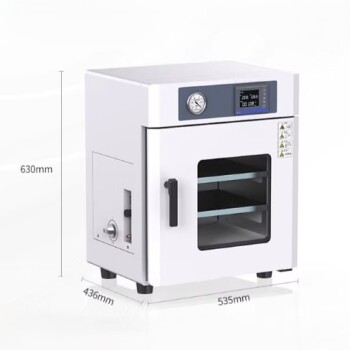
The use of a vacuum drying oven is non-negotiable for processing NCM-811 cathode and LTO anode materials to rigorously eliminate adsorbed moisture and residual solvents before assembly. This process is particularly critical for solid-state batteries, where even trace amounts of water can trigger severe chemical degradation and compromise the entire system's integrity.
Core Takeaway In solid-state battery manufacturing, moisture is a reactive contaminant that destroys sulfide electrolytes. Vacuum drying effectively removes this threat without oxidizing the active materials, ensuring the chemical stability required for high performance and safety.
The Critical Role of Moisture Elimination
Protecting Sulfide Solid Electrolytes
The primary driver for using a vacuum drying oven is the extreme sensitivity of sulfide solid electrolytes. Unlike liquid electrolytes, sulfide materials react instantly with moisture.
If NCM-811 or LTO materials contain adsorbed water, they will react with the sulfide electrolyte to generate toxic hydrogen sulfide ($H_2S$) gas. This reaction decomposes the electrolyte, destroying its ability to conduct ions and creating dangerous pressure buildup within the cell.
Ensuring Interfacial Stability
Solid-state batteries rely on perfect contact between solid particles to function. Moisture creates resistive layers at the interface between the electrode (NCM-811 or LTO) and the electrolyte.
Thorough drying at high temperatures (such as 250°C for powders) ensures these surfaces are pristine. This minimizes interfacial resistance, which is essential for the battery to charge and discharge efficiently without overheating.
Why Vacuum is Superior to Standard Heating
Preventing Oxidation of Active Materials
NCM-811 is a nickel-rich cathode material that is prone to surface instability when exposed to air at high temperatures. Standard ovens would dry the material but simultaneously degrade it through oxidation.
A vacuum oven removes oxygen from the chamber. This allows you to heat the materials to the necessary temperatures to drive off moisture without altering their chemical structure or reducing their capacity.
Efficient Solvent Removal
During the electrode coating process, organic solvents like N-methyl-2-pyrrolidone (NMP) are used to create a slurry. These solvents must be completely removed to prevent side reactions.
The vacuum environment lowers the boiling point of these solvents. This allows for deep drying of coated electrode sheets at moderate temperatures (e.g., 120°C), ensuring complete solvent removal without thermally damaging the binder or the active material structure.
Understanding the Trade-offs
Temperature Sensitivity vs. Drying Speed
While higher temperatures generally remove moisture faster, there is a distinct limit based on the state of your material.
Raw powders (NCM-811/LTO) can often withstand 250°C to ensure total moisture desorption. However, once these materials are coated onto current collectors with binders, you must limit temperatures (often to ~120°C) to avoid melting the binder or cracking the coating.
Throughput Limitations
Vacuum drying is inherently a batch process that is time-consuming. Achieving the necessary level of dryness often requires extended dwell times, sometimes lasting 12 hours or overnight.
This creates a bottleneck compared to continuous convection drying. However, attempting to rush this step by increasing temperature or reducing time poses a high risk of leaving deep-pore moisture trapped, which will eventually lead to cell failure.
Making the Right Choice for Your Goal
To optimize your drying process for solid-state battery assembly, align your parameters with your specific material stage:
- If your primary focus is Raw Material Preparation: Utilize high temperatures (approx. 250°C) under vacuum to strip all adsorbed moisture from NCM-811 and LTO powders before they are mixed into a slurry.
- If your primary focus is Electrode Sheet Finishing: Lower the temperature (approx. 120°C) and extend the drying time to thoroughly remove NMP solvents and pore-trapped moisture without degrading the binder network.
Ultimately, the vacuum drying oven is the gatekeeper of quality, transforming sensitive chemical powders into stable, high-performance battery components.
Summary Table:
| Feature | Powder Processing (NCM-811/LTO) | Electrode Sheet (Coated) |
|---|---|---|
| Primary Goal | Complete moisture desorption | Solvent (NMP) & deep-pore water removal |
| Typical Temperature | ~250°C | ~120°C |
| Environment | High Vacuum | High Vacuum |
| Key Benefit | Prevents $H_2S$ gas formation | Protects binder & interface integrity |
| Process Risk | Surface contamination | Thermal degradation of binder |
Elevate Your Battery Research with KINTEK Precision
Don't let trace moisture compromise your solid-state battery performance. KINTEK specializes in advanced laboratory equipment designed for the rigorous demands of energy storage R&D. Our high-performance vacuum drying ovens provide the precise temperature control and vacuum stability needed to process sensitive NCM-811 cathode and LTO anode materials without oxidation.
From raw material preparation to final electrode finishing, KINTEK offers a comprehensive suite of solutions, including:
- High-Temperature Vacuum & Atmosphere Furnaces
- Electrode Processing Tools & Hydraulic Presses
- Advanced Crushing, Milling, and Sieving Systems
- Specialized Battery Research Consumables
Ready to optimize your drying protocols and ensure interfacial stability? Contact KINTEK today to discuss your project requirements!
Related Products
- 56L Vertical Laboratory Vacuum Drying Oven
- 23L Laboratory Vacuum Drying Oven
- Laboratory Scientific Electric Heating Blast Drying Oven
- Benchtop Laboratory Vacuum Freeze Dryer
People Also Ask
- Why is a laboratory vacuum drying oven recommended for rice straw residues? Protect Your Biomass Integrity
- What role does a laboratory vacuum drying oven play in the preparation of modified multi-walled carbon nanotubes?
- What is the importance of using a laboratory vacuum drying oven? Preserving Slow-Release Microcapsule Integrity
- Why is a Laboratory Vacuum Drying Oven recommended for PBAT microspheres? Protect Sensitive Polymer Integrity
- What role does a laboratory vacuum drying oven play in processing nanoparticle powder samples? Protect Sample Integrity