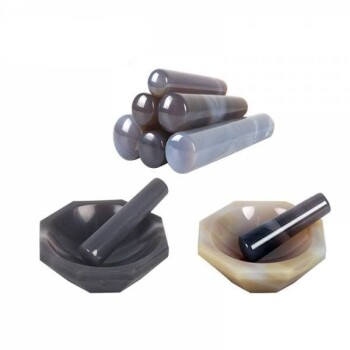
The specific selection of an agate mortar for mixing LLZO composite electrolytes is driven by the critical need to prevent metallic contamination while ensuring a uniform distribution of the ionic liquid. This tool allows for the application of gentle mechanical force to coat 15 wt% ionic liquid onto LLZO particles, filling microscopic gaps without compromising the mixture's solid-state properties.
Success in solid-state electrolyte synthesis relies on ensuring purity and structural uniformity. Agate mortars provide a chemically stable, wear-resistant environment that allows for the precise mechanical distribution of ionic liquids into LLZO ceramic voids without compromising the material's integrity through contamination.
Preserving Chemical Integrity
Eliminating Metal Impurities
The primary risk in manual grinding is the introduction of foreign materials from the grinding tool itself. Standard metal mortars can shed microscopic shavings due to friction.
Agate prevents this contamination. Because it is a hard, mineral-based material, it allows for vigorous mixing without introducing metal impurities that would degrade the electrochemical performance of the electrolyte.
High Chemical Stability
LLZO (Lithium Lanthanum Zirconium Oxide) and ionic liquids are chemically sensitive materials. The reaction vessel must be inert to prevent unwanted side reactions.
Agate offers superior chemical stability compared to other grinding materials. This ensures that the mortar does not react with the ionic liquid or the ceramic particles during the mixing process.
Mechanics of the Mixture
Harnessing Wear Resistance
Grinding ceramic particles requires a tool that is harder than the sample being processed. Agate is exceptionally hard and possesses high wear resistance.
This durability ensures the mortar surface remains smooth and intact over time. It prevents the degradation of the tool, which ensures consistent results across multiple experimental batches.
Effective Gap Filling
The mechanical goal of this process is to combine a liquid component with a solid ceramic. Specifically, the ionic liquid must penetrate the voids between the solid particles.
Using an agate mortar allows the researcher to apply the precise pressure needed to force the ionic liquid into the ceramic particle gaps. This creates a continuous pathway for ions without crushing the ceramic structure.
Achieving the Ideal Composite State
Uniform Surface Coating
The target composition involves coating LLZO particles with exactly 15 wt% ionic liquid. Uniformity is essential for consistent conductivity throughout the electrolyte.
Manual grinding in agate facilitates a gentle mechanical force. This spreads the liquid evenly across the surface of the LLZO particles rather than creating isolated pools of liquid.
Maintaining Solid-State Characteristics
The final product must act as a solid electrolyte, not a slurry or paste. The mixing process must integrate the liquid component effectively.
By using an agate mortar, researchers can achieve a homogeneous mix where the liquid is absorbed into the surface structure. This ensures the final composite maintains its solid state despite the addition of the ionic liquid.
Operational Considerations and Trade-offs
Reliance on Operator Technique
While agate mortars are excellent for purity, the "gentle mechanical force" required is subjective. The quality of the coating depends heavily on the consistency of the human operator.
Limitations in Scalability
This method is ideal for laboratory-scale synthesis and fundamental research. However, the manual nature of using a mortar and pestle makes it difficult to scale for mass production without switching to automated milling equivalents.
Making the Right Choice for Your Goal
To maximize the performance of your LLZO composite electrolytes, consider how the mixing method aligns with your specific objectives.
- If your primary focus is electrochemical purity: Rely on agate tools to completely eliminate the variable of metallic contamination, which is often a silent killer of battery performance.
- If your primary focus is structural homogeneity: Use the mortar to apply consistent, gentle shear force, ensuring the ionic liquid fully infiltrates the ceramic voids for maximum contact.
By choosing the right tool for the physical mixing process, you ensure that the intrinsic properties of your materials are preserved in the final device.
Summary Table:
| Feature | Benefit for LLZO Mixing |
|---|---|
| High Hardness | Exceptional wear resistance prevents tool degradation and sample contamination. |
| Chemical Inertness | Prevents side reactions between the mortar and sensitive ionic liquids or ceramics. |
| Metal-Free Composition | Eliminates the risk of metallic shavings that degrade electrochemical performance. |
| Surface Texture | Facilitates gentle mechanical force to coat particles without crushing the structure. |
| Precision Control | Allows for effective gap-filling of ionic liquids into ceramic voids at a 15 wt% ratio. |
Elevate Your Battery Research with KINTEK Precision Tools
Achieving electrochemical purity and structural homogeneity in LLZO composite electrolytes requires tools that never compromise your material integrity. KINTEK specializes in high-quality laboratory equipment designed for the most demanding energy research applications.
Beyond our premium agate mortars and pestles, we provide a comprehensive range of solutions for solid-state battery development, including:
- Crushing and Milling Systems for precise particle size control.
- High-Temperature Furnaces (Muffle, Tube, Vacuum) for ceramic sintering.
- Hydraulic Presses (Pellet, Isostatic) for high-density electrolyte fabrication.
- Battery Research Consumables and specialized PTFE/Ceramic products.
Don't let metallic contamination or uneven distribution stall your breakthroughs. Partner with KINTEK for reliable, laboratory-grade performance.
Contact Our Technical Experts Today
References
- Akiko Tsurumaki, Maria Assunta Navarra. Inorganic–Organic Hybrid Electrolytes Based on Al-Doped Li7La3Zr2O12 and Ionic Liquids. DOI: 10.3390/app12147318
This article is also based on technical information from Kintek Solution Knowledge Base .
Related Products
- Nature Agate Mortar and Pestle for Grinding and Mixing
- Laboratory Jar Mill with Agate Grinding Jar and Balls
People Also Ask
- Why are agate mortars and pestles used for grinding iron oxide? Ensure Sample Purity for XRD Analysis
- What is the function of an agate mortar and pestle? Ensure Purity in Halide Solid-State Electrolyte Synthesis
- What is the primary function of an agate mortar and pestle? Optimize VO2+ CaZn2(PO4)2 Nanopowder Pre-Treatment
- Why is an agate mortar and pestle required for grinding Zr3(Al1-xSix)C2? Ensure Maximum Sample Purity
- Why is an agate mortar and pestle preferred for grinding MAX phase? Ensure Sample Purity & Zero Contamination