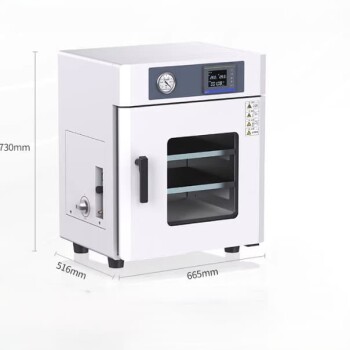
The prevention of air entrapment is the fundamental prerequisite for effective autoclave sterilization. If air remains within the chamber or the load, it creates a physical barrier that prevents saturated steam from making direct contact with the materials, making it impossible to ensure the destruction of all infectious agents.
Core Takeaway: Sterility relies entirely on the direct application of both steam and heat to the material's surface. Air pockets act as insulators that block this contact, compromising the process and allowing microorganisms to survive.
The Physics of Sterilization Failure
To understand why air entrapment is critical, you must understand the relationship between the sterilizing agent (steam) and the target load.
The Necessity of Direct Contact
The autoclave process is not merely about raising the ambient temperature of the chamber.
For sterilization to occur, the steam must physically touch every surface of the instruments or materials being treated.
If air is trapped, it forms a protective pocket around the object. This prevents the steam from reaching the surface, effectively shielding bacteria and spores from the sterilization process.
Air as a Thermal Insulator
Air is a poor conductor of heat compared to steam.
When air is trapped, it acts as an insulator, preventing the rapid heat transfer required to kill microorganisms.
Consequently, the temperature within an air pocket will be significantly lower than the temperature of the surrounding steam, leading to "cold spots" within the load where sterilization fails.
The Role of Moisture
Heat alone is often insufficient for rapid sterilization; moisture is the catalyst that accelerates the destruction of proteins in infectious agents.
Steam provides this necessary moisture.
If air blocks the steam, the material is subjected only to dry heat, which requires significantly higher temperatures and longer exposure times to be effective—conditions not met in a standard steam cycle.
Common Pitfalls and Trade-offs
Even with a functioning autoclave, operator error can inadvertently cause air entrapment. Understanding these risks is vital for quality assurance.
Improper Load Configuration
Packing an autoclave too tightly is the most common cause of air entrapment.
Steam requires pathways to penetrate the load. If bundles are compressed or pouches are stacked flat on top of one another, air cannot escape, and steam cannot enter.
Orientation of Hollow Objects
Gravity plays a significant role in air removal.
Because air is heavier than steam, it tends to sink. If a bowl or cup is placed upright, air will pool at the bottom, and steam will pass over the top without displacing it.
Limitations of Gravity Cycles
Standard gravity-displacement cycles rely on the passive removal of air.
These cycles are less aggressive than pre-vacuum cycles. If the load is dense or porous, a gravity cycle may physically fail to pull the air out of the material, regardless of the cycle duration.
Making the Right Choice for Your Goal
To ensure safety and compliance, you must tailor your approach based on your specific role in the sterilization process.
- If your primary focus is Daily Operation: Ensure loose loading patterns and place all hollow containers upside down to allow air to drain out effectively.
- If your primary focus is Process Validation: Verify that your cycle parameters (vacuum pulses or gravity purges) are sufficient to penetrate the most difficult-to-sterilize point in your specific load type.
Effective sterilization is impossible without the complete displacement of air by steam.
Summary Table:
| Factor | Impact of Air Entrapment | Requirement for Success |
|---|---|---|
| Heat Transfer | Acts as an insulator, creating "cold spots" | Direct contact with saturated steam |
| Moisture | Blocks moisture; results in ineffective dry heat | Continuous steam condensation on surfaces |
| Microbial Kill | Protects bacteria and spores from destruction | Simultaneous application of heat and moisture |
| Load Density | Creates air pockets in tightly packed items | Loose loading to allow steam pathways |
| Geometry | Traps air in upright hollow containers | Inverted placement for gravity displacement |
Eliminate Sterilization Risks with KINTEK Expertise
Don't let air entrapment compromise your laboratory's safety and research integrity. KINTEK specializes in advanced sterilization solutions, offering a comprehensive range of high-temperature high-pressure reactors and autoclaves designed for maximum steam penetration and process validation.
Whether you are managing daily operations or complex process validations, our expert team provides the high-performance equipment and consumables—including ceramics, crucibles, and cooling solutions—needed to maintain a sterile environment.
Ready to optimize your sterilization protocol? Contact KINTEK today to discover how our precision-engineered autoclaves and laboratory systems can enhance your lab's efficiency and safety.
Related Products
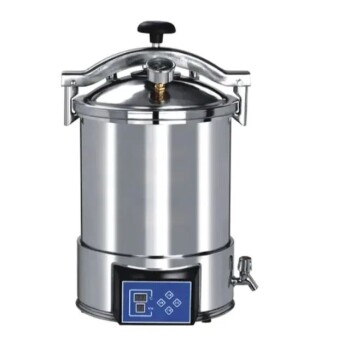
- Portable High Pressure Laboratory Autoclave Steam Sterilizer for Lab Use
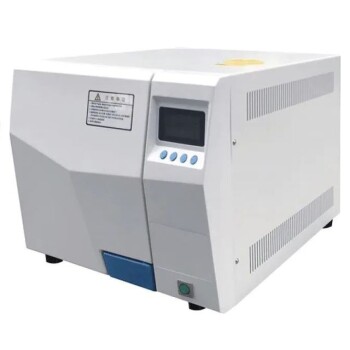
- Portable Digital Display Automatic Laboratory Sterilizer Lab Autoclave for Sterilization Pressure
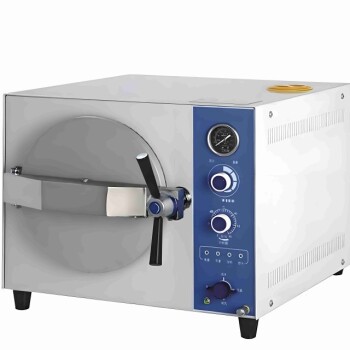
- Desktop Fast High Pressure Laboratory Autoclave Sterilizer 16L 24L for Lab Use
- Desktop Fast Laboratory Autoclave Sterilizer 35L 50L 90L for Lab Use
- Desktop Fast Laboratory Autoclave Sterilizer 20L 24L for Lab Use
People Also Ask
- Why is a laboratory high-pressure autoclave sterilizer necessary? Ensure Accuracy in Antibacterial Research
- What is the role of a laboratory high-pressure autoclave in the conversion of furfural to piperidine? Optimize Yields
- What are the two types of autoclave used in the laboratory? Gravity vs. Pre-Vacuum Explained
- What precautions should be taken during autoclave in laboratory? A Complete Safety Guide to Prevent Burns and Explosions
- What extreme conditions does a laboratory autoclave simulate? Testing Wear Resistance of Nuclear Fuel Cladding