Blog The Architecture of Accuracy: Why the Electrolytic Cell Lid is Your Most Critical Interface
The Architecture of Accuracy: Why the Electrolytic Cell Lid is Your Most Critical Interface

The Architecture of Accuracy: Why the Electrolytic Cell Lid is Your Most Critical Interface

10 hours ago

In electrochemistry, we obsess over the purity of the electrolyte. We meticulously polish the working electrode. We calibrate the potentiostat to the millivolt.

Yet, we often ignore the one component that holds the entire chaos together: The lid.

It seems like a trivial piece of plastic. In reality, the electrolytic cell lid is the interface between your controlled environment and the entropy of the outside world. It is the command center of the three-electrode system.

If the lid fails—if the apertures are loose, if the seal is compromised, or if the layout forces an awkward geometry—the experiment fails. Not with a bang, but with the quiet, creeping error of oxygen contamination or IR drop.

Here is the engineering logic behind the standard lid, and why relying on "standard" is often a dangerous assumption.

The Myth of the Universal Standard

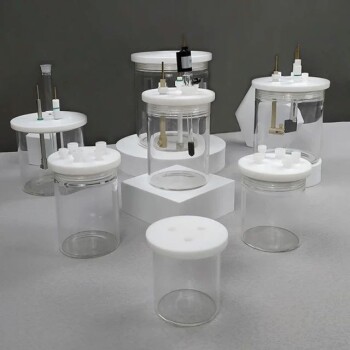
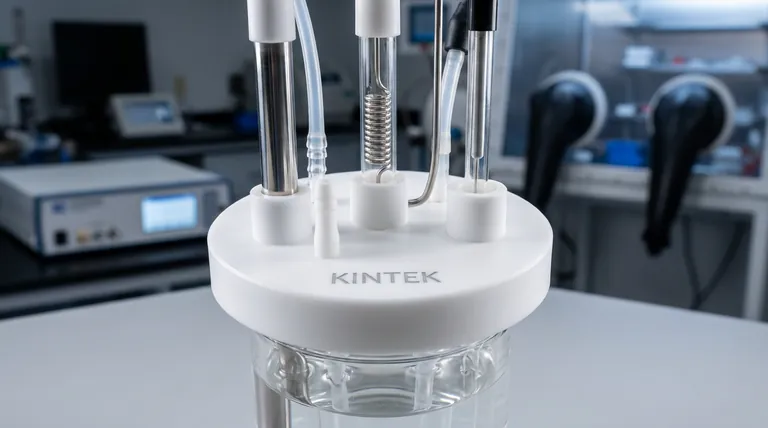
If you ask a supplier for a "standard" multifunctional electrolytic cell lid, you will likely receive a disc of PTFE (Teflon) drilled with specific coordinates.

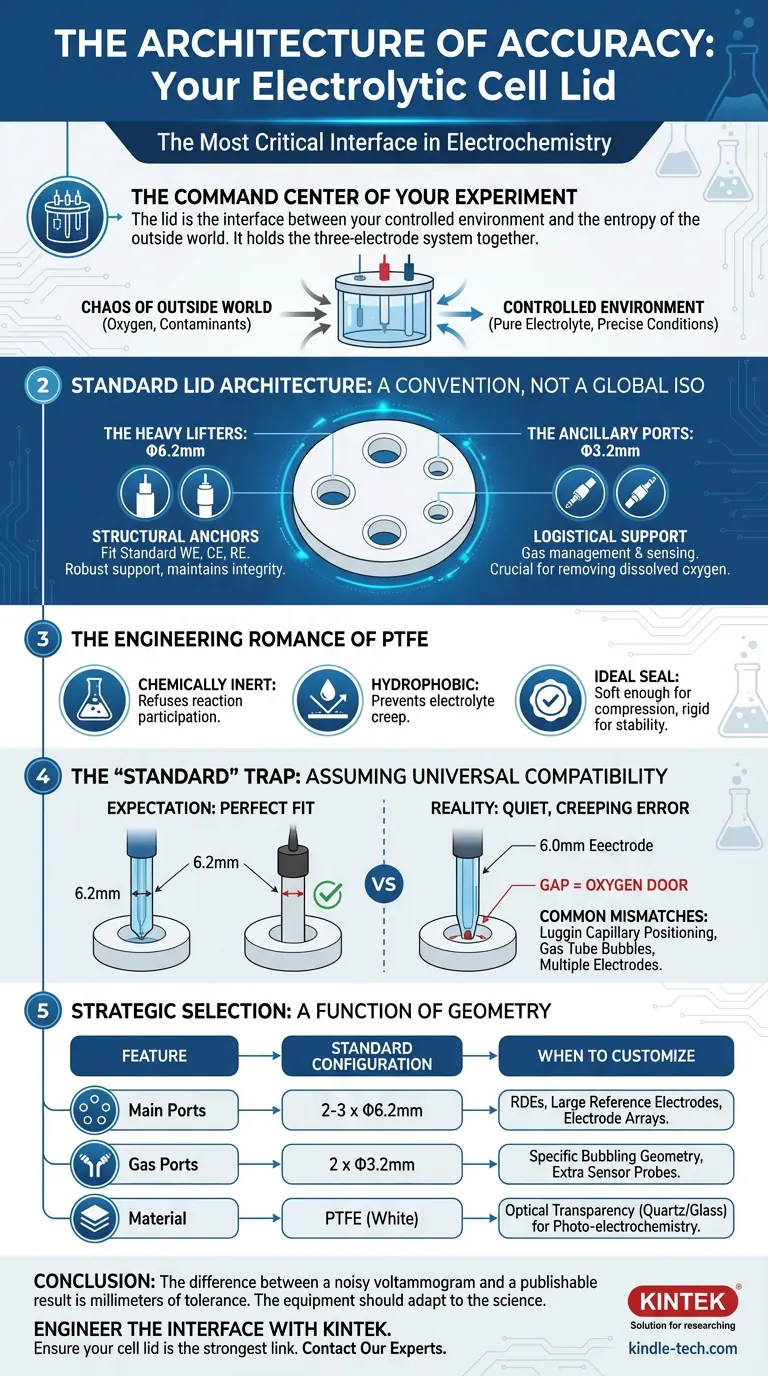
There is no global ISO standard for this. However, convention has coalesced around two specific dimensions designed to accommodate the classic three-electrode setup.

The Heavy Lifters: Φ6.2mm

You will typically find two or three ports of this size. They are the structural anchors of the experiment.

  • Purpose: To house the electrode bodies.
  • Fit: Standard Working Electrodes (WE), Counter Electrodes (CE), and Reference Electrodes (RE).
  • Why 6mm? This diameter is robust enough to support the electrode shaft without bending, yet small enough to maintain structural integrity of the lid.

The Ancillary Ports: Φ3.2mm

These are the logistical support. A standard lid usually features two of these.

  • Purpose: Gas management and sensing.
  • Fit: Gas inlet/outlet tubes (for purging nitrogen or argon) or Luggin capillaries.
  • Why it matters: Without these, you cannot remove dissolved oxygen, rendering reduction experiments invalid.

The Engineering Romance of PTFE

The material choice is not accidental. The lid is almost universally machined from Polytetrafluoroethylene (PTFE).

It is an engineer's dream material for this application. It is chemically inert, meaning it refuses to participate in your reaction. It is hydrophobic, preventing electrolyte creep. It is distinctively soft enough to form a compression seal, yet rigid enough to hold heavy electrodes in place.

The "Standard" Trap

Here is the psychological trap: We assume "standard" means "universal compatibility."

It does not.

A researcher might buy a high-end Rotating Disk Electrode (RDE) only to find its shaft requires a 10mm port. Or they might use a double-junction reference electrode that is slightly oversized.

If you force a 6.3mm electrode into a 6.2mm port, you damage the equipment. If you place a 6.0mm electrode into a 6.2mm port, you create a gap.

In an inert atmosphere box, that gap is an open door for oxygen. In a volatile solvent experiment, it is an escape route for your electrolyte.

Common Mismatches

  • The Luggin Capillary: Often requires precise positioning close to the working electrode to minimize IR drop. Standard port placement may be too far away.
  • The Gas Tube: If the inlet port is not positioned correctly, the gas bubbles might accumulate on the electrode surface, creating noise in your data.
  • Multiple Working Electrodes: Some advanced corrosion studies require array electrodes, rendering a 3-port standard lid useless.

Strategic Selection: A Function of Geometry

Do not view the lid as a cover. View it as a customizable platform. Your experimental design should dictate the lid configuration, not the other way around.

Feature Standard Configuration When to Customize
Main Ports 2-3 x Φ6.2mm When using RDEs, large reference electrodes, or electrode arrays.
Gas Ports 2 x Φ3.2mm When specific bubbling geometry is required or extra sensor probes are needed.
Material PTFE (White) When optical transparency is required (quartz/glass lids) for photo-electrochemistry.

Conclusion

The difference between a noisy voltammogram and a publishable result is often just a millimeter of tolerance.

The "standard" Φ6.2mm and Φ3.2mm configuration covers 80% of use cases. It is a brilliant, time-tested layout. But for the other 20%—the cutting-edge research—it is a constraint.

At KINTEK, we believe the equipment should adapt to the science. Whether you need a standard replacement or a bespoke topology for a complex electrochemical system, we engineer the interface so you can focus on the reaction.

Contact Our Experts to ensure your cell lid is the strongest link in your experimental chain.

Visual Guide
The Architecture of Accuracy: Why the Electrolytic Cell Lid is Your Most Critical Interface Visual Guide

Related Products

Related Articles

Related Products

Electrolytic Electrochemical Cell with Five-Port

Electrolytic Electrochemical Cell with Five-Port

Streamline your laboratory consumables with Kintek's Electrolytic Cell with five-port design. Choose from sealed and non-sealed options with customizable electrodes. Order now.

Electrolytic Electrochemical Cell for Coating Evaluation

Electrolytic Electrochemical Cell for Coating Evaluation

Looking for corrosion-resistant coating evaluation electrolytic cells for electrochemical experiments? Our cells boast complete specifications, good sealing, high-quality materials, safety, and durability. Plus, they're easily customizable to meet your needs.

Super Sealed Electrolytic Electrochemical Cell

Super Sealed Electrolytic Electrochemical Cell

Super-sealed electrolytic cell offers enhanced sealing capabilities, making it ideal for experiments that require high airtightness.

Double-Layer Water Bath Electrolytic Electrochemical Cell

Double-Layer Water Bath Electrolytic Electrochemical Cell

Discover the temperature-controllable electrolytic cell with a double-layer water bath, corrosion resistance, and customization options. Complete specifications included.

Side Window Optical Electrolytic Electrochemical Cell

Side Window Optical Electrolytic Electrochemical Cell

Experience reliable and efficient electrochemical experiments with a side window optical electrolytic cell. Boasting corrosion resistance and complete specifications, this cell is customizable and built to last.

Quartz Electrolytic Electrochemical Cell for Electrochemical Experiments

Quartz Electrolytic Electrochemical Cell for Electrochemical Experiments

Looking for a reliable quartz electrochemical cell? Our product boasts excellent corrosion resistance and complete specifications. With high-quality materials and good sealing, it's both safe and durable. Customize to meet your needs.

Electrolytic Electrochemical Cell Gas Diffusion Liquid Flow Reaction Cell

Electrolytic Electrochemical Cell Gas Diffusion Liquid Flow Reaction Cell

Looking for a high-quality gas diffusion electrolysis cell? Our liquid flow reaction cell boasts exceptional corrosion resistance and complete specifications, with customizable options available to suit your needs. Contact us today!

H-Type Double-Layer Optical Electrolytic Electrochemical Cell with Water Bath

H-Type Double-Layer Optical Electrolytic Electrochemical Cell with Water Bath

Double-layer H-type optical water bath electrolytic cells, with excellent corrosion resistance and a wide range of specifications available. Customization options are also available.

PTFE Electrolytic Cell Electrochemical Cell Corrosion-Resistant Sealed and Non-Sealed

PTFE Electrolytic Cell Electrochemical Cell Corrosion-Resistant Sealed and Non-Sealed

Choose our PTFE Electrolytic Cell for reliable, corrosion-resistant performance. Customize specifications with optional sealing. Explore now.

H Type Electrolytic Cell Triple Electrochemical Cell

H Type Electrolytic Cell Triple Electrochemical Cell

Experience versatile electrochemical performance with our H-type Electrolytic Cell. Choose from membrane or non-membrane sealing, 2-3 hybrid configurations. Learn more now.

Optical Water Bath Electrolytic Electrochemical Cell

Optical Water Bath Electrolytic Electrochemical Cell

Upgrade your electrolytic experiments with our Optical Water Bath. With controllable temperature and excellent corrosion resistance, it's customizable for your specific needs. Discover our complete specifications today.

Thin-Layer Spectral Electrolysis Electrochemical Cell

Thin-Layer Spectral Electrolysis Electrochemical Cell

Discover the benefits of our thin-layer spectral electrolysis cell. Corrosion-resistant, complete specifications, and customizable for your needs.

Customizable PEM Electrolysis Cells for Diverse Research Applications

Customizable PEM Electrolysis Cells for Diverse Research Applications

Custom PEM test cell for electrochemical research. Durable, versatile, for fuel cells & CO2 reduction. Fully customizable. Get a quote!

Double Layer Five-Port Water Bath Electrolytic Electrochemical Cell

Double Layer Five-Port Water Bath Electrolytic Electrochemical Cell

Experience optimal performance with our Water Bath Electrolytic Cell. Our double-layer, five-port design boasts corrosion resistance and longevity. Customizable to fit your specific needs. View specs now.

Flat Corrosion Electrolytic Electrochemical Cell

Flat Corrosion Electrolytic Electrochemical Cell

Discover our flat corrosion electrolytic cell for electrochemical experiments. With exceptional corrosion resistance and complete specifications, our cell guarantees optimal performance. Our high-quality materials and good sealing ensure a safe and durable product, and customization options are available.

Customizable CO2 Reduction Flow Cell for NRR ORR and CO2RR Research

Customizable CO2 Reduction Flow Cell for NRR ORR and CO2RR Research

The cell is meticulously crafted from high-quality materials to ensure chemical stability and experimental accuracy.

FS Electrochemical Hydrogen Fuel Cells for Diverse Applications

FS Electrochemical Hydrogen Fuel Cells for Diverse Applications

KINTEK's FS Electrochemical Cell: Modular PEM fuel cell stack for R&D and training. Acid-resistant, scalable, and customizable for reliable performance.

Customizable Swagelok Type Test Cells for Advanced Battery Research Electrochemical Analysis

Customizable Swagelok Type Test Cells for Advanced Battery Research Electrochemical Analysis

The KINTEK Swagelok-type test cell is a modular, T-shaped device constructed from high-quality, chemically inert materials.

Battery Lab Equipment Battery Capacity and Comprehensive Tester

Battery Lab Equipment Battery Capacity and Comprehensive Tester

The scope of application of the battery comprehensive tester can be tested: 18650 and other cylindrical, square lithium batteries, polymer batteries, nickel-cadmium batteries, nickel-metal hydride batteries, lead-acid batteries, etc.

KF ISO Stainless Steel Vacuum Flange Blind Plate for High Vacuum Systems

KF ISO Stainless Steel Vacuum Flange Blind Plate for High Vacuum Systems

Discover KF/ISO stainless steel vacuum flange blind plates, ideal for high vacuum systems in semiconductor, photovoltaic, and research labs. High-quality materials, efficient sealing, and easy installation.<|end▁of▁sentence|>


Leave Your Message