Blog The Geometry of Control: Why Millimeters Dictate Experimental Destiny
The Geometry of Control: Why Millimeters Dictate Experimental Destiny

The Geometry of Control: Why Millimeters Dictate Experimental Destiny

1 week ago

In the laboratory, we often obsess over the chemistry. We meticulously calculate molarities. We polish electrodes until they mirror our own exhaustion. We refine the code for the potentiostat.

But we frequently ignore the vessel itself.

This is a psychological blind spot. We view the electrolytic cell as merely a bucket—a passive container for the "real" science.

This assumption is dangerous. The cell is not a bucket; it is an interface. It is the boundary between the chaotic environment of the lab and the controlled universe of your experiment.

The success of that interface depends entirely on a few millimeters of glass. Specifically, the standard aperture specifications.

The Architecture of Open Systems

Most electrochemical experiments begin with the Non-Sealed Cell.

It represents the baseline of scientific inquiry. It is designed for robustness and accessibility. But its simplicity is deceptive. Its design relies on a rigid industry standard: The Φ 6.2mm aperture.

The Rule of Three

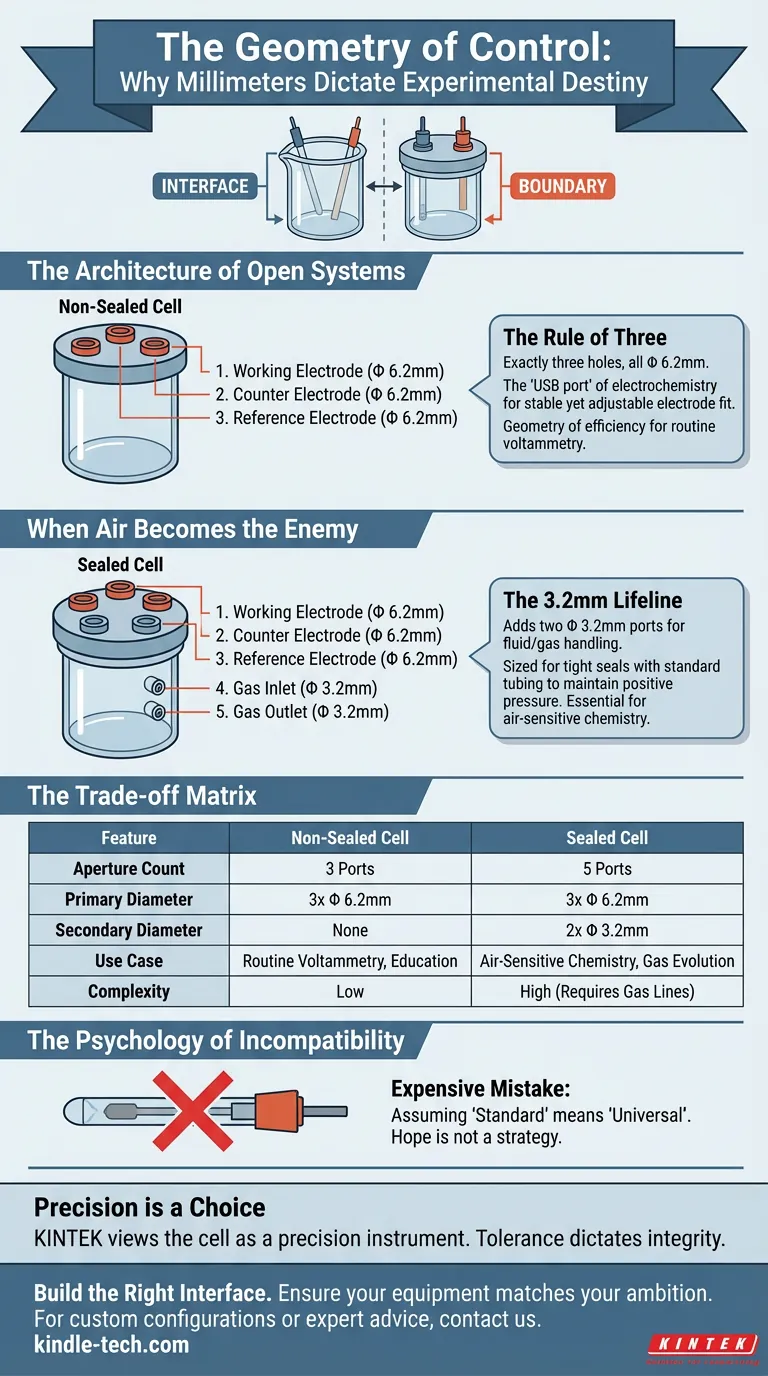
A standard non-sealed cell features exactly three holes, all drilled to a diameter of Φ 6.2mm.

This is not an arbitrary number. It is the "USB port" of electrochemistry.

  1. Working Electrode
  2. Counter Electrode
  3. Reference Electrode

The Φ 6.2mm dimension allows these standard electrodes to slide in with a fit that is secure enough to be stable, yet loose enough to allow for adjustment.

If you are running cyclic voltammetry on stable compounds, this is your workhorse. It is the geometry of efficiency.

When Air Becomes the Enemy

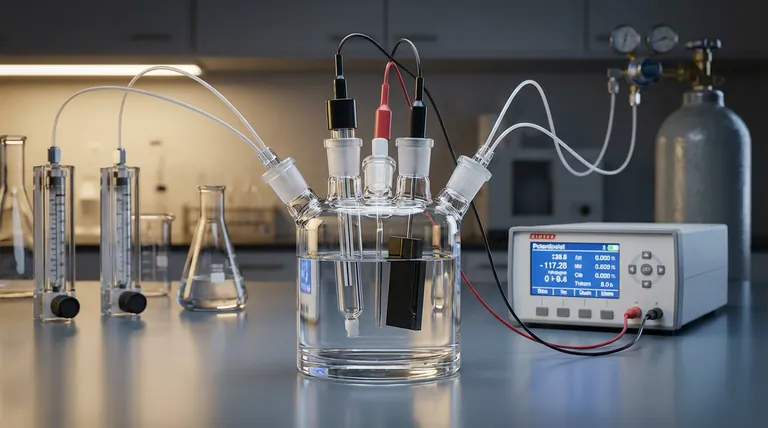
The moment your chemistry becomes sensitive to oxygen, or involves gaseous reactants, the "open bucket" philosophy fails.

You need an airlock. You need a Sealed Cell.

Here, the architecture changes. The geometry becomes more complex because the requirements for control have increased. The standard sealed cell retains the three Φ 6.2mm ports for the electrodes, but adds a critical new dimension: The Φ 3.2mm port.

The 3.2mm Lifeline

A sealed cell typically adds two holes of Φ 3.2mm.

While the large ports handle the solid interfaces (electrodes), these smaller ports handle the fluids (gases).

  • Inlet: For sparging inert gases like Nitrogen or Argon to kill dissolved oxygen.
  • Outlet: To vent the system without backflow.

Why 3.2mm? It is sized perfectly for standard PTFE or thin plastic tubing. It creates a tight seal necessary to maintain positive pressure. If these holes were 6.2mm, the tubing would flail, the seal would fail, and the atmosphere would intrude.

The Psychology of Incompatibility

The most expensive mistake in a lab is rarely an explosion. It is the "small" incompatibility that halts research for three weeks.

We see this often. A researcher buys a cell assuming "standard" means "universal." They arrive with a custom reference electrode that is 6.5mm wide.

It doesn’t fit.

Or they attempt to force a gas line into an electrode port, using Parafilm and hope to create a seal.

Hope is not a strategy.

The Trade-off Matrix

Understanding the anatomy of your cell allows you to make the right trade-off between control and complexity.

Feature Non-Sealed Cell Sealed Cell
Aperture Count 3 Ports 5 Ports
Primary Diameter 3x Φ 6.2mm 3x Φ 6.2mm
Secondary Diameter None 2x Φ 3.2mm
Use Case Routine Voltammetry, Education Air-Sensitive Chemistry, Gas Evolution
Complexity Low High (Requires Gas Lines)

Precision is a Choice

At KINTEK, we view the electrolytic cell as a precision instrument.

We understand that the tolerance of a glass port dictates the integrity of a sealed environment. We know that a Φ 6.2mm hole must actually be Φ 6.2mm, not Φ 6.0mm and not Φ 6.5mm.

If your research fits the industry standards, our off-the-shelf non-sealed and sealed cells provide immediate, reliable infrastructure for your work.

However, science often pushes the boundaries of "standard."

  • Do you use oversized electrodes?
  • Do you need a Luggin capillary for IR drop compensation?
  • Do you need additional ports for temperature sensors?

If so, the standard geometry will fight you.

Build the Right Interface

Don't let a millimeter of glass dictate the limits of your discovery.

Whether you need the robust simplicity of a standard non-sealed cell or the rigorous atmosphere control of a sealed system, ensure your equipment matches your ambition.

If you are unsure if your current electrodes will fit, or if you need a custom configuration to accommodate a complex sensor array, reach out to us. We speak the language of precision.

Contact Our Experts

Visual Guide

The Geometry of Control: Why Millimeters Dictate Experimental Destiny Visual Guide

Related Products

Related Articles

Related Products

Glassy Carbon Sheet RVC for Electrochemical Experiments

Glassy Carbon Sheet RVC for Electrochemical Experiments

Discover our Glassy Carbon Sheet - RVC. Perfect for your experiments, this high-quality material will elevate your research to the next level.

1700℃ Muffle Oven Furnace for Laboratory

1700℃ Muffle Oven Furnace for Laboratory

Get superior heat control with our 1700℃ Muffle Furnace. Equipped with intelligent temperature microprocessor, TFT touch screen controller & advanced insulation materials for precise heating up to 1700C. Order now!

Customer Made Versatile CVD Tube Furnace Chemical Vapor Deposition Chamber System Equipment

Customer Made Versatile CVD Tube Furnace Chemical Vapor Deposition Chamber System Equipment

Get your exclusive CVD furnace with KT-CTF16 Customer Made Versatile Furnace. Customizable sliding, rotating, and tilting functions for precise reactions. Order now!

Split Chamber CVD Tube Furnace with Vacuum Station Chemical Vapor Deposition System Equipment Machine

Split Chamber CVD Tube Furnace with Vacuum Station Chemical Vapor Deposition System Equipment Machine

Efficient split chamber CVD furnace with vacuum station for intuitive sample checking and quick cooling. Up to 1200℃ max temperature with accurate MFC mass flowmeter control.

Shaking Incubators for Diverse Laboratory Applications

Shaking Incubators for Diverse Laboratory Applications

Precision lab shaking incubators for cell culture & research. Quiet, reliable, customizable. Get expert advice today!

Variable Speed Peristaltic Pump

Variable Speed Peristaltic Pump

KT-VSP Series Smart Variable Speed Peristaltic Pumps offer precise flow control for labs, medical, and industrial applications. Reliable, contamination-free liquid transfer.

RF PECVD System Radio Frequency Plasma-Enhanced Chemical Vapor Deposition RF PECVD

RF PECVD System Radio Frequency Plasma-Enhanced Chemical Vapor Deposition RF PECVD

RF-PECVD is an acronym for "Radio Frequency Plasma-Enhanced Chemical Vapor Deposition." It deposits DLC (Diamond-like carbon film) on germanium and silicon substrates. It is utilized in the 3-12um infrared wavelength range.

Cylindrical Press Mold with Scale for Lab

Cylindrical Press Mold with Scale for Lab

Discover precision with our Cylindrical Press Mold. Ideal for high-pressure applications, it molds various shapes and sizes, ensuring stability and uniformity. Perfect for lab use.

Vacuum Heat Treat and Pressure Sintering Furnace for High Temperature Applications

Vacuum Heat Treat and Pressure Sintering Furnace for High Temperature Applications

Vacuum pressure sintering furnaces are designed for high temperature hot pressing applications in metal and ceramic sintering. Its advanced features ensure precise temperature control, reliable pressure maintenance, and a robust design for seamless operation.

Inclined Rotary Plasma Enhanced Chemical Vapor Deposition PECVD Equipment Tube Furnace Machine

Inclined Rotary Plasma Enhanced Chemical Vapor Deposition PECVD Equipment Tube Furnace Machine

Upgrade your coating process with PECVD coating equipment. Ideal for LED, power semiconductors, MEMS and more. Deposits high-quality solid films at low temps.

KF ISO Stainless Steel Vacuum Flange Blind Plate for High Vacuum Systems

KF ISO Stainless Steel Vacuum Flange Blind Plate for High Vacuum Systems

Discover KF/ISO stainless steel vacuum flange blind plates, ideal for high vacuum systems in semiconductor, photovoltaic, and research labs. High-quality materials, efficient sealing, and easy installation.<|end▁of▁sentence|>

Custom PTFE Teflon Parts Manufacturer for Acid and Alkali Resistant Chemical Powder Material Scoops

Custom PTFE Teflon Parts Manufacturer for Acid and Alkali Resistant Chemical Powder Material Scoops

Known for its excellent thermal stability, chemical resistance and electrical insulating properties, PTFE is a versatile thermoplastic material.

Infrared Transmission Coating Sapphire Sheet Substrate Window

Infrared Transmission Coating Sapphire Sheet Substrate Window

Crafted from sapphire, the substrate boasts unparalleled chemical, optical, and physical properties. Its remarkable resistance to thermal shocks, high temperatures, sand erosion, and water sets it apart.

1700℃ Controlled Atmosphere Furnace Nitrogen Inert Atmosphere Furnace

1700℃ Controlled Atmosphere Furnace Nitrogen Inert Atmosphere Furnace

KT-17A Controlled atmosphere furnace: 1700℃ heating, vacuum sealing technology, PID temperature control, and versatile TFT smart touch screen controller for laboratory and industrial use.

Circulating Water Vacuum Pump for Laboratory and Industrial Use

Circulating Water Vacuum Pump for Laboratory and Industrial Use

Efficient circulating water vacuum pump for labs - oil-free, corrosion-resistant, quiet operation. Multiple models available. Get yours now!

XRF & KBR plastic ring lab Powder Pellet Pressing Mold for FTIR

XRF & KBR plastic ring lab Powder Pellet Pressing Mold for FTIR

Get precise XRF samples with our plastic ring lab powder pellet pressing mold. Fast tableting speed and customizable sizes for perfect molding every time.

Cylindrical Resonator MPCVD Machine System Reactor for Microwave Plasma Chemical Vapor Deposition and Lab Diamond Growth

Cylindrical Resonator MPCVD Machine System Reactor for Microwave Plasma Chemical Vapor Deposition and Lab Diamond Growth

Learn about Cylindrical Resonator MPCVD Machine, the microwave plasma chemical vapor deposition method used for growing diamond gemstones and films in the jewelry and semi-conductor industries. Discover its cost-effective advantages over traditional HPHT methods.

Vacuum Arc Induction Melting Furnace

Vacuum Arc Induction Melting Furnace

Discover the power of Vacuum Arc Furnace for melting active & refractory metals. High-speed, remarkable degassing effect, and free of contamination. Learn more now!

Laboratory manual slicer

Laboratory manual slicer

Manual microtome is a high-precision cutting device designed for laboratories, industry and medical fields. It is suitable for the preparation of thin slices of various materials such as paraffin samples, biological tissues, battery materials, food, etc.

Laboratory Benchtop Water Circulating Vacuum Pump for Lab Use

Laboratory Benchtop Water Circulating Vacuum Pump for Lab Use

Need a water circulating vacuum pump for your lab or small-scale industry? Our Benchtop Water Circulating Vacuum Pump is perfect for evaporation, distillation, crystallization, and more.


Leave Your Message