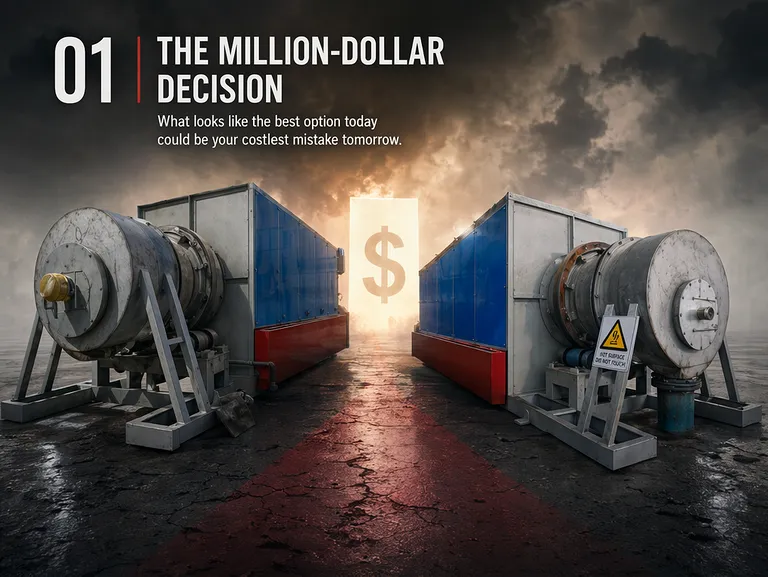
You’ve been tasked with a critical, high-stakes project: managing your facility's hazardous waste stream. In every meeting, one technology comes up as the "gold standard"—the rotary kiln incinerator. It’s powerful, versatile, and effective. The path seems clear, but the pressure is immense. Making the wrong decision doesn't just mean a technical setback; it could mean a multi-million dollar investment that drains resources for years to come.
The All-Too-Common Struggle: Focusing on the Wrong Price Tag
When faced with this decision, most organizations fall into a predictable pattern. The entire evaluation process narrows down to one thing: the initial capital expenditure (CapEx).
Your team spends months comparing quotes from manufacturers. You meticulously analyze feature lists, debating the merits of advanced air seals versus specialized heaters. The primary battle becomes an internal one: securing the budget. To make the numbers work, you might be tempted to make compromises that seem reasonable at the time:
- "Can we go with a less experienced installation team to save 15%?"
- "We can train our existing staff later; let's get the machine in first."
- "The basic maintenance package should be fine for the first year."
These decisions are made with the best intentions—to acquire a top-tier asset within a constrained budget. Yet, this is precisely where the seeds of future failure are sown. The result? Six months post-installation, the "state-of-the-art" system becomes a constant source of frustration. Unexpected shutdowns disrupt operations. Maintenance costs spiral far beyond projections. The team you thought you were empowering is now engaged in a perpetual battle with a machine that was supposed to solve their problems, not create new ones.
The Real Culprit: Ignoring the Total Cost of Ownership
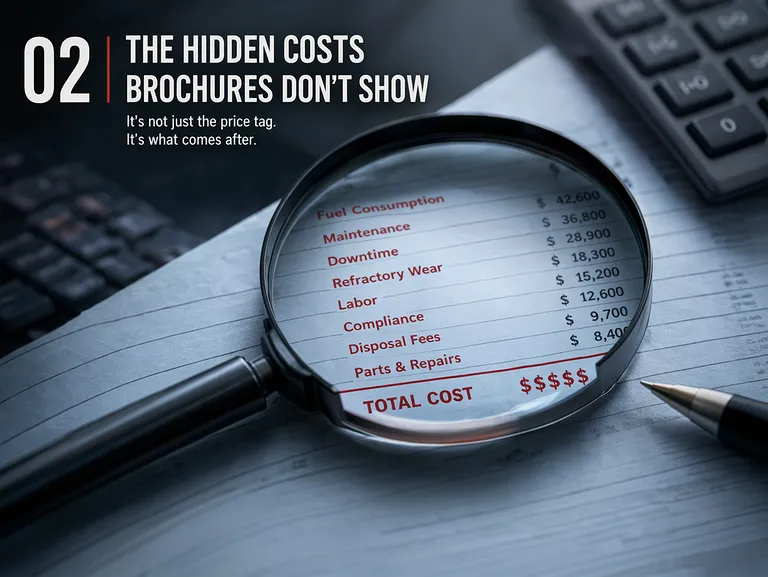
The fundamental mistake isn't choosing a bad kiln. The mistake is focusing on the sticker price while ignoring the massive, unavoidable operational costs baked into the technology's very design. The true cost of a rotary kiln isn't what you pay for it; it's what you pay to run it.
Let's break down the physics of the problem:
1. The Insatiable Demand for Energy
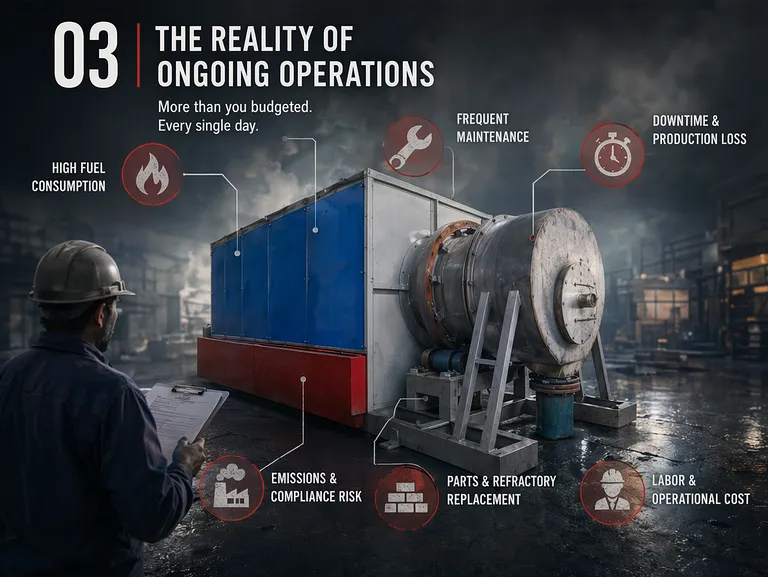
A rotary kiln works by using extreme heat (often over 1,000°C) and long residence times to destroy hazardous materials. Maintaining these temperatures requires a colossal amount of energy, 24/7. This isn't a variable you can optimize away; it's a fundamental requirement of the thermal destruction process. Your energy bill won't be a minor operational expense—it will be a primary driver of your budget.
2. The Unavoidable War of Attrition
Imagine a massive, rotating steel drum filled with abrasive materials and superheated to the temperature of lava. This is the daily reality inside a kiln. The combination of intense heat, chemical corrosion, and physical abrasion wages a relentless war on every component. Refractory linings, seals, support wheels, and drive systems are under constant stress. They don't just sometimes fail; they are designed to wear out. Consequently, maintenance isn't a periodic task; it's a constant, demanding, and expensive necessity that requires scheduled downtime and a highly skilled crew.
3. The Human Factor is Non-Negotiable
These are not "set-it-and-forget-it" systems. A rotary kiln is a complex, dynamic chemical reactor. Operating it safely and efficiently requires a team of well-trained engineers who can manage precise waste feed rates, temperature profiles, and emissions control. Anything less risks inefficient operation, safety hazards, and catastrophic equipment damage. The cost of this specialized human expertise is as real and significant as the cost of the hardware itself.
The "common solutions" of cutting installation costs or skimping on training fail because they ignore this reality. They treat the kiln like a simple piece of equipment when it is, in fact, a complex industrial process.
The Right Tool for the Job: A Comprehensive Needs Assessment
To solve this problem, you don't need a better kiln. You need a better decision-making framework. Instead of starting with the question, "Which rotary kiln should we buy?", the right question is, "What is the most efficient, reliable, and cost-effective method to manage our specific waste stream for the next decade?"
Answering this requires looking beyond a single technology and conducting a holistic assessment of your needs. This is the "tool" that prevents a million-dollar mistake. This strategic approach involves:
- Analyzing Your Waste Stream: Is it consistent or highly variable? Does it truly require the versatility of a rotary kiln, or could a simpler, more specialized, and less expensive technology suffice?
- Modeling the Total Cost of Ownership (TCO): Calculating not just the CapEx, but forecasting the long-term OpEx, including energy, maintenance, consumables, and specialized labor.
- Evaluating Your Operational Capacity: Do you have the in-house expertise to run and maintain such a complex system, or would you be better served by a solution with lower operational demands?
This is where KINTEK's expertise becomes your greatest asset. We aren't just a supplier of equipment; we are your partners in navigating these complex technical and financial decisions. Our approach is built on a deep understanding of laboratory and facility operations, allowing us to help you evaluate all viable options—not just the most powerful one.
Beyond the Fix: Achieving Predictability and Strategic Focus
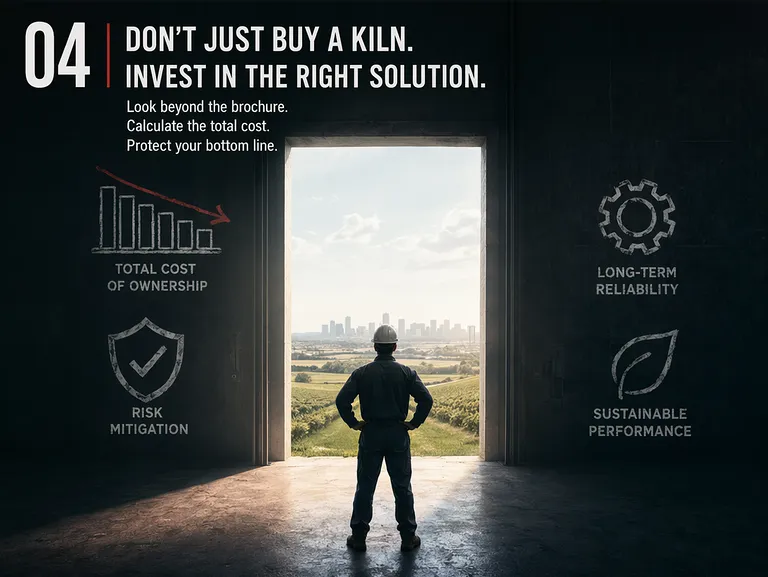
When you shift from a product-focused purchase to a solution-oriented strategy, everything changes. The goal is no longer to simply acquire a machine; it's to achieve operational certainty.
By correctly matching the technology to your actual needs and budget, you unlock new potential. You transform a volatile, unpredictable capital expense into a manageable and predictable operational cost. This financial stability allows your team to stop firefighting equipment issues and focus on what they do best: driving research, innovation, and production. You move from being the manager of a problematic asset to a strategic leader who has secured a sustainable, long-term solution for a critical business challenge.
Making the right equipment choice is about more than just technical specifications; it's about ensuring the long-term success and financial health of your operation. If you're facing a complex waste management decision, don't navigate it alone. Our team can help you analyze your unique challenges and map out a solution that truly fits your goals and budget. Let us help you make an investment you can be confident in for years to come. Contact Our Experts.
Related Products
- Electric Rotary Kiln Small Rotary Furnace for Activated Carbon Regeneration
- Electric Rotary Kiln Small Rotary Furnace Biomass Pyrolysis Plant
- Electric Rotary Kiln Pyrolysis Furnace Plant Machine Calciner Small Rotary Kiln Rotating Furnace
- Electric Rotary Kiln Continuous Working Small Rotary Furnace Heating Pyrolysis Plant
- Vacuum Sealed Continuous Working Rotary Tube Furnace Rotating Tube Furnace
Related Articles
- What is activated carbon regeneration Rotary Furnace
- Why Your Rotary Kiln Keeps Failing—And Why a 'Quick Fix' Is the Most Expensive Solution
- Scaling Your Lab's Production? Why a Giant Rotary Kiln Is Often the Wrong Answer.
- Your Rotary Kiln Is Inefficient. Here's the Counterintuitive Reason Why.
- A Comprehensive Guide to Rotary Kilns: Applications, Types, and Working Principles