Yes, different sieves are absolutely essential for separating different mixtures. The specific sieve used is chosen based on a single, critical factor: the size of the particles you want to separate. Using the wrong sieve—one with openings that are too large or too small—will result in a failed or incomplete separation.
The core principle is simple: a sieve works by allowing smaller particles to pass through its openings while retaining larger particles. Therefore, the selection of a sieve must always be dictated by the specific particle sizes of the components within the mixture you need to separate.
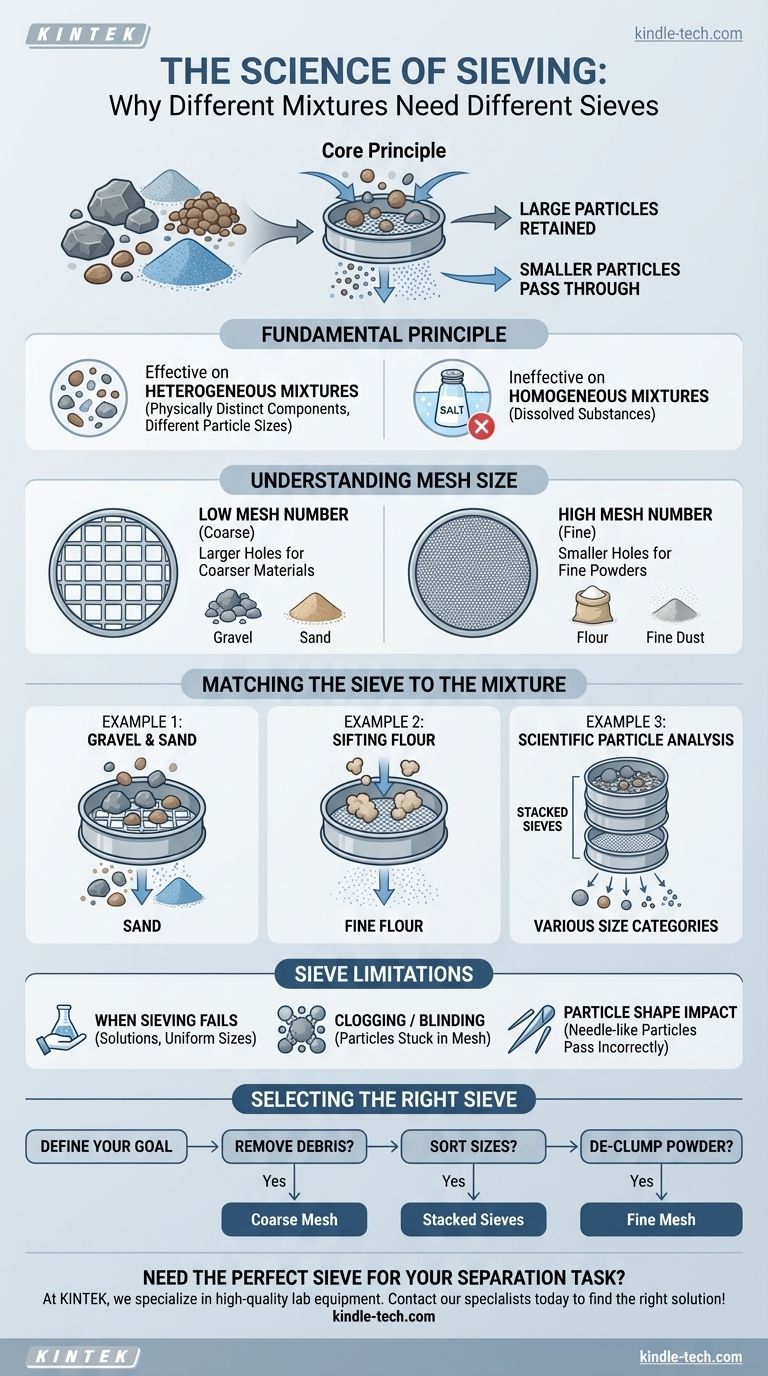
The Fundamental Principle of Sieving
Sieving, also known as sifting, is one of the most straightforward methods of mechanical separation. Its effectiveness hinges on the physical properties of the mixture's components.
What Defines a Mixture for Sieving?
Sieving is only effective on heterogeneous mixtures, which are mixtures where the different components are physically distinct and visible.
Crucially, the components must have different particle sizes. Sieving cannot separate particles of the same size or dissolved substances in a solution.
The Role of Mesh Size
The functionality of any sieve is defined by its mesh size. This term refers to the size of the openings in the sieve's screen.
Mesh size is often described by the number of openings per linear inch. A higher mesh number indicates more openings per inch, which means the holes are smaller and will only allow very fine particles to pass through. Conversely, a low mesh number means larger holes for separating coarser materials.
Matching the Sieve to the Mixture
The choice of sieve is a direct response to the separation task at hand. The goal is to select a mesh size that is larger than the particles you want to pass through but smaller than the particles you want to retain.
Example 1: Separating Gravel and Sand
To separate a simple mixture of gravel and sand, you need a sieve with a coarse mesh (a low mesh number).
The openings must be large enough for the sand grains to fall through easily but small enough to catch all the pieces of gravel.
Example 2: Sifting Flour for Baking
When sifting flour, the goal isn't to separate two different substances but to break up clumps and aerate the flour.
This requires a sieve with a very fine mesh (a high mesh number). The fine screen allows individual flour particles to pass through while catching and helping to break down any compacted clumps.
Example 3: Scientific Particle Analysis
In a laboratory or industrial setting, a single material might be sorted into various size categories. This is often done for quality control or research.
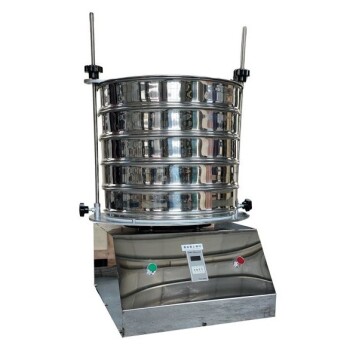
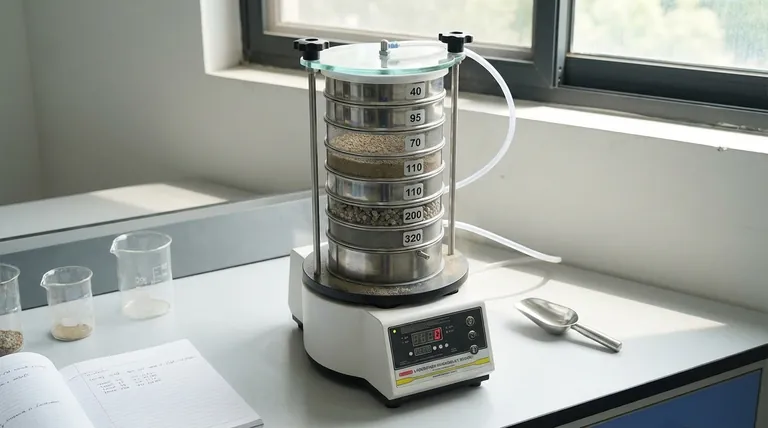
This process uses a stack of sieves, with the coarsest mesh on top and progressively finer meshes below. As the stack is shaken, the material is sorted into different size fractions, with each sieve catching particles of a specific size range.
Understanding the Limitations
While powerful, sieving is not a universal solution. Understanding its limitations is key to using it effectively.
When Sieving Fails
Sieving is completely ineffective for homogeneous mixtures, such as salt dissolved in water. Since the salt is dissolved at a molecular level, no mechanical screen can separate it.
It also fails if all the solid particles in a mixture are roughly the same size.
The Challenge of Clogging
A common issue is blinding or clogging, which occurs when particles that are very close in size to the mesh openings get stuck. This blocks the sieve and reduces its efficiency over time.
The Impact of Particle Shape
The shape of a particle can also affect separation. Long, needle-like particles might not pass through a mesh opening even if their overall volume is small enough, potentially leading to an inaccurate separation.
Selecting the Right Sieve for Your Task
To apply this knowledge, always begin by analyzing the components of your mixture and defining your goal.
- If your primary focus is removing large debris from a finer material: Choose a sieve with a mesh size that is slightly larger than your desired fine particles but smaller than the debris.
- If your primary focus is to separate a single material into multiple size categories: Use a stacked set of sieves with progressively finer mesh sizes, from coarsest on top to finest on the bottom.
- If your primary focus is to break up clumps in a uniform powder: Use a fine-mesh sieve designed to catch agglomerated particles while allowing the primary particles to pass through freely.
Ultimately, selecting the correct sieve transforms a simple mesh screen into a precision tool for separation.
Summary Table:
| Sieve Type (Mesh Size) | Ideal For Separating | Example Mixtures |
|---|---|---|
| Coarse Mesh (Low Number) | Large from small particles | Gravel from sand |
| Fine Mesh (High Number) | Fine powders, de-clumping | Sifting flour, removing clumps |
| Stacked Sieves | Sorting into multiple size fractions | Laboratory particle analysis |
Need the perfect sieve for your specific separation task?
At KINTEK, we specialize in providing high-quality lab equipment, including a wide range of precision sieves for every application. Whether you're in quality control, research, or production, our experts can help you select the ideal sieve to ensure accurate and efficient results.
Contact our specialists today to discuss your needs and find the right solution for your laboratory!
Visual Guide
Related Products
- Custom PTFE Teflon Parts Manufacturer for PTFE Mesh F4 Sieve
- Laboratory Test Sieves and Sieving Machines
- Laboratory Vibratory Sieve Shaker Machine Slap Vibrating Sieve
- Three-dimensional electromagnetic sieving instrument
- 10L Chilling Circulator Cooling Water Bath Low Temperature Constant Temperature Reaction Bath
People Also Ask
- How do we select a sieve? A Systems-Based Guide to Accurate Particle Separation
- What is the difference between ASTM standards sieves and is standard sieves? Ensure Compliance for Your Lab
- What are the primary reasons for selecting PTFE as a matrix? Enhance Composites with Carbon Nanotube Reinforcement
- How is PTFE utilized for insulation in Alloy 22 corrosion setups? Ensure Signal Purity & Accuracy
- What are the specific applications of PTFE in micro-batch slug flow systems? Enhance Your Microfluidic Reaction Purity