Knowledge Can sieving be used to separate a solid substance from a liquid substance? Learn the Right Technique for Your Mixture
Author avatar

Tech Team · Kintek Solution

Updated 6 days ago

Can sieving be used to separate a solid substance from a liquid substance? Learn the Right Technique for Your Mixture


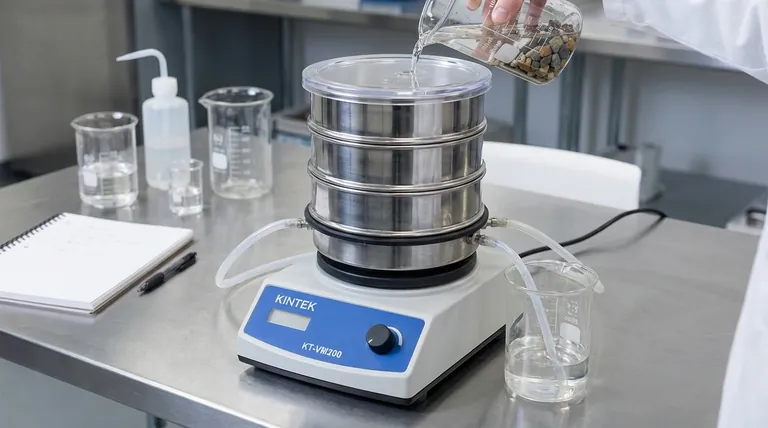
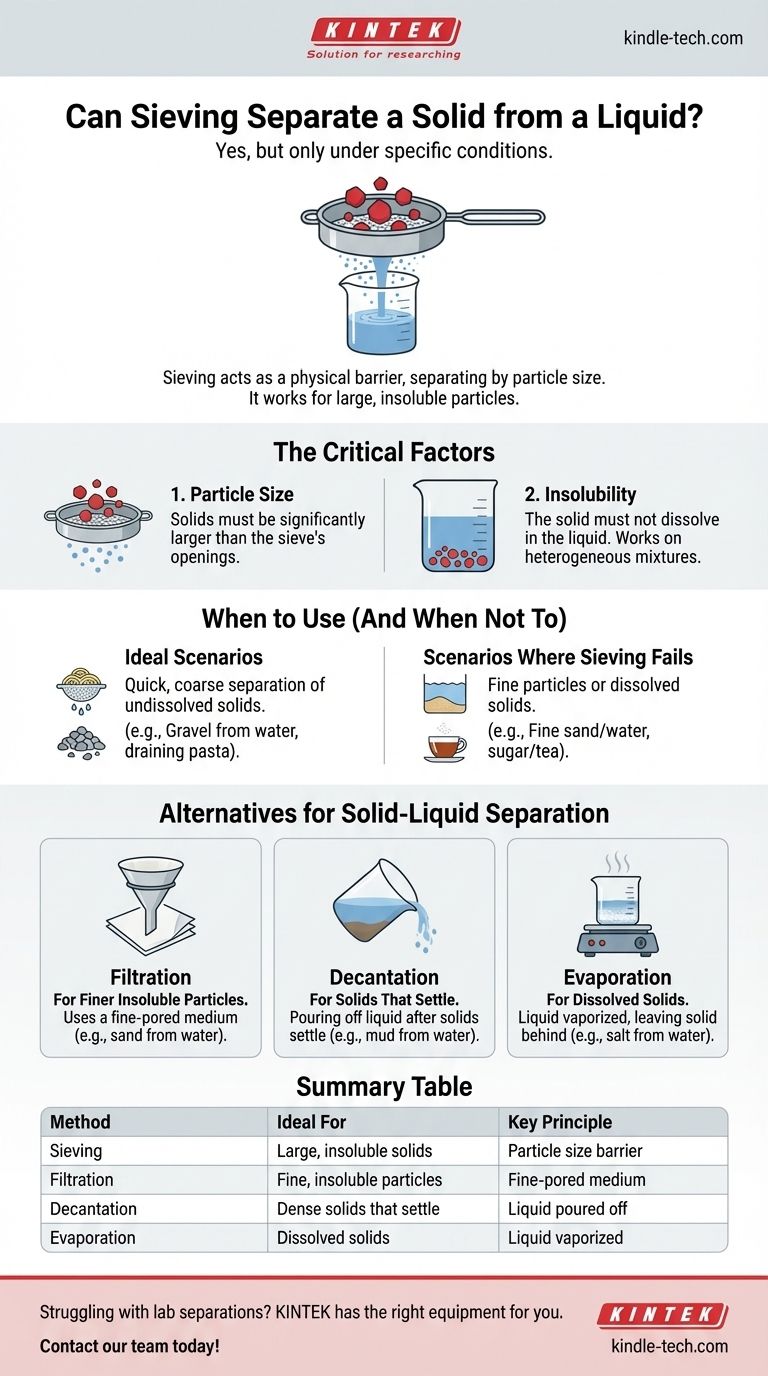
Yes, but only under specific conditions. Sieving can be used to separate a solid from a liquid, but only when the solid particles are insoluble and large enough to be caught by the openings in the sieve. This method works by acting as a physical barrier, allowing the liquid to pass through while retaining the larger solid components.

The core principle is simple: sieving separates mixtures based on particle size. It is the right tool for large, undissolved solids, but for fine particles or dissolved substances, you must turn to more precise methods like filtration or evaporation.
Can sieving be used to separate a solid substance from a liquid substance? Learn the Right Technique for Your Mixture

The Core Principle of Sieving

How Sieving Works

Sieving, often called sifting, is a mechanical separation process. It uses a mesh or screen with uniform openings.

When a mixture is poured onto the sieve, components smaller than the openings pass through, while components larger than the openings are retained. In a solid-liquid mixture, the liquid molecules easily pass through, along with any very fine suspended or dissolved solids.

The Critical Factor: Particle Size

The success of sieving depends entirely on a significant difference in size between the solid particles and the sieve's holes.

Think of draining cooked pasta in a colander. The pasta (large solid) is trapped, while the water (liquid) flows freely through. This is a perfect application of sieving.

The Second Critical Factor: Insolubility

Sieving only works on heterogeneous mixtures, where the solid does not dissolve in the liquid.

If you pour saltwater through a sieve, both the salt ions and the water molecules will pass through. Since the salt is dissolved, its individual particles are far too small to be caught. The mixture remains unchanged.

When to Use Sieving (And When Not To)

Ideal Scenarios for Sieving

Sieving is the ideal method for quick, coarse separations of undissolved solids.

Common examples include separating gravel from water, removing pulp from juice, or draining canned vegetables. The process is fast, simple, and requires minimal equipment.

Scenarios Where Sieving Fails

This method is ineffective for separating mixtures with very fine or dissolved solids.

Attempting to separate fine sand or silt from water with a standard kitchen sieve will fail because the sand particles are small enough to pass through the mesh along with the water. For a dissolved solid like sugar in tea, sieving is completely useless.

Understanding the Alternatives for Solid-Liquid Separation

If sieving isn't the right tool, another method will be. The correct choice depends on the properties of your mixture.

Filtration: For Finer Insoluble Particles

Filtration is essentially sieving on a microscopic level. It uses a filter medium (like paper or cloth) with pores far smaller than a sieve's mesh.

This is the correct technique for separating fine, insoluble particles, such as sand from water or coffee grounds from brewed coffee.

Decantation: For Solids That Settle

Decantation is used when a dense, insoluble solid settles at the bottom of a liquid over time, forming a sediment.

The process involves carefully pouring off the liquid, leaving the solid behind. It's a simple method for separating things like mud from water after the mud has settled.

Evaporation: For Dissolved Solids

When a solid is dissolved in a liquid, creating a solution, the only way to separate them is through evaporation.

By heating the solution, the liquid turns into a gas and evaporates, leaving the solid behind. This is the classic method for recovering salt from saltwater.

Choosing the Right Separation Method

Your choice of technique depends on the properties of your specific solid-liquid mixture.

  • If your primary focus is a quick separation of large, undissolved solids: Sieving is your most efficient choice.
  • If you are separating fine, undissolved particles for high purity: Use filtration for a more precise result.
  • If the solid is completely dissolved in the liquid to form a solution: Evaporation is the only method that will recover the solid.
  • If your insoluble solid is dense and settles quickly on its own: Decantation is a simple and effective option that requires no special equipment.

Understanding the nature of your mixture is the key to selecting the most effective separation technique.

Summary Table:

Separation Method Ideal For Key Principle
Sieving Large, insoluble solids (e.g., gravel from water) Particle size difference; acts as a physical barrier
Filtration Fine, insoluble particles (e.g., sand from water) Uses a fine-pored medium to trap small particles
Evaporation Dissolved solids in a solution (e.g., salt from water) Liquid is vaporized, leaving the solid behind
Decantation Dense solids that settle (e.g., mud from water) Liquid is carefully poured off after settling

Struggling to separate your lab mixtures efficiently? The right equipment is key to achieving pure, accurate results. KINTEK specializes in high-quality lab sieves, filtration systems, and evaporation equipment designed for reliability and precision. Whether you're processing samples or developing new methods, our experts can help you select the perfect tool for your specific solid-liquid separation needs.

Contact our team today to discuss your application and find the ideal solution for your laboratory!

Visual Guide
Can sieving be used to separate a solid substance from a liquid substance? Learn the Right Technique for Your Mixture Visual Guide

Related Products

People Also Ask

Related Products

Laboratory Test Sieves and Vibratory Sieve Shaker Machine

Laboratory Test Sieves and Vibratory Sieve Shaker Machine

Efficiently process powders, granules, and small blocks with a high-frequency vibration sieve. Control vibration frequency, screen continuously or intermittently, and achieve accurate particle size determination, separation, and classification.

Laboratory Vibratory Sieve Shaker Machine for Dry and Wet Three-Dimensional Sieving

Laboratory Vibratory Sieve Shaker Machine for Dry and Wet Three-Dimensional Sieving

KT-VD200 can be used for sieving tasks of dry and wet samples in the laboratory. The screening quality is 20g-3kg. The product is designed with a unique mechanical structure and an electromagnetic vibrating body with a vibration frequency of 3000 times per minute.

Laboratory Vibratory Sieve Shaker Machine Slap Vibrating Sieve

Laboratory Vibratory Sieve Shaker Machine Slap Vibrating Sieve

KT-T200TAP is a slapping and oscillating sieving instrument for laboratory desktop use, with 300 rpm horizontal circular motion and 300 vertical slapping motions to simulate manual sieving to help sample particles pass through better.

Vibratory Sieve Shaker Machine Dry Three-Dimensional Vibrating Sieve

Vibratory Sieve Shaker Machine Dry Three-Dimensional Vibrating Sieve

The KT-V200 product focuses on solving common sieving tasks in the laboratory. It is suitable for sieving 20g-3kg dry samples.

Laboratory Vortex Mixer Orbital Shaker Multifunctional Rotation Oscillation Mixer

Laboratory Vortex Mixer Orbital Shaker Multifunctional Rotation Oscillation Mixer

The inching mixer is small in size, mixes quickly and thoroughly, and the liquid is in a vortex shape, which can mix all the test solutions attached to the tube wall.

Custom PTFE Teflon Parts Manufacturer for PTFE Mesh F4 Sieve

Custom PTFE Teflon Parts Manufacturer for PTFE Mesh F4 Sieve

PTFE mesh sieve is a specialized test sieve designed for particle analysis in various industries, featuring a non-metallic mesh woven from PTFE filament. This synthetic mesh is ideal for applications where metal contamination is a concern . PTFE sieves are crucial for maintaining the integrity of samples in sensitive environments, ensuring accurate and reliable results in particle size distribution analysis.

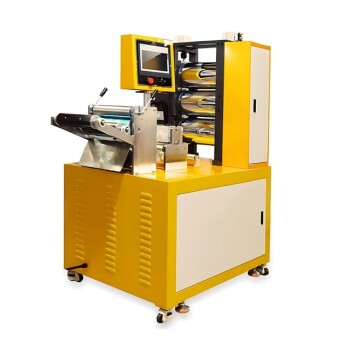
Small Lab Rubber Calendering Machine

Small Lab Rubber Calendering Machine

Small lab rubber calendering machine is used for producing thin, continuous sheets of plastic or rubber materials. It is commonly employed in laboratories, small-scale production facilities, and prototyping environments to create films, coatings, and laminates with precise thickness and surface finish.

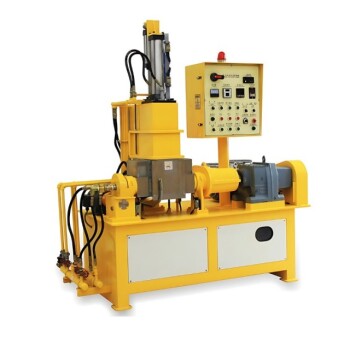
Lab Internal Rubber Mixer Rubber Kneader Machine for Mixing and Kneading

Lab Internal Rubber Mixer Rubber Kneader Machine for Mixing and Kneading

Lab internal rubber mixer is suitable for mixing, kneading and dispersing various chemical raw materials such as plastics, rubber, synthetic rubber, hot melt adhesive and various low-viscosity materials.

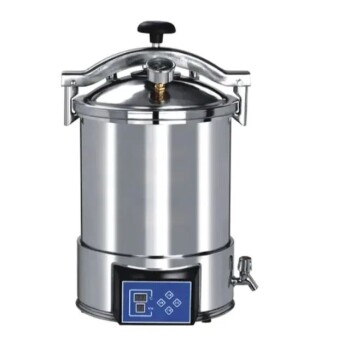
Portable Digital Display Automatic Laboratory Sterilizer Lab Autoclave for Sterilization Pressure

Portable Digital Display Automatic Laboratory Sterilizer Lab Autoclave for Sterilization Pressure

Portable autoclave sterilization pressure is a device that uses pressure saturated steam to quickly and effectively sterilize items.

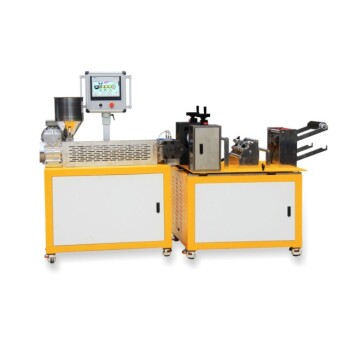
Lab Plastic PVC Calender Stretch Film Casting Machine for Film Testing

Lab Plastic PVC Calender Stretch Film Casting Machine for Film Testing

The cast film machine is designed for the molding of polymer cast film products and has multiple processing functions such as casting, extrusion, stretching, and compounding.

Single Punch Electric Tablet Press Machine Laboratory Powder Tablet Punching TDP Tablet Press

Single Punch Electric Tablet Press Machine Laboratory Powder Tablet Punching TDP Tablet Press

The single-punch electric tablet press is a laboratory-scale tablet press suitable for corporate laboratories in pharmaceutical, chemical, food, metallurgical and other industries.

Laboratory High Pressure Horizontal Autoclave Steam Sterilizer for Lab Use

Laboratory High Pressure Horizontal Autoclave Steam Sterilizer for Lab Use

The horizontal autoclave steam sterilizer adopts the gravity displacement method to remove the cold air in the inner chamber, so that the inner steam and cold air content is less, and the sterilization is more reliable.

Metallographic Specimen Mounting Machine for Laboratory Materials and Analysis

Metallographic Specimen Mounting Machine for Laboratory Materials and Analysis

Precision metallographic mounting machines for labs—automated, versatile, and efficient. Ideal for sample prep in research and quality control. Contact KINTEK today!

Portable High Pressure Laboratory Autoclave Steam Sterilizer for Lab Use

Portable High Pressure Laboratory Autoclave Steam Sterilizer for Lab Use

Portable autoclave sterilization pressure is a device that uses pressure saturated steam to quickly and effectively sterilize items.

Laboratory High Pressure Steam Sterilizer Vertical Autoclave for Lab Department

Laboratory High Pressure Steam Sterilizer Vertical Autoclave for Lab Department

Vertical pressure steam sterilizer is a kind of sterilization equipment with automatic control, which is composed of heating system, microcomputer control system and overheating and overpressure protection system.

Laboratory Sterilizer Lab Autoclave Pulsating Vacuum Desktop Steam Sterilizer

Laboratory Sterilizer Lab Autoclave Pulsating Vacuum Desktop Steam Sterilizer

The pulsating vacuum desktop steam sterilizer is a compact and reliable device used for rapid sterilization of medical, pharmaceutical, and research items.

Rubber Vulcanizer Vulcanizing Machine Plate Vulcanizing Press for Lab

Rubber Vulcanizer Vulcanizing Machine Plate Vulcanizing Press for Lab

The Plate vulcanizing press is a kind of equipment used in the production of rubber products, mainly used for the vulcanization of rubber products. Vulcanization is a key step in rubber processing.

Desktop Fast Laboratory Autoclave Sterilizer 35L 50L 90L for Lab Use

Desktop Fast Laboratory Autoclave Sterilizer 35L 50L 90L for Lab Use

The desktop fast steam sterilizer is a compact and reliable device used for rapid sterilization of medical, pharmaceutical, and research items. It efficiently sterilizes surgical instruments, glassware, medicines, and resistant materials, making it suitable for various applications.

Single Punch Tablet Press Machine and Mass Production Rotary Tablet Punching Machine for TDP

Single Punch Tablet Press Machine and Mass Production Rotary Tablet Punching Machine for TDP

Rotary tablet punching machine is an automatic rotating and continuous tableting machine. It is mainly used for tablet manufacturing in the pharmaceutical industry, and is also suitable for industrial sectors such as food, chemicals, batteries, electronics, ceramics, etc. to compress granular raw materials into tablets.

Desktop Fast High Pressure Laboratory Autoclave Sterilizer 16L 24L for Lab Use

Desktop Fast High Pressure Laboratory Autoclave Sterilizer 16L 24L for Lab Use

The desktop fast steam sterilizer is a compact and reliable device used for rapid sterilization of medical, pharmaceutical, and research items.


Leave Your Message