Yes, the material of the electrode clamp is fully customizable. While the unit comes standard with a built-in platinum sheet, this can be replaced with other conductive materials, specifically copper or titanium. Furthermore, the system can be adapted to accommodate a glassy carbon electrode through custom processing.
Core Takeaway The in-situ Raman electrolytic cell is designed for modularity, allowing you to move beyond the standard platinum interface. By swapping the clamp material for copper, titanium, or custom-processed glassy carbon, you can tailor the working electrode to match the specific catalytic or electrochemical requirements of your research.
Material Flexibility and Options
Replacing the Standard Platinum
The standard configuration utilizes a micro platinum sheet within the electrode clamp as the working electrode.
However, platinum is not suitable for every reaction due to its specific catalytic activity. To address this, the design allows for the direct replacement of the platinum sheet with copper or titanium sheets.
Advanced Customization
For experiments requiring a carbon-based surface, the system supports the use of glassy carbon electrodes.
Unlike the metal sheet options, utilizing glassy carbon requires custom processing. This ensures the brittle nature of the carbon is properly accommodated within the clamp mechanism while maintaining electrical connectivity.
The Context of the Assembly
The Standard Cell Architecture
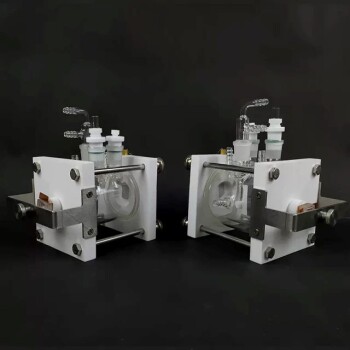
It is important to understand the environment in which this customization occurs. The cell body is constructed from chemically resistant PEEK material.
It features a quartz window on top for optical observation. Regardless of the clamp material you choose, this external architecture remains constant.
Electrode Compatibility
The standard cell lid is designed with three holes to accommodate the full electrochemical setup.
This typically includes the customizable clamp (Working Electrode), a platinum wire ring (Counter Electrode), and an Ag/AgCl electrode (Reference Electrode). Changing the clamp material does not interfere with the placement or function of the counter or reference electrodes.
Understanding the Trade-offs
Chemical Compatibility vs. Conductivity
When customizing the clamp, you must weigh the chemical inertness of the material against your experimental needs.
Platinum is the standard for a reason; it is highly conductive and inert in many environments. However, Copper and Ti (Titanium) may introduce different oxidation states or catalytic behaviors that could obscure or enhance specific Raman signals depending on your analyte.
Mechanical Integration
Replacing a metal sheet is generally straightforward due to the malleability of metals like copper and titanium.
Glassy carbon, however, is rigid and brittle. The "custom processing" requirement mentioned in the technical specifications is a critical trade-off. It implies a higher complexity in setup and potentially higher cost or lead time compared to simply swapping a metal sheet.
Making the Right Choice for Your Goal
To select the appropriate clamp material, evaluate your specific experimental parameters:
- If your primary focus is general electrochemistry: Stick with the standard platinum sheet for the best balance of conductivity and chemical inertness.
- If your primary focus is specific metal catalysis: Switch to copper or titanium to study reactions specifically catalyzed by these transition metals or to avoid platinum interference.
- If your primary focus is a wide potential window: Opt for the glassy carbon electrode (via custom processing) to minimize background currents and avoid metal oxidation in aggressive electrolytes.
Your choice of electrode material defines the boundary conditions of your experiment; choose the material that interacts most favorably with your target analyte.
Summary Table:
| Feature | Standard Option | Custom Material Options | Compatible Electrodes |
|---|---|---|---|
| Clamp Material | Platinum (Pt) Sheet | Copper (Cu), Titanium (Ti) | Glassy Carbon (Custom) |
| Cell Body | PEEK | N/A | Counter: Pt Wire Ring |
| Optical Window | Quartz | N/A | Reference: Ag/AgCl |
| Process Type | Standard Assembly | Direct Replacement | Advanced Custom Processing |
Elevate Your Electrochemical Analysis with KINTEK
Precision in material science starts with the right tools. At KINTEK, we specialize in providing high-performance laboratory solutions, from electrolytic cells and electrodes to high-temperature furnaces and advanced battery research tools.
Our in-situ Raman electrolytic cells offer the modularity you need to swap electrode clamps for copper, titanium, or glassy carbon, ensuring your setup perfectly matches your catalytic requirements. Beyond electrochemical cells, we offer a comprehensive range of PTFE products, ceramics, and crucibles to support your most demanding lab environments.
Ready to customize your lab setup?
Contact KINTEK today to discuss your specific electrode requirements and get a technical consultation!
Related Products
- Electrode Fixture for Electrochemical Experiments
- Super Sealed Electrolytic Electrochemical Cell
- Electrolytic Electrochemical Cell with Five-Port
- Electrolytic Electrochemical Cell for Coating Evaluation
- Electrolytic Electrochemical Cell Gas Diffusion Liquid Flow Reaction Cell
People Also Ask
- What criteria are used during the visual inspection of electrodes? Essential Quality Assessment for Your Lab
- How should an electrode holder be cleaned as part of regular maintenance? Ensure Reliable Electrochemical Measurements
- What is a critical precaution regarding electrolyte contact when using an electrode holder? Ensure Accurate and Safe Electrochemical Measurements
- What are the proper procedures for post-treatment and storage of an electrode holder after an experiment? Ensure Accuracy and Longevity
- What maintenance check is required for the electrical connections of an electrode holder? Ensure Reliable Data and Lab Safety