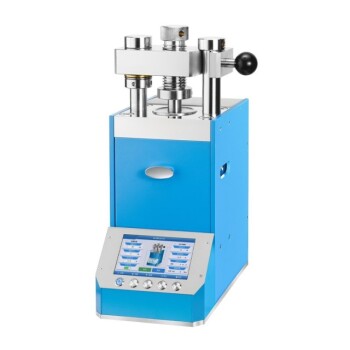
The evaluation of 3D-printed zirconia relies on a dual-stage process of precision forming and mechanical stress testing to ensure structural integrity. Universal material testing machines (UTMs) measure the fracture load and flexural strength of sintered samples, providing a direct metric for the success of sintering and debinding protocols. Meanwhile, laboratory hydraulic presses are utilized during the preparation stage to compact ceramic powder into standardized geometries, ensuring the initial material density is consistent before testing begins.
Central Takeaway: While hydraulic presses establish the foundational consistency and dimensional accuracy of zirconia test specimens, universal testing machines provide the critical mechanical data needed to optimize 3D-printing workflows for high-stress dental applications.
The Role of Hydraulic Presses in Specimen Preparation
Achieving Uniform Powder Compaction
A high-precision laboratory hydraulic press is used to apply specific pressures, often around 30MPa, for uniaxial compression molding. This process initially compacts the zirconia powder into a predetermined geometric shape, such as a disk. This step is vital because it establishes a consistent powder distribution, which serves as the foundation for subsequent isostatic pressing and sintering.
Ensuring Compliance with ISO 6872
By using high-precision steel molds, hydraulic presses provide the stable forming pressure required to meet international standards like ISO 6872. Precise control during this phase is essential to minimize experimental errors. If the forming pressure is uneven, the resulting samples may exhibit structural flaws that skew the final performance data.
Assessing Material Surface Properties
In specific manufacturing contexts, hydraulic presses are also used to assess blocking resistance. This test evaluates whether a material has a tendency to adhere to itself when placed under pressure. This quality check is important for ensuring that the raw materials or green-state components do not suffer from unwanted surface transfer or damage before final processing.
The Role of Universal Material Testing Machines (UTM)
Quantifying Flexural Strength
The UTM, equipped with high-precision load sensors, is the primary tool for performing three-point bending tests. This test quantifies the flexural strength of the sintered zirconia by measuring the exact load at which the sample fractures. This data is the most direct indicator of whether a 3D-printed part can withstand complex masticatory loads in a clinical environment.
Validating the 3D-Printing Workflow
The results from a UTM allow technicians to evaluate the success of the Suspended Encapsulated Projection Stereolithography (SEPS) molding process. By analyzing fracture data, engineers can fine-tune debinding protocols and sintering parameters. This iterative optimization ensures that the final 3D-printed restoration meets the required mechanical benchmarks for durability.
Real-Time Performance Monitoring
Modern UTMs provide highly granular data during the stress-testing phase. This allows for a deep understanding of how different printing orientations or layer thicknesses affect the final strength of the zirconia. Without this quantitative feedback, it would be impossible to guarantee the long-term reliability of 3D-printed ceramics.
Understanding the Trade-offs
Manual vs. Automated Pressure Control
While hydraulic presses are essential for forming, manual pressure application can introduce human error and inconsistency. If the pressure is not applied steadily, internal micro-cracks may form in the green-state zirconia. These defects are often invisible until the sample fails prematurely during UTM testing.
Destructive Nature of Strength Testing
It is important to recognize that UTM evaluations are destructive tests. Once a sample is tested for its fracture load, it cannot be used for the final restoration. This requires the production of extra "witness samples" to represent the quality of the actual batch, adding time and material costs to the manufacturing process.
How to Apply This to Your Project
Recommendations Based on Your Goal
- If your primary focus is ISO compliance: Use a hydraulic press with high-precision steel molds to ensure your specimen dimensions and density meet standard requirements perfectly.
- If your primary focus is workflow optimization: Prioritize UTM testing of samples printed with varying parameters to identify the exact debinding and sintering settings that yield the highest flexural strength.
- If your primary focus is material consistency: Use the hydraulic press to conduct blocking resistance tests to ensure your raw materials maintain their integrity during storage and handling.
By integrating precise hydraulic compaction with rigorous universal testing, you can transform 3D-printed zirconia from an experimental material into a reliable clinical solution.
Summary Table:
| Equipment Type | Primary Role in Workflow | Key Metrics & Standards | Clinical Significance |
|---|---|---|---|
| Hydraulic Press | Specimen Preparation & Compaction | ISO 6872, 30MPa pressure | Ensures uniform density & structural base |
| Universal Testing Machine (UTM) | Mechanical Stress Testing | Fracture load, Flexural strength | Validates durability for masticatory loads |
| Steel Molds | Geometry Standardization | Dimensional accuracy | Minimizes experimental errors during forming |
Elevate Your Material Research with KINTEK Precision
Achieve uncompromising accuracy in your 3D-printed zirconia workflows. KINTEK specializes in high-performance laboratory equipment designed to meet the rigorous demands of dental and industrial material science.
Whether you need manual or automated hydraulic presses (pellet, hot, isostatic) for flawless powder compaction, or advanced universal testing machines to quantify flexural strength, our solutions ensure your products meet international standards like ISO 6872. Our comprehensive portfolio also includes:
- High-Temperature Furnaces: Muffle, vacuum, CVD, and dental furnaces for perfect sintering.
- Material Processing: Crushing, milling, and sieving systems for raw material preparation.
- Sintering Support: High-quality ceramics, crucibles, and PTFE products.
Don't leave your structural integrity to chance. Contact KINTEK today to consult with our experts and find the perfect equipment to optimize your 3D-printing and testing protocols.
References
- Amit Unnadkat, Erica C. Teixeira. The Effect of Sintering on Zirconia Manufactured via Suspension-Enclosing Projection Stereolithography for Dental Applications: An In Vitro Study. DOI: 10.3390/ma17010014
This article is also based on technical information from Kintek Solution Knowledge Base .
Related Products
- Filter Testing Machine FPV for Dispersion Properties of Polymers and Pigments
- Lab Plastic PVC Calender Stretch Film Casting Machine for Film Testing
- Laboratory Test Sieves and Sieving Machines
- Laboratory Test Sieves and Vibratory Sieve Shaker Machine
- Metallographic Specimen Mounting Machine for Laboratory Materials and Analysis
People Also Ask
- What is a filter tester? A Guide to Measuring Filtration Efficiency & Performance
- What is the role of high-purity nitrogen in a supercritical water test loop? Ensure Test Data Integrity
- Why are porous ceramic filters utilized in methane pyrolysis? Protect Your Assets with High-Precision Filtration
- How is a laboratory analytical balance utilized in studies of capillary water absorption kinetics? | Precision Data
- What is the best solvent for FTIR? Master Solvent Selection for Clear, Accurate Spectra