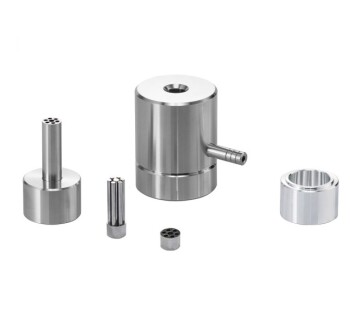
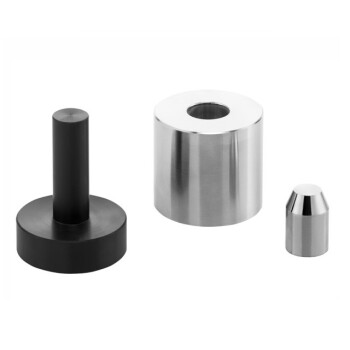
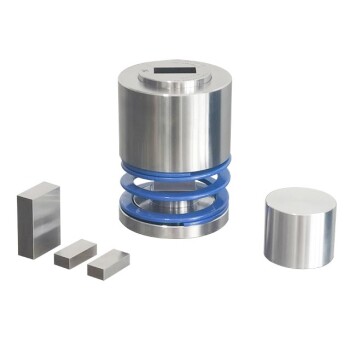
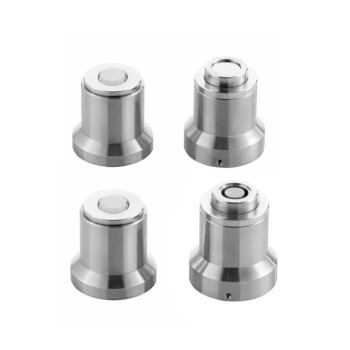
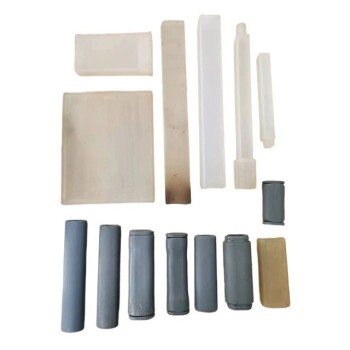
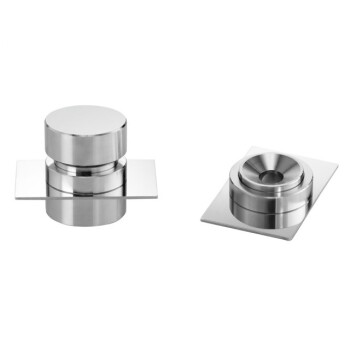
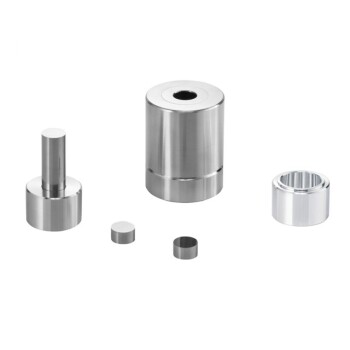
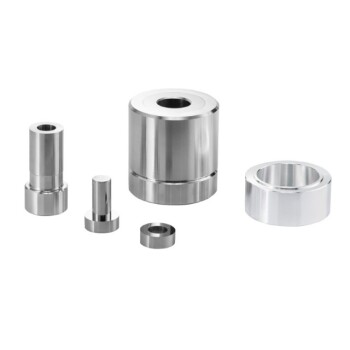
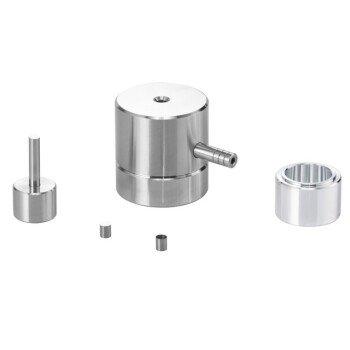
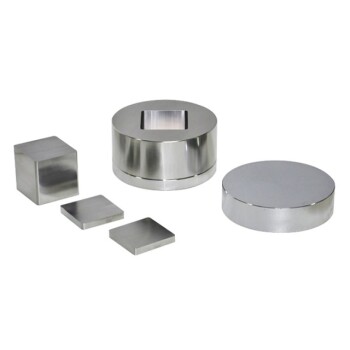
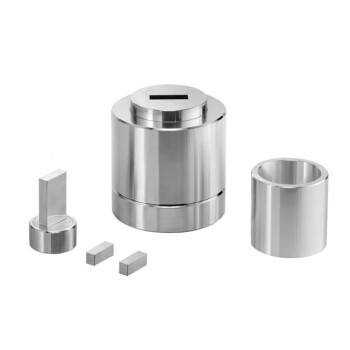
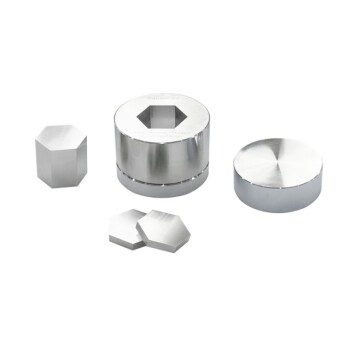
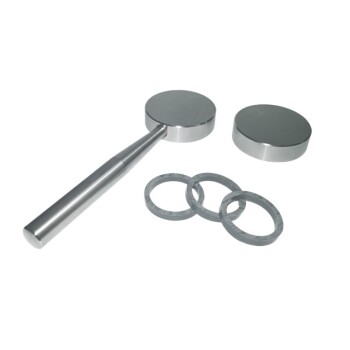
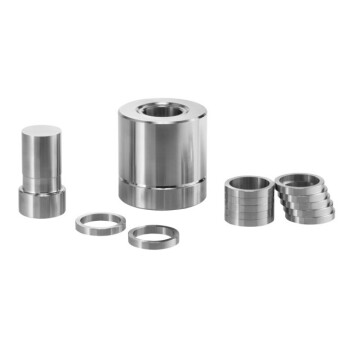
Specialized pressure molds are precision-engineered devices that serve a dual purpose: they consolidate loose battery powders into dense solid disks and maintain critical mechanical pressure during electrochemical operation. Typically constructed from high-strength PEEK sleeves and titanium or steel plungers, these molds prevent physical deformation while applying a continuous restraining force that counteracts the natural expansion and contraction of solid-state battery components.
Core Insight Solid-state batteries "breathe" during operation, expanding and contracting significantly. Without the continuous external stack pressure provided by these specialized molds, the solid layers would physically separate (delaminate), leading to a rapid spike in resistance and immediate battery failure.
The Mechanical Role of the Mold
Consolidating Battery Materials
The first function of the pressure mold occurs before testing begins. The mold acts as a containment vessel used to compress loose powder electrolytes and electrode materials into a single, dense, disk-shaped structure.
Withstanding Hydraulic Forces
To achieve sufficient density, the mold must endure immense force from a hydraulic press. Specialized materials are required to survive this process without warping.
Material Selection for Rigidity
Primary references highlight the use of PEEK (polyether ether ketone) sleeves combined with titanium or steel plungers. These materials are selected specifically for their ability to resist deformation under high loads, ensuring the pressure is applied to the battery, not absorbed by the mold.
Managing Chemo-Mechanical Volume Changes
Counteracting Anisotropic Expansion
During charge and discharge cycles, solid-state batteries undergo significant volume changes. High-nickel cathode materials (such as NCM-811) display "anisotropic" behavior, meaning they expand and contract unevenly in different directions.
The Problem of Lattice Contraction
Specifically, during the delithiation (charging) process, the crystal lattice of the cathode material contracts. Without external pressure, this contraction creates voids between the active particles and the solid electrolyte.
Preventing Interface Failure
The specialized mold applies a constant external stack pressure, generally ranging from 1.5 MPa to over 17 MPa. This continuous clamping force ensures that when the battery material shrinks, the mold "squeezes" it to maintain solid-solid contact.
Critical Parameters and Pitfalls
The Necessity of Constant Pressure
Standard battery casings are often insufficient for solid-state testing because they cannot adapt to volume fluctuations. If the pressure relaxes even slightly, the interface between the electrode and electrolyte will separate.
Mitigating Impedance Rise
The primary failure mode in these tests is not chemical degradation, but physical delamination. The specialized mold prevents the crack propagation and contact loss that lead to irreversible increases in interfacial resistance (impedance).
Avoiding Deformation Errors
A common pitfall in high-pressure testing is the deformation of the test cell itself. If the mold materials (sleeve and plunger) deform under the hydraulic load, the effective pressure on the battery drops, rendering the test data inaccurate.
Making the Right Choice for Your Goal
To ensure accurate data in solid-state battery research, align your equipment usage with your specific testing objectives:
- If your primary focus is Sample Preparation: Prioritize molds with high-strength steel or titanium plungers that can withstand the hydraulic force needed to consolidate loose powders into dense pellets.
- If your primary focus is Cycle Life Testing: Ensure your setup can maintain a constant stack pressure (typically 7–17 MPa) to compensate for the volume contraction of materials like NCM-811 during charging.
- If your primary focus is Minimizing Resistance: Use a pressure-controlled cell to prevent physical detachment at the electrolyte interface, which is the leading cause of impedance spikes.
The success of solid-state battery testing relies not just on the chemistry, but on the mechanical ability of the mold to maintain physical integrity under dynamic pressure.
Summary Table:
| Feature | Role in Solid-State Testing | Impact on Battery Performance |
|---|---|---|
| Powder Consolidation | Compresses loose electrolytes/electrodes into dense disks | Increases ionic conductivity and material density |
| Mechanical Constraint | Counteracts lattice expansion/contraction (NCM-811) | Prevents interface delamination and cracking |
| Material Selection | Uses high-strength PEEK sleeves and titanium plungers | Ensures rigidity and prevents deformation under load |
| Pressure Control | Maintains constant stack pressure (1.5 - 17+ MPa) | Minimizes interfacial resistance and impedance spikes |
Elevate Your Battery Research with KINTEK Precision
Precise mechanical control is the difference between breakthrough data and battery failure. KINTEK specializes in advanced laboratory equipment designed for the rigorous demands of energy storage research. From high-durability pressure molds and hydraulic presses (pellet, hot, isostatic) to specialized electrolytic cells and battery research tools, we provide the hardware necessary to maintain constant stack pressure and material integrity.
Our comprehensive portfolio also includes high-temperature furnaces, autoclaves, and essential consumables like PTFE and ceramic crucibles to support every stage of your material synthesis.
Ready to optimize your solid-state testing? Contact KINTEK today to discover how our high-pressure solutions can enhance your lab's efficiency and data accuracy.
Related Products
- Special Shape Press Mold for Lab
- Button Battery Tablet Press Sealing Mold for Lab Use
- Square Bidirectional Pressure Mold for Lab Use
- Anti-Cracking Press Mold for Lab Use
- Button Battery Disassembly and Sealing Mold for Lab Use
People Also Ask
- How to use a press mold? Master the Art of Creating Consistent Ceramic Forms
- What is the press mould method? A Guide to Consistent, Detailed Ceramic Forms
- Why are pressure molds with non-conductive resin inner walls required for battery testing? Ensure Data Accuracy
- What is the purpose of specialized pressure devices in sulfide solid-state batteries? Ensure Chemo-Mechanical Stability
- What is the function of press molds during the preparation of SiCf/Ti-43Al-9V composites? Achieve Structural Precision