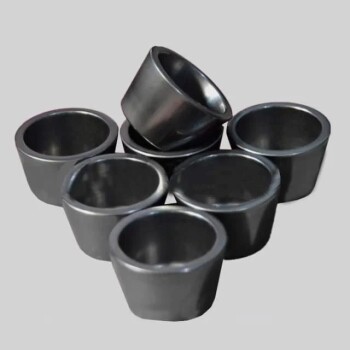
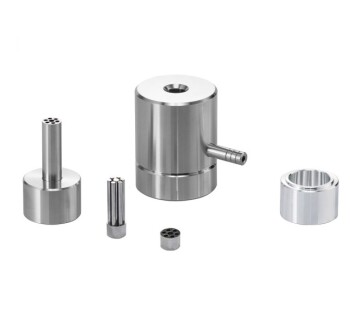
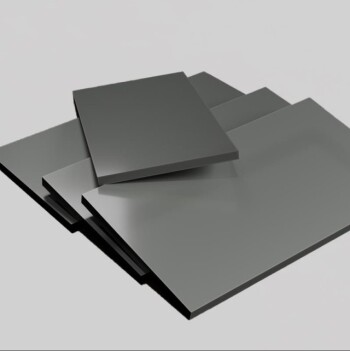
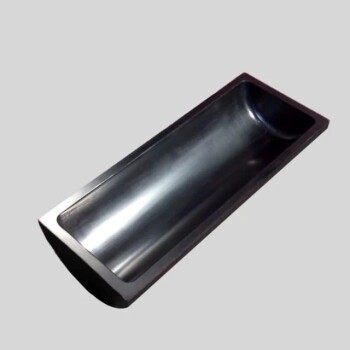
High-strength graphite molds serve as the critical structural interface between the machinery and the material during vacuum hot pressing. They function primarily as robust containers that define the final geometry of the diamond/copper composite while simultaneously acting as a transmission medium to transfer immense mechanical pressure to the powder mixture. Without the mold’s specific ability to maintain rigidity at temperatures exceeding 800°C and pressures of several dozen megapascals (MPa), achieving the necessary material density and dimensional accuracy would be impossible.
The Core Insight The value of high-strength graphite lies in its unique ability to decouple thermal endurance from mechanical failure. Unlike many metals that soften under heat, graphite maintains the structural integrity required to transfer hydraulic force into the powder body, driving the densification process essential for high-performance composites.
The Mechanical Role: Pressure and Shape
Defining the Geometric Profile
At the most fundamental level, the graphite mold acts as a precision container. It holds the loose mixture of diamond and copper powders in place prior to sintering.
Because the powder is initially loose, the mold is the sole determinant of the final sample’s shape and dimensional accuracy.
Transmitting Uniaxial Force
In vacuum hot pressing (VHP), pressure is applied externally, often by a hydraulic cylinder. The mold serves as the transmission vehicle for this force.
It must transfer uniaxial pressures—often ranging from 30 MPa to over 100 MPa—directly to the powder body. Effective transmission is what forces the powder particles together, promoting plastic deformation and mechanical bonding.
Thermal Resilience and Material Density
Withstanding Extreme Environments
The sintering of diamond/copper composites requires high thermal energy, often demanding temperatures above 800°C (and up to 1000°C in some variations).
High-strength graphite is essential because it possesses excellent high-temperature mechanical strength. It resists deformation and creep under conditions where standard metal molds would soften, warp, or fail.
Ensuring High Density
The ultimate goal of the composite is high density and low porosity. This is achieved only if the pressure is maintained consistently throughout the heating cycle.
Because the graphite mold does not yield under the combined stress of heat and pressure, it ensures the force is applied effectively to the powder. This results in a fully densified, non-porous sintered sample.
Chemical and Process Stability
Uniform Heat Transfer
Graphite exhibits excellent thermal conductivity. This property allows the mold to distribute heat evenly across the entire powder mixture.
Uniform heating is vital for preventing internal stress or uneven sintering, which could lead to cracks or weak spots in the diamond/copper composite.
Chemical Inertness and Demolding
High-strength graphite is chemically stable and generally inert regarding the copper matrix, particularly in a vacuum or reducing atmosphere.
This prevents the mold from bonding with the composite material. A lack of chemical reaction preserves the purity of the sample and ensures smooth, easy demolding of the finished billet.
Operational Considerations and Trade-offs
The Risk of Oxidation
While graphite is thermally stable in a vacuum, it oxidizes rapidly if exposed to air at high temperatures.
The trade-off: You must strictly maintain a vacuum or inert gas atmosphere. Any breach in the vacuum system will degrade the mold and potentially contaminate the composite.
Mechanical Wear and Lifecycle
Despite its high strength, graphite is brittle compared to tough metals.
The trade-off: Repeated cycling at high pressures (dozens of MPa) eventually fatigues the mold. They should be treated as precision consumables that require regular inspection for micro-cracks to prevent catastrophic failure under load.
Making the Right Choice for Your Project
When selecting graphite molds for diamond/copper sintering, your specific requirements dictate the grade of graphite needed.
- If your primary focus is Maximum Density: Prioritize graphite grades with the highest compressive strength ratings to withstand pressures exceeding 50 MPa without microscopic deformation.
- If your primary focus is Dimensional Precision: Ensure the graphite has a low coefficient of thermal expansion to minimize size variations during the cooling phase.
- If your primary focus is Process Efficiency: Look for high-density graphite with a polished finish to reduce friction and facilitate rapid demolding without damaging the sample edges.
High-strength graphite is not just a container; it is an active mechanical component that enables the transformation of loose powder into a solid, high-performance composite.
Summary Table:
| Feature | Benefit for Diamond/Copper Composites |
|---|---|
| High Compressive Strength | Transmits 30-100 MPa pressure without deformation, ensuring maximum density. |
| Thermal Resilience | Maintains structural integrity at temperatures >800°C where metals soften. |
| Thermal Conductivity | Provides uniform heat distribution, preventing internal stress and cracking. |
| Chemical Inertness | Prevents bonding with the copper matrix for easy demolding and high purity. |
| Dimensional Stability | Ensures precise geometric profiles and tight tolerances for the final part. |
Elevate Your Material Research with KINTEK
Precision-engineered composites require precision-engineered tools. KINTEK specializes in high-performance laboratory equipment and consumables, providing the high-strength graphite molds and advanced vacuum hot pressing systems necessary for superior diamond/copper sintering.
Our extensive portfolio—from muffle and vacuum furnaces to high-pressure reactors and hydraulic pellet presses—is designed to help researchers and manufacturers achieve exceptional material density and purity. Whether you are developing next-generation heat sinks or advanced battery tools, our experts are ready to support your lab's specific needs.
Ready to optimize your sintering process? Contact us today to discuss your custom requirements!
Related Products
- High Purity Pure Graphite Crucible for Evaporation
- High Purity Pure Graphite Crucible for Electron Beam Evaporation
- Vertical High Temperature Graphite Vacuum Graphitization Furnace
- Horizontal High Temperature Graphite Vacuum Graphitization Furnace
- Special Shape Press Mold for Lab
People Also Ask
- Why are high-purity graphite crucibles preferred for sulfide solid electrolytes? Achieve Superior Material Purity
- Why is a high-purity graphite crucible required for Chromel-TaC composites? Ensure Peak Purity at 1400°C
- What role do high-purity graphite crucibles play in molten salt corrosion research? Ensure Reactor-Grade Precision
- Why are high-purity graphite crucibles used for magnesium distillation? Ensure 3N8 Purity & Thermal Stability
- Why is a high-purity graphite crucible ideal for nitrogen-doped graphene at 1500 °C? Maximize Purity and Stability