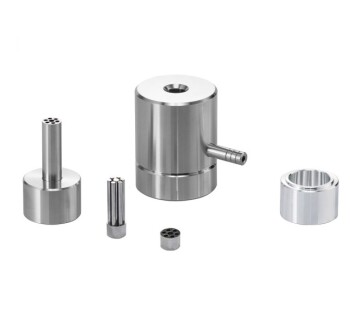
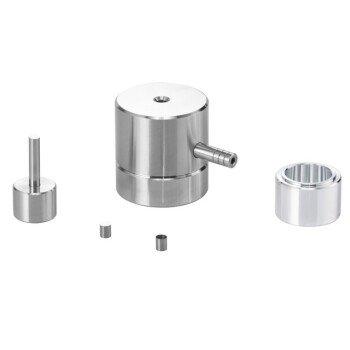
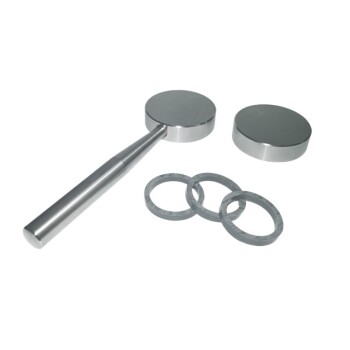
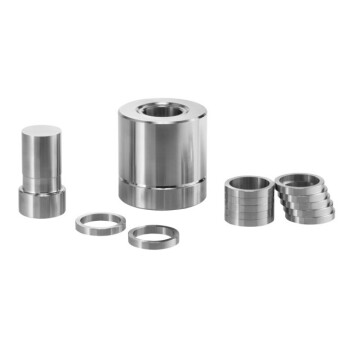
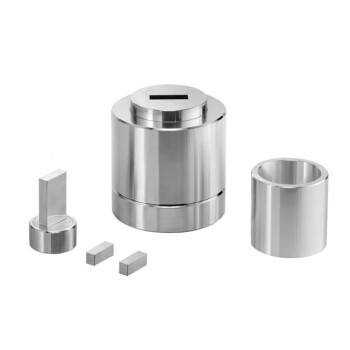
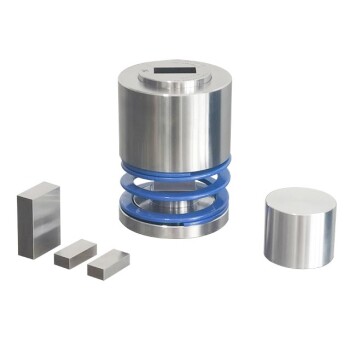
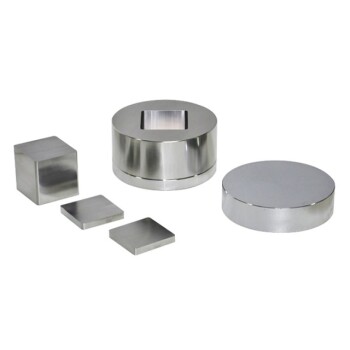
To ensure the successful compaction of Li10GeP2S12 solid-state electrolyte pellets, specialty pressure molds must possess extreme hardness and an exceptional surface finish. Typically manufactured from robust materials like tungsten carbide, these molds are engineered to withstand pressures between 240 MPa and 300 MPa without experiencing plastic deformation.
Core Insight: The performance of a solid-state electrolyte is directly limited by the quality of its compaction. A mold's rigidity and surface smoothness are not merely structural features; they are the primary drivers for minimizing interfacial resistance and maximizing ionic conductivity in the final cell.
Critical Material Characteristics
Extreme Hardness and Rigidity
The mold material must exhibit extreme hardness, such as that found in tungsten carbide. This is non-negotiable because the compaction process requires high pressures—often reaching 300 MPa—to densify the powder.
If the mold material lacks this rigidity, it will deform under load. Deformation during pressing compromises the geometric integrity of the pellet, leading to uneven density distributions and structural failure.
Superior Surface Finish
A high surface finish is required on the interior walls and plungers of the mold. The surface texture of the mold is directly transferred to the pressed pellet.
A smooth, flat pellet surface is essential for establishing tight physical contact with the lithium metal anode or composite cathode. Rough surfaces create gaps that increase interfacial contact resistance, severely degrading battery performance.
The Role of High-Pressure Densification
Eliminating Porosity
The primary function of the mold is to facilitate cold isostatic or uniaxial pressure that eliminates pores between powder particles.
By sustaining high pressures (e.g., 240 MPa), the mold allows loose sulfide electrolyte powders to be compressed into a high-density solid.
Establishing Ion-Conducting Channels
Densification is critical for creating continuous ion-conducting channels within the pellet.
When pores are eliminated, grain boundary resistance is reduced. This directly enhances the ionic conductivity of the Li10GeP2S12 electrolyte, which is the fundamental metric of its efficiency.
Common Pitfalls and Engineering Trade-offs
The Risk of Insufficient Hardness
Using molds made from standard steel or softer alloys often leads to microscopic flexing at high pressures. Even slight deformation can cause the pellet to crack upon ejection or result in non-uniform thickness.
Surface Degradation Over Time
While a high surface finish is required, maintaining it is a challenge. Scratches or pitting on the mold surface will mirror onto the electrolyte pellet, creating voids at the electrode interface.
Regular inspection of the mold's surface is necessary to ensure that contact resistance remains minimized over repeated compaction cycles.
Making the Right Choice for Your Project
To maximize the performance of your Li10GeP2S12 pellets, align your tooling choices with your specific electrochemical goals.
- If your primary focus is maximizing Ionic Conductivity: Prioritize mold rigidity and pressure rating (300 MPa+) to ensure maximum densification and the formation of continuous ion channels.
- If your primary focus is minimizing Interfacial Resistance: Prioritize the surface finish quality of the mold to ensure a perfectly flat interface for optimal contact with the anode and cathode.
Select a tungsten carbide mold with mirror-polished surfaces to ensure your mechanical processing does not become the bottleneck for your chemical performance.
Summary Table:
| Technical Feature | Requirement Specification | Impact on Pellet Quality |
|---|---|---|
| Material | Tungsten Carbide | Prevents plastic deformation under high load |
| Pressure Rating | 240 MPa to 300 MPa | Ensures maximum densification and pore elimination |
| Hardness | Extreme Rigidity | Maintains geometric integrity and density uniformity |
| Surface Finish | Mirror Polished | Minimizes interfacial resistance for better conductivity |
Elevate Your Battery Research with Precision Tooling
Maximize the ionic conductivity of your Li10GeP2S12 electrolytes with KINTEK’s premium compaction solutions. Our specialty tungsten carbide molds and hydraulic pellet presses are engineered to withstand pressures up to 300 MPa while delivering the mirror-polished surface finish required to eliminate interfacial resistance.
From high-performance hydraulic presses (pellet, hot, isostatic) to specialized battery research tools and consumables, KINTEK provides the high-precision equipment necessary for cutting-edge solid-state battery development.
Ready to optimize your pellet density and battery performance? Contact our laboratory specialists today to find the perfect tooling for your research goals.
Related Products
- Special Shape Press Mold for Lab
- Anti-Cracking Press Mold for Lab Use
- Flat Corrosion Electrolytic Electrochemical Cell
- Cylindrical Press Mold for Lab Applications
- XRF & KBR plastic ring lab Powder Pellet Pressing Mold for FTIR
People Also Ask
- How to use a press mold? Master the Art of Creating Consistent Ceramic Forms
- What is the press mould method? A Guide to Consistent, Detailed Ceramic Forms
- Why are pressure molds with non-conductive resin inner walls required for battery testing? Ensure Data Accuracy
- What is the purpose of specialized pressure devices in sulfide solid-state batteries? Ensure Chemo-Mechanical Stability
- What is the function of press molds during the preparation of SiCf/Ti-43Al-9V composites? Achieve Structural Precision