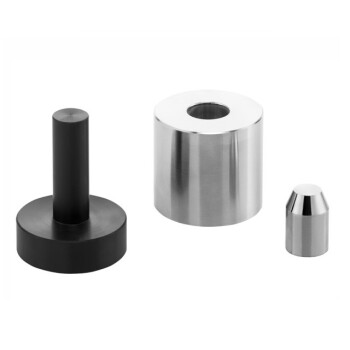
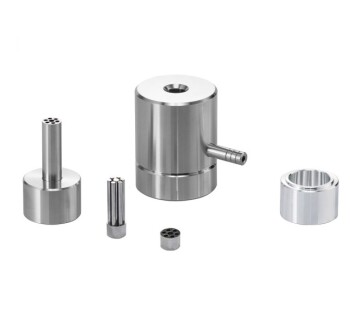
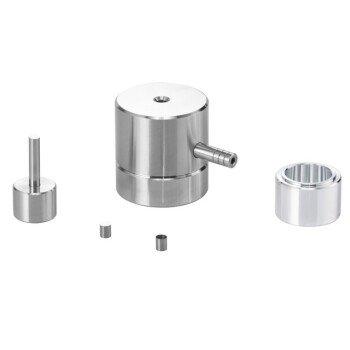
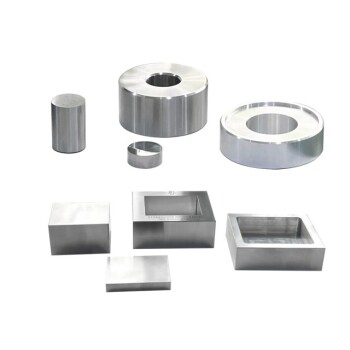
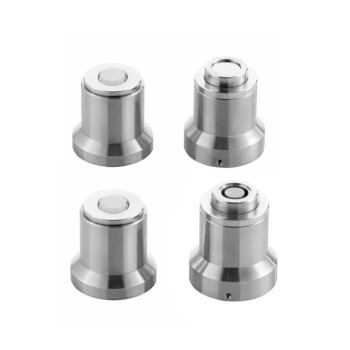
A stainless steel pressure die ensures electrolyte quality by maintaining absolute structural rigidity under immense mechanical load. Designed to withstand forming pressures of several hundred megapascals without deforming, the die functions as a precision mold. By ensuring pressure is distributed completely uniformly across the powder surface, it prevents the structural inconsistencies that typically lead to battery failure.
By resisting deformation at high pressures, the die eliminates mechanical variances that lead to structural defects. This ensures a homogeneous electrolyte layer, which is essential for consistent ionic conductivity and battery reliability.
The Mechanics of Uniform Compression
To create a viable all-solid-state battery, electrolyte powders must be densified into a solid pellet. The pressure die is the critical variable in this process.
Resisting Deformation Under Load
The primary function of the high-strength stainless steel is to remain rigid while subjecting powders to hundreds of megapascals. If the die material yields or warps even slightly, the applied force becomes erratic.
Defining Precise Geometry
The die acts as a physical boundary that dictates the exact dimensions of the solid-state electrolyte and electrode layers. This geometric precision ensures that the resulting pellet fits perfectly within standard battery casings or testing setups.
Preventing Structural Defects
The quality of a solid-state electrolyte is defined by its internal homogeneity. The pressure die directly mitigates the two most common causes of failure during assembly.
Eliminating Density Gradients
When pressure is applied unevenly, powder compresses more in some areas than others. This creates density gradients, where "loose" spots impede ion flow. The stainless steel die forces uniform densification, creating a consistent pathway for ions throughout the entire layer.
Stopping Interlayer Delamination
In multi-layer assemblies (e.g., electrode plus electrolyte), layers must bond physically. Non-uniform pressure causes shear stresses that lead to delamination, or separation of layers. The die’s uniform pressure distribution ensures these interfaces fuse correctly without cracking.
Understanding the Trade-offs
While stainless steel pressure dies are the standard for high-quality assembly, it is important to understand their specific role and limitations in a broader context.
The Role of Blocking Electrodes
In research settings involving Electrochemical Impedance Spectroscopy (EIS), the stainless steel components often serve a dual purpose as blocking electrodes. They physically press the sample but also block ion transport while conducting electrons.
Limitation in Functional Testing
Because stainless steel blocks ions, it cannot mimic the chemistry of a live battery anode (like lithium metal). It is excellent for measuring intrinsic properties like ionic conductivity and activation energy, but it does not simulate the electrochemical reactions of a full cell cycle.
Making the Right Choice for Your Goal
To maximize the utility of your pressure die assembly, consider your specific objective:
- If your primary focus is Assembly Integrity: Prioritize a die rated for pressures significantly higher than your target densification point to prevent even microscopic deformation.
- If your primary focus is Material Characterization: Leverage the stainless steel plungers as blocking electrodes to isolate and accurately measure the electrolyte's intrinsic ionic conductivity.
Successful solid-state battery assembly begins with the mechanical precision of your tooling.
Summary Table:
| Feature | Benefit for Electrolyte Quality |
|---|---|
| Structural Rigidity | Resists deformation under hundreds of MPa, ensuring stable pressure application. |
| Geometric Precision | Dictates exact pellet dimensions for seamless fit in battery casings. |
| Uniform Compression | Eliminates density gradients to provide a consistent pathway for ion flow. |
| High-Strength Material | Prevents interlayer delamination by ensuring layers fuse without cracking. |
| Dual Functionality | Serves as both a precision mold and a blocking electrode for EIS testing. |
Elevate Your Battery Research with KINTEK Precision
Achieving the perfect solid-state electrolyte layer requires more than just pressure—it requires absolute mechanical integrity. KINTEK specializes in high-performance laboratory equipment, providing the stainless steel pressure dies, hydraulic pellet presses, and high-temperature furnaces essential for advanced battery assembly.
Whether you are focusing on ionic conductivity measurements or full-cell densification, our robust tools—including isostatic presses, vacuum furnaces, and specialized battery research consumables—ensure your materials meet the highest standards of homogeneity and reliability.
Ready to eliminate structural defects in your research? Contact our experts today to find the perfect crushing, milling, and pressing solutions tailored to your lab's needs.
Related Products
- Warm Isostatic Press for Solid State Battery Research
- Button Battery Tablet Press Sealing Mold for Lab Use
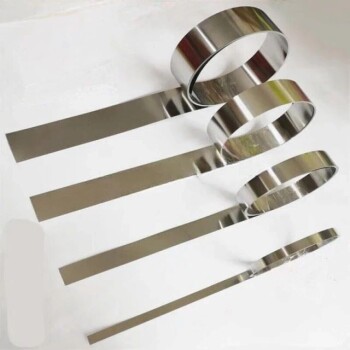
- Battery Lab Equipment 304 Stainless Steel Strip Foil 20um Thick for Battery Test
- Ring Press Mold for Lab Applications
- Special Shape Press Mold for Lab
People Also Ask
- What is the temperature of a warm isostatic press? Achieve Optimal Densification for Your Materials
- What is the function of a Warm Isostatic Press (WIP) in all-solid-state pouch cells? Optimize Battery Density
- Why are Warm Isostatic Presses (WIP) necessary for solid-state batteries? Achieve Atomic-Level Contact
- What advantages does a warm isostatic press offer over a traditional uniaxial press for Li6PS5Cl electrolyte sheets?
- How do warm isostatic presses improve dry electrode performance? Enhance ASSB Conductivity with Heat & Pressure