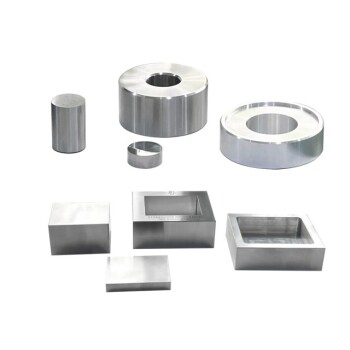
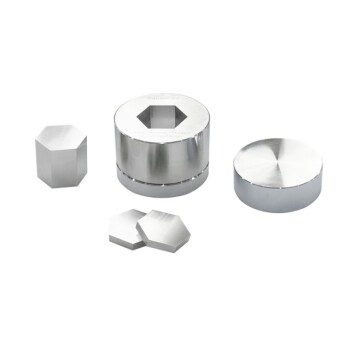
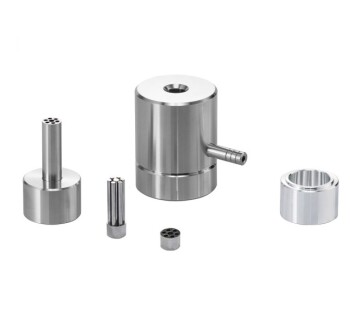
High-Purity Graphite Molds act as the critical process enablers during the hot-press sintering of aluminum matrix composites. They perform three fundamental functions: acting as a robust containment vessel to define the part's geometry, transmitting massive axial pressure to densify the powder, and regulating heat flow to ensure a uniform microstructure.
Core Takeaway Ideally, a mold is more than just a shape-holder; it is an active component in the thermodynamic process. High-Purity Graphite Molds must simultaneously withstand extreme mechanical crushing forces and high thermal loads without deforming, ensuring the final composite is dense, dimensionally accurate, and structurally consistent.
The Role of Containment and Shaping
Defining Geometric Precision
The most immediate function of the mold is to act as a high-temperature carrier. It confines the loose mixed powder or cold-pressed preform within a restricted space.
Because the mold maintains its structural integrity at elevated temperatures, it defines the final geometric dimensions of the composite part.
Resisting Deformation (Creep)
During sintering, materials often soften and deform. High-Purity Graphite is essential because it possesses exceptional dimensional stability.
It resists "creep" (deformation under stress over time) even at temperatures where the aluminum matrix might be near melting. This ensures the part produced matches the intended design specifications.
Load Transmission and Densification
The Pressure Conduit
Hot pressing relies on hydraulic rams to force powder particles together. The graphite mold serves as the primary load-bearing component that transfers this force.
It transmits high axial pressure—often ranging from 35 MPa to over 200 MPa—directly from the press head to the powder sample.
Withstanding Uniaxial Stress
To function correctly, the mold must possess high mechanical strength. It must endure these immense pressures without fracturing or buckling.
If the mold fails to support this load, the pressure will not be transferred effectively to the powder, leading to low density and porosity in the final composite.
Thermal Regulation and Material Quality
Ensuring Uniform Heating
One of the most critical roles of the mold is facilitating uniform heat distribution. High-Purity Graphite has excellent thermal conductivity.
This property ensures that heat travels quickly from the furnace elements through the mold and into the center of the powder sample.
Preventing Microstructural Defects
Without this conductivity, the outer edges of the sample would heat faster than the center. Uneven heating leads to inconsistent sintering, warping, and varying material properties across the part.
The graphite mold eliminates these thermal gradients, ensuring the entire specimen achieves a consistent microstructure.
Chemical Stability and Oxidation Protection
The chemical nature of high-purity graphite offers distinct advantages in vacuum environments. It creates a local reducing atmosphere.
This helps protect the aluminum metal powders from oxidation by residual oxygen. Furthermore, because graphite is chemically stable and does not react aggressively with the aluminum matrix, it ensures a high-quality surface finish and facilitates easier demolding after the process.
Understanding the Trade-offs
While High-Purity Graphite is the standard for this application, it is not without limitations that must be managed.
Mechanical Brittleness
Despite its high compressive strength, graphite is brittle. It acts as a ceramic rather than a metal. While it can handle immense squeezing (compression), it is susceptible to damage from impact or tensile forces during handling or improper loading.
Oxidation and Wear
Although it protects the sample, graphite itself can oxidize if exposed to air at high temperatures. In vacuum or inert gas environments, this is minimized, but the molds act as a consumable item that will eventually degrade or lose dimensional tolerance after repeated cycles.
Making the Right Choice for Your Project
The specific grade of graphite you choose should depend on the most critical parameter of your composite material.
- If your primary focus is Geometric Precision: Prioritize graphite grades with the highest compressive strength and density to resist even microscopic creep deformation under load.
- If your primary focus is Microstructure Consistency: Prioritize graphite grades with superior thermal conductivity ratings to ensure perfectly even heating rates throughout the sample volume.
Ultimately, the success of your hot-press sintering relies on the graphite mold functioning not just as a container, but as a precise thermal and mechanical transmission tool.
Summary Table:
| Function | Description | Key Benefit |
|---|---|---|
| Geometric Containment | Confines powder and resists creep at high temperatures. | Ensures dimensional accuracy and structural integrity. |
| Pressure Transmission | Transfers axial loads (35-200 MPa) to the powder. | Achieves maximum densification and eliminates porosity. |
| Thermal Regulation | Distributes heat uniformly via high thermal conductivity. | Prevents warping and ensures consistent microstructure. |
| Chemical Stability | Provides a local reducing atmosphere in vacuum. | Protects against oxidation and ensures smooth demolding. |
Optimize Your Advanced Material Fabrication with KINTEK
High-performance sintering requires precision-engineered tools that withstand extreme mechanical and thermal loads. KINTEK specializes in premium laboratory equipment and high-purity consumables designed for rigorous research and production environments.
Whether you are working with aluminum matrix composites or exploring advanced material synthesis, our portfolio offers everything from high-strength graphite molds and hydraulic presses to high-temperature vacuum, tube, and atmosphere furnaces. We also provide essential high-pressure reactors, ceramics, and crucibles to ensure your process is seamless and repeatable.
Ready to elevate your lab's capabilities? Contact KINTEK today for expert solutions and high-quality consumables!
Related Products
- High Purity Pure Graphite Crucible for Evaporation
- Special Heat Press Mold for Lab Use
- High Purity Pure Graphite Crucible for Electron Beam Evaporation
- Polygon Press Mold for Lab
- Anti-Cracking Press Mold for Lab Use
People Also Ask
- Why are high-purity graphite crucibles preferred for sulfide solid electrolytes? Achieve Superior Material Purity
- Why is a high-purity graphite crucible required for Chromel-TaC composites? Ensure Peak Purity at 1400°C
- What role do high-purity graphite crucibles play in molten salt corrosion research? Ensure Reactor-Grade Precision
- Why are high-purity graphite crucibles used for magnesium distillation? Ensure 3N8 Purity & Thermal Stability
- Why is a high-purity graphite crucible ideal for nitrogen-doped graphene at 1500 °C? Maximize Purity and Stability