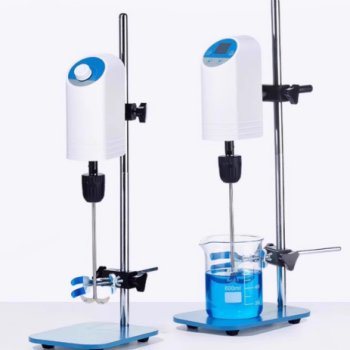
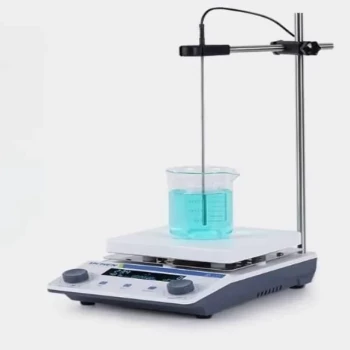
Stirred laboratory reactors provide a distinct advantage by using mechanical agitation to significantly enhance the mass transfer between gas and liquid phases. Unlike non-stirred systems, this agitation ensures uniform mixing and maximizes the contact area necessary for accurate kinetic measurements, particularly when evaluating the performance of solvents and additives.
By eliminating concentration gradients and optimizing gas-liquid contact, stirred reactors allow researchers to isolate the true reaction rates of solvents and additives, mirroring the dynamic conditions of industrial carbon capture more accurately than static methods.
The Mechanics of Enhanced Kinetic Study
Overcoming Mass Transfer Limitations
In Carbon Dioxide (CO2) capture, the speed at which gas moves into the liquid solvent is a critical variable. Stirred reactors utilize mechanical agitation, often operating at speeds such as 300 rpm, to physically drive this interaction.
This movement increases the effective contact area between the CO2 and the amine solution. By actively forcing the gas and liquid to mix, the system overcomes the physical barriers that limit reaction speeds in non-stirred setups.
Eliminating Concentration Gradients
A major flaw in non-stirred systems is the formation of local "hotspots" or dead zones where concentrations vary. As CO2 is absorbed at the surface, the liquid there becomes saturated while the bulk liquid remains unreacted.
Stirred reactors solve this by continuously homogenizing the solution. This ensures that concentration gradients are eliminated, maintaining a consistent chemical environment throughout the reactor vessel during the absorption process.
Maximizing Additive Efficiency
Advanced solvents often employ kinetic additives, such as piperazine, to act as catalysts and accelerate CO2 uptake. For these additives to function, they must be evenly distributed.
Mechanical agitation ensures these additives are thoroughly mixed with the amine solution. This allows the additives to exert their full catalytic effects, providing data that reflects the true potential of the chemical formulation.
The Pitfall of Static Assessments
The Disconnect from Industrial Reality
The primary "trade-off" in this context isn't a downside of stirring, but rather the critical risk of relying on non-stirred systems. Static or non-stirred laboratory setups fail to replicate the dynamic nature of industrial absorbers.
Data collected without agitation essentially measures diffusion limits rather than true chemical kinetics. Consequently, non-stirred systems cannot provide the accurate assessment of solvent reaction rates required to scale a solution up to an industrial environment.
Ensuring Data Integrity in Kinetic Studies
To achieve reliable results in carbon capture research, the reactor setup must mimic the hydrodynamic principles of the target application.
- If your primary focus is Accurate Reaction Rates: You must use stirred reactors to ensure that mass transfer limitations do not mask the actual speed of the chemical reaction.
- If your primary focus is Additive Evaluation: Ensure mechanical agitation is sufficient to fully disperse catalysts like piperazine, allowing them to perform as they would in a processing plant.
Ultimately, mechanical agitation is not merely an enhancement; it is a fundamental requirement for generating kinetically relevant data in carbon capture research.
Summary Table:
| Feature | Non-Stirred Systems | Stirred Laboratory Reactors |
|---|---|---|
| Mass Transfer | Limited by passive diffusion | Significantly enhanced by mechanical agitation |
| Mixing Consistency | Poor; presence of concentration gradients | Uniform; eliminates local hotspots/dead zones |
| Kinetic Accuracy | Measures diffusion limits, not chemistry | Isolates true reaction rates of solvents |
| Additive Efficiency | Inconsistent dispersion of catalysts | Thorough mixing (e.g., piperazine) for full effect |
| Industrial Relevance | Low; fails to mimic dynamic conditions | High; mirrors industrial absorber hydrodynamics |
Elevate Your Carbon Capture Research with KINTEK
Precise kinetic data is the cornerstone of industrial scalability. KINTEK specializes in advanced laboratory equipment designed to meet the rigorous demands of chemical research. Our range of high-temperature high-pressure reactors and autoclaves is engineered to provide the mechanical agitation and thermal stability required for accurate CO2 capture studies.
Whether you are evaluating amine solvents or testing catalytic additives, KINTEK offers a comprehensive portfolio including:
- Stirred Autoclaves & Reactors for uniform mixing and kinetic integrity.
- High-Temperature Furnaces for thermal degradation testing.
- Crushing & Milling Systems for material preparation.
- Precision Cooling Solutions for process control.
Maximize your lab's potential and ensure your data reflects industrial reality. Contact us today to consult with our experts on the ideal reactor configuration for your specific research needs.
References
- Verónica Calva, Marvin Ricaurte. CO2 Capture Using Amine-Based Solvents: Identification of Additives to Improve the Kinetics and Thermodynamics of CO2 Sorption at High-Pressure Conditions. DOI: 10.3390/gases5010004
This article is also based on technical information from Kintek Solution Knowledge Base .
Related Products
- High Performance Laboratory Stirrers for Diverse Applications
- Laboratory Small Constant Temperature Heated Magnetic Stirrer Heater and Stirrer
- Customizable Laboratory High Temperature High Pressure Reactors for Diverse Scientific Applications
- Stainless High Pressure Autoclave Reactor Laboratory Pressure Reactor
- High Pressure Laboratory Autoclave Reactor for Hydrothermal Synthesis
People Also Ask
- How does a laboratory stirrer influence MOF product quality? Master Precision in Non-Solvothermal Synthesis
- What critical role does a Laboratory Stirrer play during leaching? Enhance Titanium-Magnesium Waste Recovery
- What is the primary function of laboratory stirring equipment in the preparation of compost leachate? Optimize Extraction
- What is a laboratory mixer? A Guide to Achieving Perfect Sample Homogeneity
- What is a laboratory mixer used for? Choose the Right Tool for Liquids or Solids