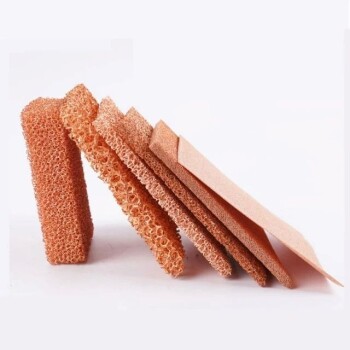
Three-dimensional metal foam cathodes significantly enhance electrowinning efficiency by fundamentally altering the available surface area for reaction. Unlike standard planar cathodes, these components utilize a highly interconnected porous structure to provide an effective electrochemical active area that is 7 to 14 times larger within the same physical dimensions. This geometric expansion directly lowers electrical resistance and accelerates the metal deposition process.
Core Insight: By transitioning from flat plates to a 3D porous network, operators can triple mass transfer and deposition rates. This geometry allows for the optimization of production capacity using existing equipment, primarily by significantly reducing charge transfer resistance at the electrode surface.
The Geometric Advantage
The Power of Porosity
The defining feature of metal foam cathodes, such as copper foam, is their highly interconnected porous structure. This architecture departs from the 2D limitations of flat metal sheets, extending the electrode into three dimensions.
Massive Increase in Active Area
This 3D structure creates a dramatic increase in the "effective electrochemical active area." Compared to a planar electrode of the identical size and footprint, the metal foam offers a surface area that is 7 to 14 times larger.
Electrochemical Performance Gains
Reducing Resistance
The expanded surface area does more than just provide space; it alters the electrical characteristics of the cell. The 3D structure significantly reduces the charge transfer resistance at the electrode surface, a key bottleneck in traditional electrowinning.
Tripling Deposition Rates
Lower resistance and higher surface area combine to drive kinetic performance. The mass transfer of metal ions and their subsequent deposition rates increase by approximately three times compared to planar counterparts.
Understanding the Trade-offs: Planar vs. 3D
The Limitations of Planar Cathodes
Traditional planar cathodes are limited by their geometry. To increase production capacity with planar technology, one generally must increase the physical size of the equipment or the facility footprint, as the active area is restricted to the 2D face of the plate.
The Intensity of 3D Cathodes
Metal foam cathodes solve the space constraint by intensifying the process internally. They are designed to optimize the production capacity of electrowinning equipment, effectively allowing a facility to produce more metal without expanding its physical footprint.
Making the Right Choice for Your Goal
To determine if 3D metal foam cathodes are the correct upgrade for your electrowinning process, consider your primary operational constraints.
- If your primary focus is Production Speed: Implement metal foam cathodes to leverage the ~3x increase in mass transfer and deposition rates.
- If your primary focus is Facility Footprint: Use metal foam to maximize the active area (7-14x) within your current tank dimensions, avoiding the need for facility expansion.
Switching to three-dimensional foam geometries offers a direct pathway to higher capacity through superior surface physics.
Summary Table:
| Feature | Planar Cathodes | 3D Metal Foam Cathodes |
|---|---|---|
| Effective Active Area | 1x (Limited to 2D Surface) | 7x to 14x Larger |
| Deposition Rate | Standard | ~3x Faster |
| Charge Transfer Resistance | Higher | Significantly Lower |
| Mass Transfer Efficiency | Lower | Triple the Performance |
| Space Utilization | Low (Requires larger footprint) | High (Process Intensification) |
Elevate Your Electrochemical Performance with KINTEK
Maximize your production capacity and reduce energy overhead with KINTEK’s advanced electrolytic cells and electrodes. Our high-performance 3D metal foam cathodes are designed to eliminate the bottlenecks of traditional planar technology, offering unparalleled surface area for faster, more efficient electrowinning.
As experts in laboratory and industrial solutions, KINTEK provides a comprehensive range of equipment, including:
- Electrochemical Tools: High-performance electrolytic cells, electrodes, and battery research consumables.
- Thermal Processing: Muffle, tube, vacuum, and CVD furnaces.
- High-Pressure Systems: High-temperature high-pressure reactors and autoclaves.
- Material Preparation: Crushing, milling, and hydraulic pellet presses.
Ready to upgrade your lab's efficiency and achieve superior deposition rates? Contact our technical team today to find the precision-engineered components your project demands.
References
- H. Cesiulis, Н. Цынцару. Eco-Friendly Electrowinning for Metals Recovery from Waste Electrical and Electronic Equipment (WEEE). DOI: 10.3390/coatings13030574
This article is also based on technical information from Kintek Solution Knowledge Base .
Related Products
- Copper Foam
- Copper Nickel Foam Metal Sheet
- Nickel Foam for Industrial and Laboratory Applications
- Folding Molybdenum Tantalum Boat With or Without Cover
People Also Ask
- What is copper foam used for? A Guide to Its High-Performance Thermal and Energy Applications
- How do you make copper foam? A Step-by-Step Guide to Creating Porous Metal Structures
- What are the available sizes and thicknesses for copper foam? Optimize Your Thermal and Filtration Performance
- What are the characteristics of copper foam? Unlock High-Performance Thermal and Electrical Solutions
- Is copper foam safe? Discover the facts about its antimicrobial and cooling benefits