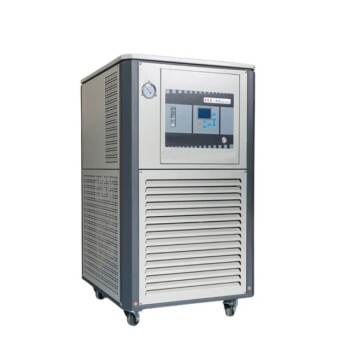
A laboratory constant temperature drying oven serves as a critical processing tool for Covalent Organic Frameworks (COFs) by facilitating both material activation and chemical synthesis. Primarily, it employs controlled thermal convection to rigorously remove residual high-boiling solvents, such as dimethylformamide (DMF) or tetrahydrofuran (THF), from the purified product. This step converts the raw, wet material into a usable dry powder while ensuring the internal pore structure is open and accessible.
The drying oven is not merely a tool for moisture removal; it is a thermodynamic driver that ensures high crystallinity during synthesis and fully activates the material's specific surface area by unblocking micropores during purification.
Activating the Microstructure Post-Synthesis
The primary value of the constant temperature oven lies in its ability to transform a purified, solvent-laden COF into a functional material.
Removing Stubborn Solvents
Raw COF products undergo rigorous washing with heavy solvents to remove impurities.
However, solvents like DMF and THF have high boiling points and cling tenaciously to the material.
The drying oven provides the sustained thermal energy required to overcome this affinity and drive the solvent molecules out of the solid matrix.
Unlocking Specific Surface Area
The removal of solvent is not just about drying; it is an activation process.
When solvent molecules occupy the internal pores of the COF, they block the active sites necessary for applications like photocatalysis.
By thoroughly evacuating these molecules, the oven exposes the internal microporous structure, maximizing the material's specific surface area.
Facilitating the Synthesis Reaction
While the primary reference highlights post-purification activation, the oven also plays a vital role in the initial creation of the raw COF material.
Driving Schiff Base Condensation
Creating a COF requires a precise chemical reaction between donor and acceptor linkers.
The oven maintains a stable, high-temperature environment (often around 120°C) for extended periods, such as three days.
This provides the necessary thermodynamic conditions to drive the Schiff base condensation reaction to completion.
Ensuring High Crystallinity
Stability is paramount during the formation of the framework.
Fluctuations in temperature can lead to amorphous (disordered) structures rather than the desired crystalline lattice.
The constant temperature ensures the formation of high-crystallinity porous frameworks, which are essential for the material's structural integrity.
Understanding Operational Trade-offs
While standard constant temperature drying ovens are effective, they are not universally superior for all COF processing stages.
Thermal Convection vs. Vacuum Drying
A standard oven relies on thermal convection, which requires higher temperatures to remove solvents at atmospheric pressure.
If the COF is sensitive to oxidation or heat, a vacuum drying oven may be preferable as it lowers the boiling point of solvents.
Operators must balance the need for thorough solvent removal against the risk of thermally degrading the framework.
The Risk of Pore Blockage
Incomplete drying is a common pitfall in COF processing.
If the oven temperature is too low or the duration too short, solvent remains trapped deep within the pores.
This results in a "dead" material with artificially low surface area measurements, rendering it ineffective for gas adsorption or catalysis.
Making the Right Choice for Your Goal
Select your drying parameters based on the specific stage of COF production you are currently managing.
- If your primary focus is Synthesis: Prioritize temperature stability and duration (e.g., 120°C for 72 hours) to ensure the thermodynamic conditions necessary for high crystallinity.
- If your primary focus is Activation: Prioritize sufficient heat to exceed the boiling point of your wash solvent (e.g., DMF) to fully evacuate micropores and maximize surface area.
Success in COF processing relies on treating the drying oven as a precision instrument for structural engineering, rather than a simple dehydrator.
Summary Table:
| Feature | Role in COF Processing | Key Benefit |
|---|---|---|
| Thermodynamic Drive | Facilitates Schiff base condensation | High crystallinity and structural integrity |
| Thermal Convection | Removes high-boiling solvents (DMF/THF) | Converts wet material into usable dry powder |
| Pore Activation | Evacuates trapped molecules from micropores | Maximizes specific surface area for catalysis |
| Precise Stability | Maintains constant heat (e.g., 120°C) | Prevents disordered amorphous structures |
Elevate Your Material Research with KINTEK Precision
Precise thermal processing is the difference between a disordered structure and a high-performance framework. KINTEK specializes in advanced laboratory equipment designed for the rigorous demands of material science. Whether you are synthesizing Covalent Organic Frameworks or activating porous materials, our comprehensive range of laboratory drying ovens, vacuum systems, and high-temperature furnaces ensures the thermal stability your research requires.
From crushing and milling systems for precursor preparation to high-pressure reactors and PTFE consumables for synthesis, KINTEK provides the end-to-end solutions researchers trust.
Ready to optimize your COF crystallinity and surface area?
Contact KINTEK today for expert equipment solutions
References
- Shu Yang, Duozhi Wang. Nitrogen-Rich Triazine-Based Covalent Organic Frameworks as Efficient Visible Light Photocatalysts for Hydrogen Peroxide Production. DOI: 10.3390/nano14070643
This article is also based on technical information from Kintek Solution Knowledge Base .
Related Products
- 23L Laboratory Vacuum Drying Oven
- Laboratory Scientific Electric Heating Blast Drying Oven
- 56L Vertical Laboratory Vacuum Drying Oven
- High Temperature Muffle Oven Furnace for Laboratory Debinding and Pre Sintering
- 10L Chilling Circulator Cooling Water Bath Low Temperature Constant Temperature Reaction Bath
People Also Ask
- Why is a laboratory vacuum drying oven recommended for rice straw residues? Protect Your Biomass Integrity
- What role does a laboratory vacuum drying oven play in the preparation of modified multi-walled carbon nanotubes?
- What is the importance of using a laboratory vacuum drying oven? Preserving Slow-Release Microcapsule Integrity
- Why is a Laboratory Vacuum Drying Oven recommended for PBAT microspheres? Protect Sensitive Polymer Integrity
- What role does a laboratory vacuum drying oven play in processing nanoparticle powder samples? Protect Sample Integrity