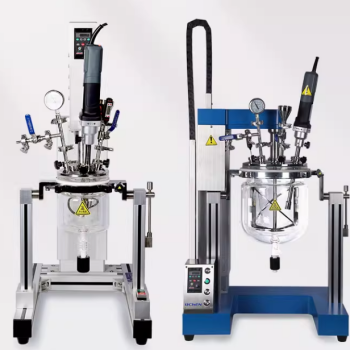
A probe-type ultrasonic homogenizer drives the exfoliation of graphitic carbon nitride (C3N4) by generating high-frequency mechanical vibrations within a liquid medium, typically deionized water. These vibrations induce acoustic cavitation—the formation and collapse of microscopic bubbles—which releases intense local shear forces capable of stripping layers from the bulk material.
By harnessing the physical power of cavitation bubbles, the homogenizer generates shock waves strong enough to overcome the Van der Waals forces binding C3N4 layers together. This transforms the bulk powder into thin nanosheets with a massive increase in specific surface area, directly enhancing their reactivity for applications like photocatalysis.
The Mechanics of Exfoliation
generating Acoustic Cavitation
The core mechanism begins when the ultrasonic probe transmits high-energy sound waves into the deionized water mixture.
These waves create alternating high-pressure and low-pressure cycles. During the low-pressure cycle, vacuum bubbles form; during the high-pressure cycle, they collapse violently.
Creating Shear Forces and Shock Waves
The collapse of these cavitation bubbles is not a gentle process. It generates instantaneous high-pressure shock waves and significant turbulence in the liquid.
These resulting shear forces act directly on the suspended bulk C3N4 particles.
Overcoming Van der Waals Forces
Bulk graphitic carbon nitride is composed of stacked layers held together by weak molecular interactions known as Van der Waals forces.
To exfoliate the material, the external energy applied must exceed the energy holding these layers together. The shear forces generated by the ultrasonic probe provide the necessary physical energy to break these bonds, effectively peeling the layers apart.
Material Transformation and Benefits
From Bulk to Nanosheets
The primary result of this process is the reduction of "bulk" C3N4—which has a low surface-to-volume ratio—into ultra-thin, two-dimensional nanosheets.
This physical separation preserves the fundamental chemical structure of the layers while drastically changing their physical dimensions.
Maximizing Specific Surface Area
As the layers are separated, the total exposed surface area of the material increases exponentially.
This is the most critical advantage of the probe-type homogenizer method. By thinning the material, you expose surface area that was previously hidden inside the bulk stack.
Enhancing Photocatalytic Activity
For C3N4, performance is often dictated by the number of available active sites where reactions can occur.
The increased specific surface area provided by the nanosheets translates directly to a higher density of active sites. This makes the exfoliated material significantly more efficient for photocatalytic reactions compared to its bulk counterpart.
Understanding the Trade-offs
Mechanical Force vs. Sheet Size
While high-power ultrasonication is effective, it is an aggressive physical process.
If the intensity is too high or applied for too long, the shear forces may fracture the nanosheets laterally, reducing their size rather than just thinning them. This can potentially alter the material's electronic properties.
Heat Generation
The cavitation process generates significant local heat.
In a closed system, this can raise the temperature of the deionized water bath. While C3N4 is thermally stable, uncontrolled heating can affect dispersion stability or solvent properties, often requiring external cooling baths during the process.
Optimizing the Process for Your Application
To get the most out of your ultrasonic exfoliation, align your processing parameters with your specific end-goal:
- If your primary focus is maximum photocatalytic efficiency: Prioritize longer exfoliation times to maximize specific surface area and active site density, ensuring the bulk material is fully processed into nanosheets.
- If your primary focus is preserving 2D structural integrity: Use intermittent sonication bursts (pulsed mode) to manage heat and prevent excessive fragmentation of the nanosheets.
Success in this process relies on balancing the raw power of cavitation with the need to preserve the delicate structure of the resulting nanomaterial.
Summary Table:
| Feature | Description | Benefit for C3N4 Exfoliation |
|---|---|---|
| Mechanism | Acoustic Cavitation | Breaks Van der Waals forces to peel apart bulk layers. |
| Force Type | High-Intensity Shear Forces | Efficiently thins material into 2D nanosheets. |
| Resulting Form | Ultra-thin Nanosheets | Maximizes specific surface area and reactivity. |
| Key Outcome | Increased Active Sites | Drastically improves photocatalytic efficiency. |
| Process Control | Pulsed Mode / Cooling | Preserves structural integrity and prevents overheating. |
Maximize Your Nanomaterial Potential with KINTEK
Ready to transform bulk materials into high-performance nanosheets? KINTEK specializes in advanced laboratory equipment, including high-power ultrasonic homogenizers, cooling solutions, and crushing systems designed for precision material processing. Whether you are optimizing photocatalytic reactions or developing next-gen battery tools, our team provides the high-performance technology you need to achieve superior results.
Take your research to the next level—Contact KINTEK today to find the perfect homogenization solution for your lab!
References
- Shaohui Guo, Bingqing Wei. Boosting photocatalytic hydrogen production from water by photothermally induced biphase systems. DOI: 10.1038/s41467-021-21526-4
This article is also based on technical information from Kintek Solution Knowledge Base .
Related Products
- High Shear Homogenizer for Pharmaceutical and Cosmetic Applications
- High Performance Lab Homogenizer for Pharma Cosmetics and Food R&D
- Lab Sterile Slapping Type Homogenizer for Tissue Mashing and Dispersing
- Laboratory Disc Rotary Mixer for Efficient Sample Mixing and Homogenization
- Laboratory High Throughput Tissue Grinding Mill Grinder
People Also Ask
- Why Use a High Shear Homogenizer for Cathode Slurries? Optimize Double-Layer Solid-State Battery Production
- What is the function of high-shear dispersion equipment in corona-resistant nanocomposites? Elevate Your Insulation
- What is the necessity of using an industrial-grade high-shear homogenizer for biomass washing? Ensure Process Efficiency
- What are the advantages of using a high-shear homogenizer for BED/GMA coatings? Achieve Superior Nano-Dispersion
- What role does a high-shear homogenizer play in ODC catalyst suspensions? Unlock Superior Electrochemical Efficiency