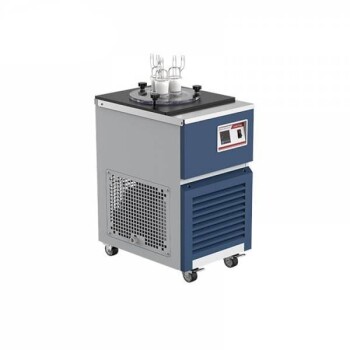
The primary reason for preferring a freeze dryer over conventional thermal drying is the preservation of structural integrity. Thermal drying causes severe stacking and agglomeration of reduced graphene oxide (Hh-RGO) nanosheets, whereas freeze drying (lyophilization) utilizes sublimation to remove moisture. This maintains a loose, porous structure and high surface area, ensuring the powder can be effectively re-dispersed in matrices like epoxy resins.
Core Takeaway By removing moisture through sublimation rather than evaporation, freeze drying bypasses the liquid-phase forces that cause nanomaterials to collapse and stick together. This process guarantees a fluffy, high-activity powder essential for high-performance composite applications.
The Mechanism of Preservation
Sublimation vs. Evaporation
Conventional thermal drying relies on evaporation, where liquid water turns to gas at high temperatures. In contrast, a freeze dryer operates by sublimating moisture directly from a frozen state to a gas under vacuum conditions.
Eliminating Capillary Forces
The critical advantage of sublimation is that it avoids the liquid phase entirely during the drying process. In thermal drying, the surface tension of evaporating liquid creates strong capillary forces.
These forces pull adjacent nanosheets together, leading to irreversible aggregation. Freeze drying eliminates this tension, preserving the original spacing between particles.
Structural Consequences for Hh-RGO
Preventing "Hard" Agglomeration
When Hh-RGO is dried thermally, the nanosheets undergo severe stacking. This results in hard agglomeration, where the layers bond tightly and become difficult to separate.
Freeze drying produces a loose, fragile powder structure. Because the sheets do not collapse onto one another, the material retains its discrete, nanosized characteristics.
Maintaining Surface Area and Porosity
Thermal drying can lead to a phenomenon similar to "hornification," where microporous structures collapse and surfaces harden. This drastically reduces the available surface area.
Freeze drying maximizes the preservation of the high specific surface area and porous structure. This is vital for maintaining the material's reactive activity.
The Pitfalls of Conventional Thermal Drying
Irreversible Structural Collapse
It is critical to understand that the damage caused by thermal drying is often irreversible. Once the nanosheets have restacked due to surface tension, they cannot be easily separated again.
Loss of Functional Performance
Aggregated powders suffer from surface functional group inactivation. The collapse of the pore structure blocks access to active sites, rendering the material less effective for chemical interactions or binding.
The Impact on End-Use Applications
Re-dispersibility in Epoxy Resins
The ultimate test of Hh-RGO powder is how well it mixes with other materials. The loose structure created by freeze drying ensures excellent re-dispersibility.
Ensuring Uniform Composites
If the powder is agglomerated (from heat drying), it will create defects or weak points in an epoxy composite. Freeze-dried Hh-RGO disperses uniformly, allowing for proper bonding and mechanical reinforcement.
Making the Right Choice for Your Goal
To ensure optimal performance of your reduced graphene oxide, align your drying method with your specific material requirements:
- If your primary focus is Re-dispersibility: Utilize freeze drying to prevent sheet stacking, ensuring the powder mixes uniformly into solvents or resins.
- If your primary focus is Surface Activity: Choose freeze drying to maintain a porous structure and prevent the inactivation of surface functional groups.
Freeze drying is not just a drying method; it is a structural preservation technique essential for high-performance nanomaterials.
Summary Table:
| Feature | Freeze Drying (Lyophilization) | Conventional Thermal Drying |
|---|---|---|
| Mechanism | Sublimation (Solid to Gas) | Evaporation (Liquid to Gas) |
| Capillary Forces | Eliminated; prevents sheet collapse | Strong; causes severe stacking |
| Material Structure | Loose, porous, and fluffy | Hard agglomerates; dense |
| Surface Area | High (Maximum preservation) | Low (Structural collapse) |
| Re-dispersibility | Excellent in resins/solvents | Poor; difficult to separate |
| Surface Activity | Fully maintained | Inactivated due to hornification |
Elevate Your Nanomaterial Research with KINTEK
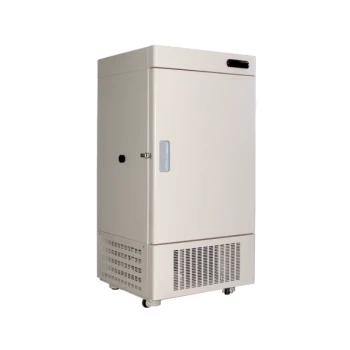
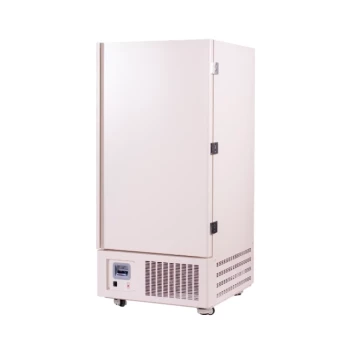
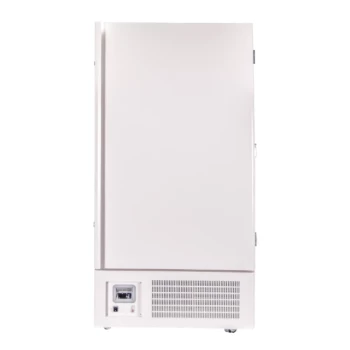
Don’t let conventional drying compromise your material's potential. KINTEK specializes in advanced laboratory solutions, offering high-performance freeze dryers and cooling solutions (ULT freezers, cold traps) designed to preserve the structural integrity of sensitive powders like Hh-RGO.
Whether you need precision high-temperature furnaces, crushing and milling systems, or hydraulic presses for material characterization, our comprehensive portfolio ensures your lab achieves superior results. From R&D to scale-up, our experts provide the tools and consumables—including PTFE products and ceramics—necessary for high-performance composite applications.
Ready to optimize your drying process? Contact KINTEK today for expert guidance and tailored equipment solutions!
References
- Hongxia Wang, Zhiwei Xu. Resistance of Graphene/Epoxy Resin—Based Composite Materials to γ Radiation Damage and Their Mechanical Properties. DOI: 10.3390/coatings13091536
This article is also based on technical information from Kintek Solution Knowledge Base .
Related Products
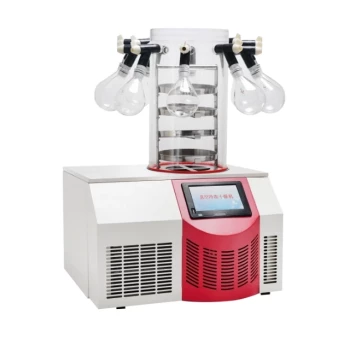
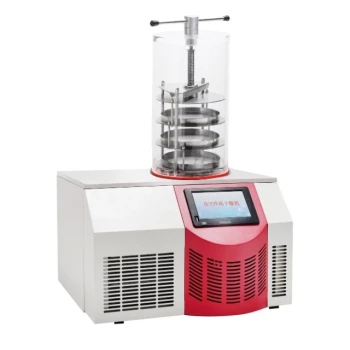
- High Performance Laboratory Freeze Dryer
- High Performance Laboratory Freeze Dryer for Research and Development
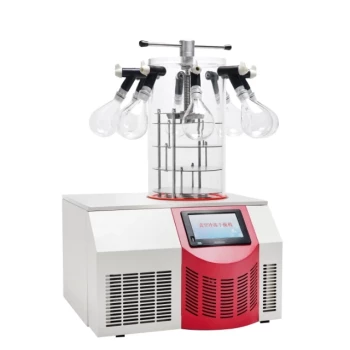
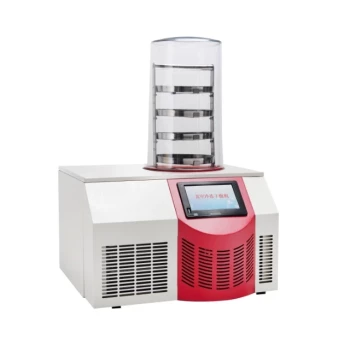
- Benchtop Laboratory Freeze Dryer for Lab Use
- Benchtop Laboratory Vacuum Freeze Dryer
- 108L Vertical Ultra Low Temperature ULT Freezer
People Also Ask
- What role does a laboratory freeze dryer play in the synthesis of graphene-based electrocatalysts? Preserve 3D Structures
- What are the technical advantages of using a laboratory freeze dryer for porous carbon precursors? Preserve 3D Networks
- What types of liquid samples can be processed using a laboratory freeze dryer? Preserve Your Sensitive Materials
- How do laboratory freeze dryers support scientific research? Preserve Sample Integrity for Reproducible Results
- Why is a laboratory freeze dryer preferred over traditional heating? Preserve Biochar Structure & Maximize Porosity