Knowledge How does a Rotary Vane Pump operate? Discover Efficient Vacuum Technology for Your Lab
Author avatar

Tech Team · Kintek Solution

Updated 2 days ago

How does a Rotary Vane Pump operate? Discover Efficient Vacuum Technology for Your Lab


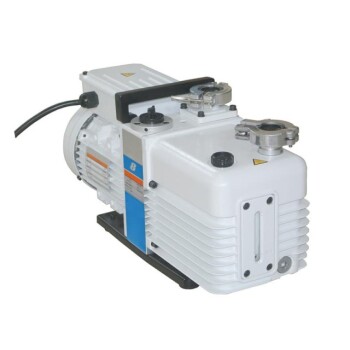
A rotary vane pump operates through a continuous cycle of positive displacement, using a rotating mechanism to trap and compress gas. Gas is drawn into a suction chamber, compressed by vanes sliding within an eccentrically mounted rotor, and then forced toward an exhaust port where it is expelled into the atmosphere.

By utilizing an eccentrically mounted rotor and spring-loaded vanes, these pumps create a continuous cycle of suction and compression. The system's efficiency relies heavily on maintaining a precise air-tight seal, typically achieved through specialized oil and mechanical tension.

The Mechanics of Compression

The Eccentric Rotor Strategy

The core component of the pump is a rotor positioned off-center (eccentrically) within the pump housing. This specific alignment creates a chamber that expands and contracts as the rotor turns.

Spring-Loaded Vanes

To ensure consistent contact with the chamber walls, the vanes are spring-loaded. As the rotor spins, these vanes slide in and out, trapping gas molecules in the space between the rotor and the housing.

The Displacement Cycle

As the vanes rotate, they physically push the trapped gas from the large suction area into a progressively smaller space. This compression forces the gas molecules toward the exhaust port for expulsion.

The Critical Role of Oil

Creating the Seal

The mechanical fit alone is rarely enough to hold a vacuum. A specifically formulated, low-vapor-pressure oil is used to create an air-tight seal between the moving rotor and the stationary housing.

Lubrication and Cooling

Beyond sealing, the oil serves two other vital functions: it lubricates the moving parts to reduce wear and absorbs heat to cool the pump during operation.

Drive Mechanisms and Performance

Direct Drive Configuration

Direct drive pumps connect the pump directly to an electric motor via a crankshaft and coupling. These units typically operate at higher speeds, often around 1750 RPM.

Due to the higher speed and direct connection, these pumps generally run at higher temperatures, averaging around 70 degrees Celsius.

Belt Drive Configuration

Belt drive pumps utilize a pulley and belt system, often incorporating speed reduction. This design allows the pump to spin at a lower RPM.

Because they run slower, belt drive models operate significantly cooler—usually 10 to 20 degrees Celsius lower than their direct drive counterparts.

Understanding Operational Trade-offs

Temperature Management

Heat is a major factor in pump longevity. While direct drive pumps are common, their higher operating temperatures (70°C) can stress internal components more than cooler running belt drive systems.

Variable Influences

Ideally, a pump runs efficiently, but real-world performance fluctuates based on maintenance. Oil quality, viscosity, and pump age all directly influence the operating temperature and seal integrity.

The Gas Factor

The type of gas being pumped also dictates performance. Processing reactive or heavy gases may alter the oil's properties, degrading the seal and increasing operating temperatures over time.

Making the Right Choice for Your Goal

Ideally, you should select a pump configuration that matches your duty cycle and thermal requirements.

  • If your primary focus is lower operating temperatures: Prioritize belt drive pumps, as their speed reduction results in operating temperatures 10-20 degrees Celsius cooler than direct drive models.
  • If your primary focus is standard speed and efficiency: Utilize direct drive pumps, keeping in mind they operate around 1750 RPM and will require management of higher running temperatures (approx. 70°C).

By understanding the relationship between the drive mechanism, oil quality, and the eccentric rotor design, you ensure your pump maintains the necessary vacuum levels for your application.

Summary Table:

Feature Direct Drive Pump Belt Drive Pump
Mechanism Motor connected via crankshaft Pulley and belt system
Operating Speed High (~1750 RPM) Low (Speed reduction)
Operating Temp. Higher (~70°C) Lower (10-20°C cooler)
Sealing Method Oil & Spring-loaded vanes Oil & Spring-loaded vanes
Best For Standard speed and efficiency Heat-sensitive applications

Optimize Your Vacuum Systems with KINTEK

At KINTEK, we understand that the right vacuum solution is critical for precision laboratory work. Whether you need high-performance rotary vane pumps for degassing, distillation, or drying, our expertise ensures you get the reliability your research demands.

Our comprehensive range of laboratory equipment includes:

  • High-Temperature Systems: Muffle, tube, and vacuum furnaces for advanced material processing.
  • Sample Preparation: Crushing, milling, and hydraulic presses for consistent results.
  • Process Control: High-pressure reactors, autoclaves, and cooling solutions like ULT freezers and cold traps.
  • Specialized Tools: Electrolytic cells, battery research consumables, and high-quality PTFE or ceramic crucibles.

Ready to enhance your lab's efficiency with precision-engineered equipment? Contact us today to find the perfect fit for your application!

Related Products

People Also Ask

Related Products

Laboratory Rotary Vane Vacuum Pump for Lab Use

Laboratory Rotary Vane Vacuum Pump for Lab Use

Experience high vacuum pumping speed and stability with our UL-certified Rotary Vane Vacuum Pump. Two-shift gas ballast valve and dual oil protection. Easy maintenance and repair.

Circulating Water Vacuum Pump for Laboratory and Industrial Use

Circulating Water Vacuum Pump for Laboratory and Industrial Use

Efficient circulating water vacuum pump for labs - oil-free, corrosion-resistant, quiet operation. Multiple models available. Get yours now!

Laboratory Benchtop Water Circulating Vacuum Pump for Lab Use

Laboratory Benchtop Water Circulating Vacuum Pump for Lab Use

Need a water circulating vacuum pump for your lab or small-scale industry? Our Benchtop Water Circulating Vacuum Pump is perfect for evaporation, distillation, crystallization, and more.

Oil Free Diaphragm Vacuum Pump for Laboratory and Industrial Use

Oil Free Diaphragm Vacuum Pump for Laboratory and Industrial Use

Oil-free diaphragm vacuum pump for labs: clean, reliable, chemical-resistant. Ideal for filtration, SPE, and rotary evaporation. Maintenance-free operation.

Vacuum Hot Press Furnace Machine for Lamination and Heating

Vacuum Hot Press Furnace Machine for Lamination and Heating

Experience clean and precise lamination with Vacuum Lamination Press. Perfect for wafer bonding, thin-film transformations, and LCP lamination. Order now!

CF Ultra-High Vacuum Observation Window Window Flange High Borosilicate Glass Sight Glass

CF Ultra-High Vacuum Observation Window Window Flange High Borosilicate Glass Sight Glass

Discover CF ultra-high vacuum observation window flanges with high borosilicate glass, perfect for semiconductor manufacturing, vacuum coating, and optical instruments. Clear observation, durable design, easy installation.

Small Vacuum Heat Treat and Tungsten Wire Sintering Furnace

Small Vacuum Heat Treat and Tungsten Wire Sintering Furnace

The small vacuum tungsten wire sintering furnace is a compact experimental vacuum furnace specially designed for universities and scientific research institutes. The furnace features a CNC welded shell and vacuum piping to ensure leak-free operation. Quick-connect electrical connections facilitate relocation and debugging, and the standard electrical control cabinet is safe and convenient to operate.

Vacuum Heat Treat Sintering Brazing Furnace

Vacuum Heat Treat Sintering Brazing Furnace

A vacuum brazing furnace is a type of industrial furnace used for brazing, a metalworking process that joins two pieces of metal using a filler metal that melts at a lower temperature than the base metals. Vacuum brazing furnaces are typically used for high-quality applications where a strong, clean joint is required.

Vacuum Cold Trap Chiller Indirect Cold Trap Chiller

Vacuum Cold Trap Chiller Indirect Cold Trap Chiller

Boost vacuum system efficiency and prolong pump life with our Indirect Cold Trap. Built-in chilling system with no need for fluid or dry ice. Compact design and easy to use.

Stainless Steel Quick Release Vacuum Chain Three-Section Clamp

Stainless Steel Quick Release Vacuum Chain Three-Section Clamp

Discover our stainless steel quick release clamp vacuum clamp, Ideal for high vacuum applications, Strong connections, reliable sealing, Easy installation, and durable design.

Custom PTFE Teflon Parts Manufacturer for PTFE Ball Valve Seat

Custom PTFE Teflon Parts Manufacturer for PTFE Ball Valve Seat

Seats and inserts are vital components in the valve industry. As a key component, polytetrafluoroethylene is usually selected as the raw material.

30T 40T Split Automatic Heated Hydraulic Press Machine with Heated Plates for Laboratory Hot Press

30T 40T Split Automatic Heated Hydraulic Press Machine with Heated Plates for Laboratory Hot Press

Discover our split automatic heated lab press 30T/40T for precise sample preparation in material research, pharmacy, ceramics, and electronics industries. With a small footprint and heating up to 300°C, it's perfect for processing under vacuum environment.

304 316 Stainless Steel Vacuum Ball Valve Stop Valve for High Vacuum Systems

304 316 Stainless Steel Vacuum Ball Valve Stop Valve for High Vacuum Systems

Discover 304/316 stainless steel vacuum ball valves, Ideal for high vacuum systems, Ensure precise control and durability. Explore now!

KF ISO Stainless Steel Vacuum Flange Blind Plate for High Vacuum Systems

KF ISO Stainless Steel Vacuum Flange Blind Plate for High Vacuum Systems

Discover KF/ISO stainless steel vacuum flange blind plates, ideal for high vacuum systems in semiconductor, photovoltaic, and research labs. High-quality materials, efficient sealing, and easy installation.<|end▁of▁sentence|>

Vacuum Bellows for Efficient Connection and Stable Vacuum in High-Performance Systems

Vacuum Bellows for Efficient Connection and Stable Vacuum in High-Performance Systems

Discover high-quality vacuum bellows for stable vacuum in high-performance systems. Made from 304 and 316 stainless steel, these bellows ensure efficient connections and excellent sealing. Ideal for

Heated Hydraulic Press Machine with Heated Plates for Vacuum Box Laboratory Hot Press

Heated Hydraulic Press Machine with Heated Plates for Vacuum Box Laboratory Hot Press

Enhance your lab's precision with our lab press for vacuum box. Press pills and powders with ease and precision in a vacuum environment, reducing oxidation and improving consistency. Compact and easy to use with a digital pressure gauge.

Graphite Vacuum Furnace Bottom Discharge Graphitization Furnace for Carbon Materials

Graphite Vacuum Furnace Bottom Discharge Graphitization Furnace for Carbon Materials

Bottom-out graphitization furnace for carbon materials, ultra-high temperature furnace up to 3100°C, suitable for graphitization and sintering of carbon rods and carbon blocks. Vertical design, bottom discharging, convenient feeding and discharging, high temperature uniformity, low energy consumption, good stability, hydraulic lifting system, convenient loading and unloading.

Precision Machined Yttria Stabilized Zirconia Ceramic Plate for Engineering Advanced Fine Ceramics

Precision Machined Yttria Stabilized Zirconia Ceramic Plate for Engineering Advanced Fine Ceramics

Yttrium-stabilized zirconia has the characteristics of high hardness and high temperature resistance, and has become an important material in the field of refractories and special ceramics.

Graphite Vacuum Continuous Graphitization Furnace

Graphite Vacuum Continuous Graphitization Furnace

High-temperature graphitization furnace is a professional equipment for graphitization treatment of carbon materials. It is a key equipment for the production of high-quality graphite products. It has high temperature, high efficiency and uniform heating. It is suitable for various high-temperature treatments and graphitization treatments. It is widely used in metallurgy, electronics, aerospace, etc. industry.

Vacuum Heat Treat Furnace with Ceramic Fiber Liner

Vacuum Heat Treat Furnace with Ceramic Fiber Liner

Vacuum furnace with polycrystalline ceramic fiber insulation liner for excellent heat insulation and uniform temperature field. Choose from 1200℃ or 1700℃ max. working temperature with high vacuum performance and precise temperature control.


Leave Your Message