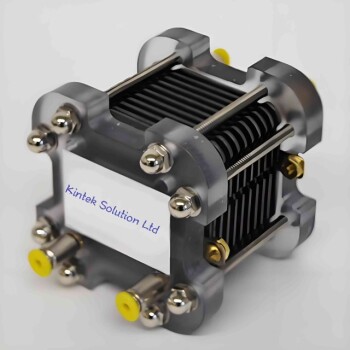
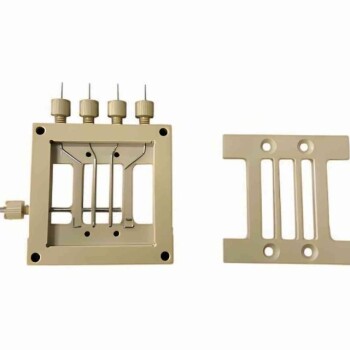
A standard three-electrode electrolytic cell system serves as the foundational tool for precisely characterizing the photoelectrochemical performance of Montmorillonite and titanium dioxide composites. This setup isolates the material's behavior to accurately measure photocurrent and electrochemical impedance spectroscopy (EIS), quantifying critical factors like charge transfer resistance and the separation efficiency of photo-generated electron-hole pairs.
By separating the measurement of potential from current flow, this system provides the interference-free data necessary to prove how specific modifications—such as iron doping—mechanistically improve a composite's conductivity and catalytic efficiency.
The Architecture of Precision
To understand the analysis, one must first understand how the system ensures accuracy. A two-electrode system often introduces errors due to polarization; the three-electrode configuration eliminates this issue by assigning distinct roles to each component.
The Working Electrode
This is the heart of the analysis. The Montmorillonite and titanium dioxide composite serves as the working electrode.
All measurements reflect the reactions occurring specifically at this surface, isolating the sample's performance from the rest of the circuit.
The Reference Electrode
The reference electrode provides a stable, unvarying potential reference point.
It ensures that any fluctuations measured are due to changes in the composite material, not the system's baseline voltage.
The Counter Electrode
Typically made of an inert material like platinum wire, the counter electrode completes the circuit.
Its specific role is to carry the polarization current. By diverting current away from the reference electrode, it prevents potential deviations that would otherwise corrupt the data.
Analyzing Material Performance
Once the environment is controlled, the system contributes to the analysis by generating two specific types of data essential for evaluating composites.
Quantifying Charge Transfer Resistance
Through Electrochemical Impedance Spectroscopy (EIS), the system measures how easily electrons move through the composite.
High resistance indicates poor conductivity, which hampers catalytic performance.
Data from this system reveals whether the interface between the Montmorillonite and titanium dioxide is facilitating or blocking electron flow.
Measuring Separation Efficiency
The system measures photocurrent to determine the separation efficiency of photo-generated electron-hole pairs.
In efficient photocatalysts, these pairs remain separated long enough to trigger reactions.
A higher photocurrent response in this system confirms that the composite is successfully preventing the recombination of charges.
Validating Modifications
This analysis is critical when introducing modifications, such as iron doping.
The three-electrode system provides the empirical evidence needed to prove that doping reduces charge migration resistance.
It moves the analysis beyond theoretical chemistry, offering hard data that the modification has improved the mechanistic function of the material.
Understanding the Trade-offs
While the three-electrode system is the industry standard for accuracy, it is not without analytical challenges.
System Geometry Sensitivity
The physical distance between the working and reference electrodes can introduce uncompensated resistance (iR drop).
If this distance is not minimized or mathematically corrected, the resulting impedance data may falsely suggest higher resistance in the composite.
Surface State Dominance
This method primarily measures electrochemical activity at the electrode-electrolyte interface.
It may not fully capture bulk properties of the Montmorillonite structure if the electrolyte does not fully permeate the composite layers.
Making the Right Choice for Your Goal
When analyzing Montmorillonite and titanium dioxide composites, the data you prioritize should depend on your specific research objective.
- If your primary focus is optimizing conductivity: Prioritize EIS data to identify and minimize charge transfer resistance at the composite interface.
- If your primary focus is photocatalytic activity: Focus on photocurrent measurements to verify that electron-hole pair separation efficiency is maximizing reaction potential.
Ultimately, the three-electrode system transforms the abstract concept of "improved performance" into quantifiable metrics of resistance and efficiency.
Summary Table:
| Component | Role in Composite Analysis | Benefit to Research |
|---|---|---|
| Working Electrode | Houses the Montmorillonite/TiO2 sample | Isolates sample-specific reactions |
| Reference Electrode | Provides stable potential baseline | Ensures accurate voltage measurements |
| Counter Electrode | Completes the circuit (e.g., Platinum wire) | Prevents potential deviations/interference |
| EIS Analysis | Measures charge transfer resistance | Quantifies conductivity improvements |
| Photocurrent | Tracks electron-hole pair separation | Validates photocatalytic efficiency |
Elevate Your Electrochemical Research with KINTEK
Precision in material science starts with the right equipment. KINTEK specializes in high-performance laboratory solutions designed to streamline your analysis of complex composites like Montmorillonite and titanium dioxide.
Our extensive portfolio includes:
- Advanced Electrolytic Cells & High-Quality Electrodes for stable, interference-free measurements.
- High-Temperature Furnaces (Muffle, Tube, Vacuum) for precise material synthesis and doping.
- Crushing, Milling, and Sieving Systems to ensure optimal composite uniformity.
- Hydraulic Presses & Battery Research Tools for comprehensive electrode preparation.
Whether you are optimizing charge transfer resistance or maximizing photocatalytic activity, KINTEK provides the reliability your data demands. Contact us today to discover how our specialized equipment and consumables can enhance your lab's efficiency and results!
References
- Li Zhang, Keiko Sasaki. Fabrication of Adsorbed Fe(III) and Structurally Doped Fe(III) in Montmorillonite/TiO2 Composite for Photocatalytic Degradation of Phenol. DOI: 10.3390/min11121381
This article is also based on technical information from Kintek Solution Knowledge Base .
Related Products
- H Type Electrolytic Cell Triple Electrochemical Cell
- PTFE Electrolytic Cell Electrochemical Cell Corrosion-Resistant Sealed and Non-Sealed
- Customizable PEM Electrolysis Cells for Diverse Research Applications
- Electrolytic Electrochemical Cell Gas Diffusion Liquid Flow Reaction Cell
- Electrolytic Electrochemical Cell with Five-Port
People Also Ask
- What is a H type cell? A Guide to Divided Electrochemical Cells for Accurate Experiments
- How should the electrolyte be prepared and added to the H-type electrolytic cell? Best Practices for Purity and Safety
- What is the technical necessity of using an H-type electrolytic cell for NO3RR tests? Protect Your Ammonia Yields
- How does the design of an H-type electrolytic cell benefit the neutral water electrolysis process for metal recovery?
- What is the primary function of an H-type electrolytic cell in NitRR? Ensure Accurate Product Yields