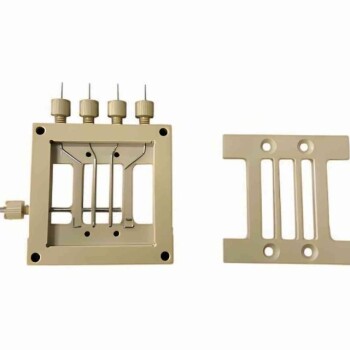
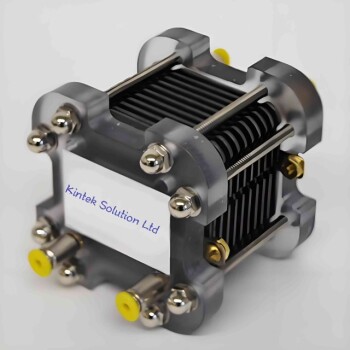
A three-electrode electrolytic cell system achieves precise control through the regulation of operational parameters during electrodeposition. By adjusting the constant current density and the deposition duration, the system dictates exactly how much active material accumulates on the substrate. This allows for micro-level management of MnO2 mass loading, enabling specific targets ranging from 2 to 45.2 mg/cm².
By fine-tuning the electrical input and timing of the deposition process, engineers can strictly control the thickness and mass of the active material. This ensures uniform distribution even within complex, porous structures, allowing the device to perform near its theoretical limit.
The Mechanics of Precision Control
Manipulating Operational Parameters
The core mechanism for control lies in the adjustment of the electrolytic cell's settings. The primary variable mentioned is deposition duration, which can be varied significantly to alter results.
Durations can range from as short as 300 seconds to tens of thousands of seconds. By extending or shortening this window, the system increases or decreases the total accumulation of MnO2 nanosheets.
Achieving Specific Mass Loading
Through these adjustments, the system provides a wide dynamic range for material loading.
Operators can achieve a specific mass loading anywhere between 2 mg/cm² and 45.2 mg/cm². This flexibility allows the electrode design to be tailored for specific energy storage requirements.
Optimizing for Complex Geometries
Uniform Distribution in Porous Structures
A major challenge with 3D-printed graphene frameworks is their complex, porous nature. Traditional coating methods often fail to penetrate deep into these internal structures.
The electrochemical deposition equipment solves this by using the electrolyte solution to carry ions throughout the entire matrix. This ensures the active material is uniformly distributed across the entire surface area, not just the outer layer.
Maximizing Electrochemical Performance
The ultimate goal of this precision is to enhance the electrode's efficiency.
By ensuring uniform coating and precise thickness, the system allows the electrode's mass-specific capacitance to approach its theoretical limit. This indicates that the active material is being utilized as efficiently as possible.
Understanding the Trade-offs
Balancing Time and Mass
While the system offers high precision, achieving high mass loading requires a significant investment in time.
Reaching the upper limits of loading (e.g., >40 mg/cm²) requires deposition durations lasting tens of thousands of seconds. This increases the manufacturing time per unit significantly compared to lighter loadings (300 seconds).
Making the Right Choice for Your Goal
To leverage this system effectively, you must align the operational parameters with your performance targets.
- If your primary focus is high total energy storage: Increase the deposition duration to maximize mass loading toward the 45.2 mg/cm² limit, accepting the longer processing time.
- If your primary focus is material efficiency: Utilize lower deposition times to create thinner, highly uniform coatings that ensure the mass-specific capacitance remains near the theoretical maximum.
precise control over electrodeposition parameters transforms complex 3D frameworks into highly efficient, optimized energy storage components.
Summary Table:
| Parameter | Range / Capability | Impact on Result |
|---|---|---|
| Deposition Duration | 300 to 10,000+ seconds | Directly scales the thickness and total mass of MnO2. |
| Mass Loading Range | 2 to 45.2 mg/cm² | Enables customization for specific energy storage goals. |
| Structural Uniformity | High (Internal & External) | Ensures active materials penetrate deep into 3D porous matrices. |
| Performance Goal | Theoretical Max Capacitance | Optimizes material utilization through precise thickness control. |
Elevate Your Material Research with KINTEK Precision Solutions
Unlock the full potential of your energy storage research with KINTEK’s high-performance electrolytic cells and electrodes. Whether you are working on advanced electrodeposition for 3D-printed frameworks or developing next-generation battery technologies, our specialized laboratory equipment provides the stability and control you need to reach theoretical performance limits.
Beyond electrochemistry, KINTEK offers a comprehensive range of solutions for demanding lab environments:
- High-Temperature Systems: Muffle, tube, and vacuum furnaces for precise thermal processing.
- Sample Preparation: Hydraulic presses, crushing systems, and high-purity crucibles.
- Advanced Reactors: High-temperature high-pressure reactors and autoclaves.
- Battery & Cooling Tools: ULT freezers, freeze dryers, and dedicated battery research consumables.
Ready to optimize your lab’s efficiency and precision? Contact KINTEK today to discuss your project requirements!
References
- Ankitha Menon, Peter Samora Owuor. Advances in 3D Printing for Electrochemical Energy Storage Systems. DOI: 10.31875/2410-4701.2021.08.7
This article is also based on technical information from Kintek Solution Knowledge Base .
Related Products
- H Type Electrolytic Cell Triple Electrochemical Cell
- PTFE Electrolytic Cell Electrochemical Cell Corrosion-Resistant Sealed and Non-Sealed
- Electrolytic Electrochemical Cell Gas Diffusion Liquid Flow Reaction Cell
- Electrolytic Electrochemical Cell with Five-Port
- Customizable PEM Electrolysis Cells for Diverse Research Applications
People Also Ask
- What is a H type cell? A Guide to Divided Electrochemical Cells for Accurate Experiments
- How should the electrolyte be prepared and added to the H-type electrolytic cell? Best Practices for Purity and Safety
- What is the technical necessity of using an H-type electrolytic cell for NO3RR tests? Protect Your Ammonia Yields
- How does the design of an H-type electrolytic cell benefit the neutral water electrolysis process for metal recovery?
- What is the primary function of an H-type electrolytic cell in NitRR? Ensure Accurate Product Yields