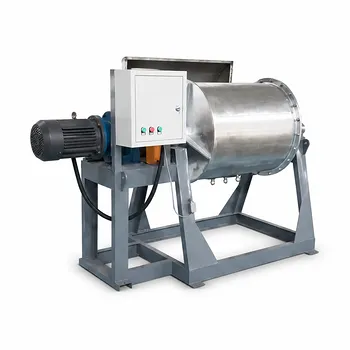
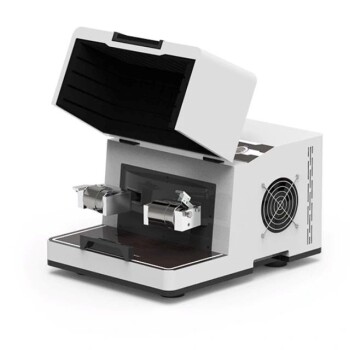
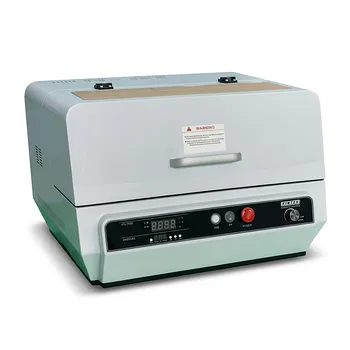
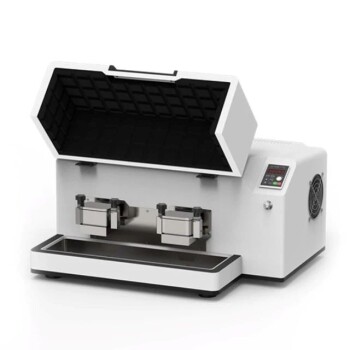
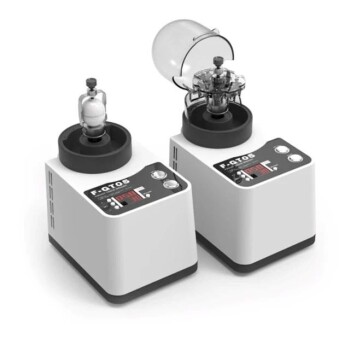
Mechanical ball milling offers a significantly streamlined equipment footprint compared to traditional oxide coating methods. While the sol-gel process necessitates a complex hardware suite involving coating apparatus, drying units, and high-temperature tube or muffle furnaces, the mechanical dry-mixing process requires only ball milling equipment to achieve the same modification.
The shift to mechanical dry-mixing effectively condenses a multi-stage infrastructure into a single operation, eliminating the reliance on high-energy heating systems and complex solvent handling protocols.
The Infrastructure of Traditional Methods
To understand the efficiency of ball milling, one must first recognize the extensive equipment requirements of traditional methods like the sol-gel process.
Reliance on Thermal Processing
The core disadvantage of the sol-gel method is its dependence on high-temperature tube furnaces or muffle furnaces.
These units are required for the final stage of the process, which involves long-term annealing. This adds a significant burden in terms of laboratory space, power supply requirements, and thermal safety management.
Complex Solvent Handling Requirements
Beyond thermal gear, traditional methods require specific equipment for coating and drying.
Because these processes involve solvents, the laboratory must be equipped to handle wet chemistry steps. This implies a need for infrastructure capable of managing evaporation and drying before the annealing phase can even begin.
The Streamlined Mechanical Approach
In direct contrast, the mechanical ball milling dry-mixing process removes the need for the peripheral equipment described above.
Single-Equipment Requirement
The mechanical approach achieves modification using only ball milling equipment.
There is no need to transfer materials between a coating machine, a dryer, and a furnace. The entire modification process is contained within the milling hardware.
Elimination of High-Energy Consumption
By utilizing mechanical energy rather than thermal energy, this process completely eliminates the need for heating equipment.
This reduction removes the most energy-intensive component of the traditional workflow—the high-temperature furnace—resulting in immediate operational cost reductions.
Operational Implications
When choosing between these methods, the implications extend beyond just the machinery on the bench.
Workflow Complexity
The sol-gel process involves a multi-step workflow that demands careful coordination between coating, drying, and annealing stages.
Ball milling offers a simplified workflow. By removing the intermediate steps of drying and the final step of annealing, the process becomes less labor-intensive and less prone to handling errors.
Cost and Safety Factors
The elimination of complex solvent handling steps reduces the need for expensive safety controls and waste disposal protocols associated with chemical solvents.
Combined with the removal of energy-hungry furnaces, the dry-mixing process presents a fundamentally lower operational cost structure.
Making the Right Choice for Your Goal
- If your primary focus is Equipment Efficiency: Choose mechanical ball milling to eliminate the need for furnaces, dryers, and coating apparatus.
- If your primary focus is Cost Reduction: Prioritize ball milling to avoid the high energy consumption of long-term annealing and the overhead of solvent management.
- If your primary focus is Workflow Simplicity: Adopting dry-mixing will allow you to consolidate multiple processing steps into a single mechanical operation.
Mechanical ball milling transforms oxide coating from a complex, thermal-chemical procedure into a concise mechanical operation, drastically reducing both equipment dependency and energy overhead.
Summary Table:
| Feature | Mechanical Ball Milling (Dry-Mixing) | Traditional Sol-Gel Process |
|---|---|---|
| Core Equipment | Ball Milling System only | Coating apparatus, drying units, & furnaces |
| Thermal Requirement | None (Mechanical energy) | High-temperature annealing (Tube/Muffle furnace) |
| Material Handling | Dry processing; no solvents | Wet chemistry; complex solvent management |
| Process Steps | Single-stage operation | Multi-stage (Coating, Drying, Annealing) |
| Energy Intensity | Low | High (Due to long-term heating) |
| Infrastructure | Minimal footprint | Extensive (requires thermal/solvent safety) |
Optimize your material processing with KINTEK’s advanced laboratory solutions. Whether you are streamlining your workflow through mechanical ball milling or require precision high-temperature tube and muffle furnaces for traditional synthesis, our comprehensive portfolio is designed to meet the rigorous demands of modern research. From crushing and milling systems to high-pressure reactors and battery research tools, we provide the high-quality equipment and consumables you need to achieve superior results. Contact our experts today to find the perfect fit for your laboratory’s efficiency and performance goals!
Related Products
- Stainless Steel Laboratory Ball Mill for Dry Powder and Liquid with Ceramic Polyurethane Lining
- High-Energy Omnidirectional Planetary Ball Mill Milling Machine for Laboratory
- Laboratory Ball Mill Jar Mill with Metal Alloy Grinding Jar and Balls
- High-Energy Omnidirectional Planetary Ball Mill Machine for Laboratory
- Hybrid High Energy Vibratory Ball Mill for Lab Use
People Also Ask
- How do laboratory ball mills facilitate the mechanochemical synthesis of ZIF-8? Solvent-Free Synthesis Explained
- What is the primary function of a laboratory ball mill in the modification of sulfide-based solid electrolytes with LiPO2F2?
- How does a laboratory ball mill ensure the mixing quality of Mn3Zn0.8Sn0.2N and Ti? Achieve Perfect Homogeneity
- What is the function of a laboratory ball mill in the preparation of AMMCs? Optimize Dispersion & Grain Refinement
- In what way does a laboratory ball mill affect material properties when modifying PHBV/pulp fiber composites?