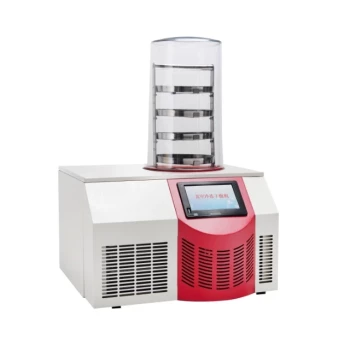
In the study of electrocoagulation sludge, a vacuum drying oven is primarily utilized to dehydrate aqueous sludge samples until they reach a constant weight. By operating under reduced pressure, the oven allows moisture to evaporate at significantly lower temperatures than standard drying methods, thereby preserving the sample's original chemical composition.
The vacuum environment protects heat-sensitive substances within the sludge from thermal degradation while ensuring total moisture removal. This process is the critical prerequisite for generating stable solid samples required for accurate microscopic and structural analysis.
The Critical Role of Temperature Control
Preventing Chemical Degradation
The most significant challenge in drying sludge is preserving its chemical identity. Electrocoagulation sludge often contains heat-sensitive substances.
If exposed to the high temperatures typical of standard convection ovens, these components can degrade or react, altering the fundamental nature of the sample.
Utilizing Reduced Pressure
The vacuum drying oven addresses this by lowering the pressure within the chamber.
This environment reduces the boiling point of water and other volatiles. Consequently, moisture evaporation occurs at low temperatures, ensuring the sludge dries effectively without "cooking" or structurally altering the material.
Enabling Accurate Characterization
Achieving Constant Weight
For scientific analysis, "dry" is not a subjective term; it is a measurable state.
The vacuum oven is used to dry the sludge until it reaches a constant weight. This ensures that all residual moisture—which could skew mass measurements or interfere with chemical readings—is thoroughly removed.
Preparing for Advanced Instrumentation
The ultimate goal of this drying process is to prepare the sludge for high-precision characterization tools.
Techniques such as X-ray diffraction (XRD), Fourier transform infrared spectroscopy (FTIR), and Scanning Electron Microscopy (SEM) require completely dry, stable solids.
The vacuum oven ensures the samples retain their true microscopic morphology, functional groups, and crystal structures, allowing these instruments to generate accurate data.
Understanding the Trade-offs
Process Speed vs. Sample Integrity
While vacuum drying is superior for preservation, it is generally a slower process compared to high-heat methods.
Researchers must accept a longer drying duration to achieve the necessary low-temperature evaporation.
Equipment Complexity
Unlike simple heating ovens, this method requires maintaining a vacuum seal and managing pressure levels.
However, this added complexity is a necessary trade-off to ensure that the mass loss measured is purely moisture and not the result of the sample itself decomposing or oxidizing.
Making the Right Choice for Your Goal
When establishing your sludge characterization protocol, align your drying method with your analytical targets.
- If your primary focus is microscopic morphology (SEM): You must use vacuum drying to prevent thermal stress from collapsing or warping the delicate micro-structures of the sludge.
- If your primary focus is chemical composition (FTIR/XRD): Rely on vacuum drying to ensure that the functional groups and crystal lattice structures remain intact and are not modified by heat.
Reliable data begins with sample preparation that respects the chemical limits of your material.
Summary Table:
| Feature | Vacuum Drying Oven | Standard Convection Oven |
|---|---|---|
| Drying Principle | Lowered boiling point via reduced pressure | Evaporation via high thermal energy |
| Sample Integrity | Preserves heat-sensitive chemical structures | Risk of chemical degradation/oxidation |
| Moisture Removal | Complete removal to constant weight | May retain trapped residual moisture |
| Morphology | Protects delicate micro-structures (SEM) | Thermal stress may warp structures |
| Best Used For | Accurate XRD, FTIR, and SEM analysis | Basic mass loss or non-sensitive drying |
Elevate Your Sludge Research with KINTEK Precision Equipment
Ensure the integrity of your electrocoagulation sludge samples with KINTEK’s high-performance laboratory solutions. We specialize in providing researchers with the tools needed for rigorous material characterization, including:
- Advanced Vacuum & High-Temperature Furnaces: Perfect for moisture removal without chemical compromise.
- Crushing & Milling Systems: Prepare your dried sludge for consistent XRD and FTIR sampling.
- Precision Laboratory Consumables: High-quality crucibles and ceramics to prevent sample contamination.
Don't let thermal degradation skew your data. From vacuum ovens and high-pressure reactors to pellet presses for spectroscopy preparation, KINTEK offers the comprehensive range your lab demands.
Ready to optimize your drying protocol? Contact our experts today to find the perfect equipment for your research goals.
References
- Xuege Gu, Jiankang Wang. Efficient removal of norfloxacin from water using batch airlift-electrocoagulation reactor: optimization and mechanisms analysis. DOI: 10.1039/d3ra00471f
This article is also based on technical information from Kintek Solution Knowledge Base .
Related Products
- 56L Vertical Laboratory Vacuum Drying Oven
- 23L Laboratory Vacuum Drying Oven
- Laboratory Scientific Electric Heating Blast Drying Oven
- Benchtop Laboratory Vacuum Freeze Dryer
- Dental Porcelain Zirconia Sintering Ceramic Vacuum Press Furnace
People Also Ask
- Why is a laboratory vacuum drying oven recommended for rice straw residues? Protect Your Biomass Integrity
- What role does a laboratory vacuum drying oven play in the preparation of modified multi-walled carbon nanotubes?
- What is the importance of using a laboratory vacuum drying oven? Preserving Slow-Release Microcapsule Integrity
- Why is a Laboratory Vacuum Drying Oven recommended for PBAT microspheres? Protect Sensitive Polymer Integrity
- What role does a laboratory vacuum drying oven play in processing nanoparticle powder samples? Protect Sample Integrity