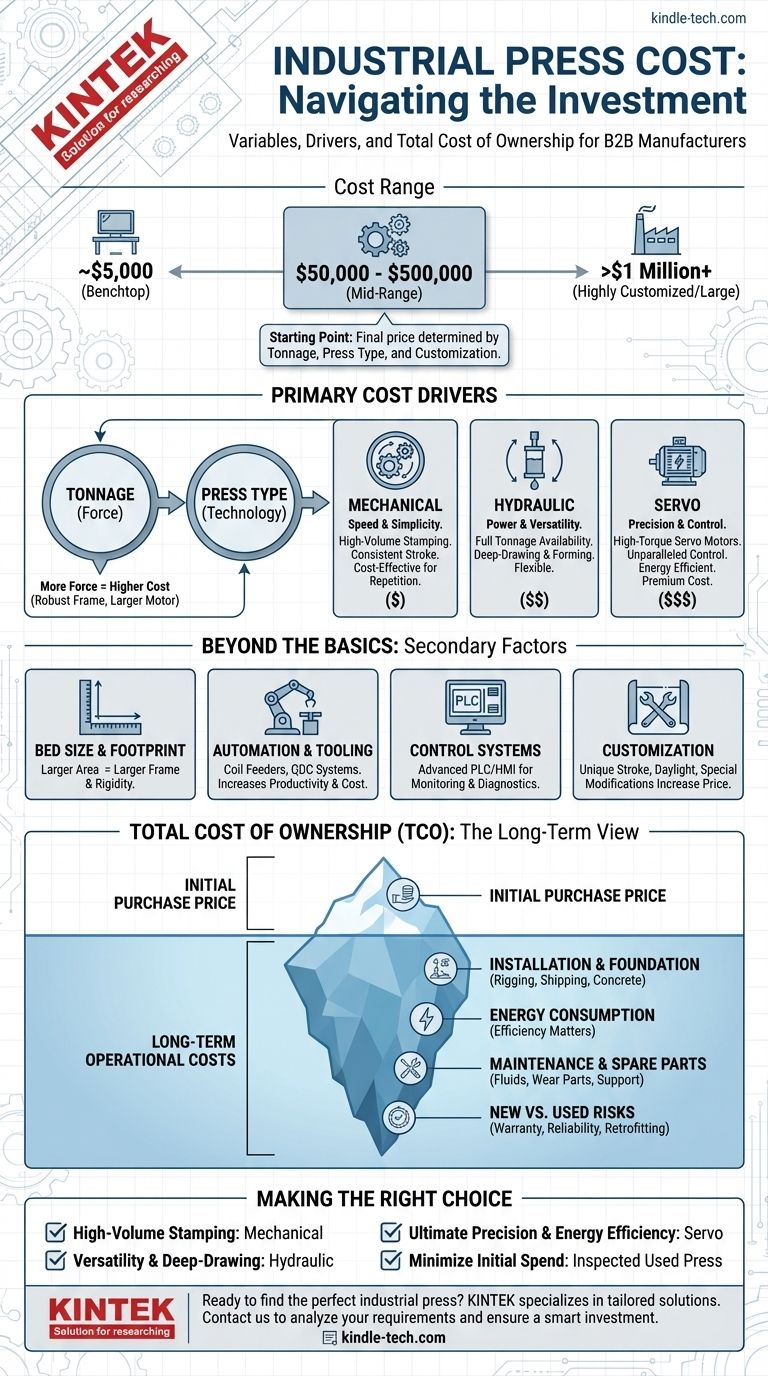
The cost of an industrial press varies dramatically, ranging from a few thousand dollars for a small benchtop model to well over a million for a large, highly customized servo or hydraulic press. For a typical mid-range industrial press used in manufacturing, you can expect to budget anywhere from $50,000 to $500,000, but this is only a starting point. The final price is determined by the press type, its force capacity (tonnage), and the level of customization required for your specific application.
The initial purchase price is merely one piece of the puzzle. The true cost of an industrial press is a function of its core technology—mechanical, hydraulic, or servo—and a comprehensive analysis of its total cost of ownership, including installation, energy use, and maintenance.

The Primary Cost Drivers: Tonnage and Press Type
Understanding the fundamental components of an industrial press is the first step in estimating its cost. The force it can exert and the technology used to generate that force are the two most significant factors influencing the price tag.
Tonnage: The Measure of Force
Tonnage is the maximum force a press can apply. It's the single most important specification and a primary driver of cost. A small 20-ton press for simple punching is fundamentally different and less expensive than a 2,000-ton press used for deep-drawing automotive body panels. Higher tonnage requires a more robust frame, a larger motor, and more powerful components, all of which increase the price exponentially.
Mechanical Presses: Speed and Simplicity
Mechanical presses use a motor-driven flywheel to store energy, which is then transferred through a clutch and crankshaft to move the ram. They are known for their high speed and consistent stroke length, making them ideal for high-volume blanking, coining, and shallow stamping operations. For applications requiring speed and repetition over flexibility, a mechanical press is often the most cost-effective solution.
Hydraulic Presses: Power and Versatility
Hydraulic presses use a system of pumps and hydraulic fluid to generate force. Their key advantage is full tonnage availability throughout the entire stroke. This makes them exceptionally versatile and ideal for deep-drawing, forming, and applications requiring long, sustained pressure. While potentially slower than mechanical presses, their flexibility and power often justify their cost, which can vary widely based on complexity.
Servo Presses: Precision and Control
Servo-electric presses represent the high end of press technology. They use high-torque servo motors to directly drive the ram, offering unparalleled control over slide speed, position, and dwell time. This precision reduces energy consumption and noise while enabling complex forming operations that are impossible with other press types. This advanced capability comes at a premium initial cost.
Beyond the Basics: Features That Shape the Final Price
Once you've determined the required tonnage and press type, a range of secondary factors will further define the final investment.
Bed Size and Physical Footprint
The bed size, or the working area for the die, directly impacts cost. A larger bed is required for larger parts or progressive die operations, which in turn necessitates a larger, heavier, and more expensive frame to maintain rigidity.
Automation and Tooling
Modern manufacturing relies on automation. Features like automatic coil feeders, part transfer systems, and Quick Die Change (QDC) systems can dramatically increase productivity but also add significant cost to the initial purchase.
Control Systems and Software
The sophistication of the Programmable Logic Controller (PLC) and human-machine interface (HMI) is a major cost variable. Advanced systems offer job storage, real-time performance monitoring, and fault diagnostics, which add value and cost.
Customization and Engineering
A standard, off-the-shelf press will always be less expensive than one requiring custom engineering. If your application demands a unique stroke length, daylight (the space for tooling), or other special modifications, expect the price to increase accordingly.
Understanding the Trade-offs: Total Cost of Ownership
A savvy buyer looks beyond the sticker price to consider the long-term financial implications of their investment.
New vs. Used Equipment
A used press can offer significant upfront savings. However, this often comes with risks, including a lack of warranty, potential for undisclosed wear and tear, and higher long-term maintenance costs. A new press provides reliability, modern safety features, and manufacturer support, but at a higher initial capital outlay.
Installation and Foundation
A large industrial press is immensely heavy and generates significant force. It requires a specialized, reinforced concrete foundation, which can be a major hidden cost. The logistics of rigging, shipping, and installation must be factored into the total project budget.
Energy Consumption
Different press technologies have vastly different energy profiles. A hydraulic press often has pumps running continuously, while a servo press consumes significant power only during the stroke itself. Over a 10-20 year lifespan, energy savings from a more efficient press can offset a higher initial price.
Maintenance and Spare Parts
Consider the ongoing costs of operation. Hydraulic systems require regular fluid and filter changes. Mechanical presses have clutches and brakes that wear over time. The availability and cost of spare parts from the manufacturer are critical long-term considerations.
Making the Right Choice for Your Goal
Selecting the right press is about aligning technology with your specific manufacturing needs and budget.
- If your primary focus is high-volume, repetitive stamping: A mechanical press likely offers the best balance of speed and initial cost.
- If your primary focus is part versatility and deep-drawing: The full-stroke tonnage and control of a hydraulic press make it the superior choice.
- If your primary focus is ultimate precision and energy efficiency: A servo press is the leading-edge solution, justifying its higher price with unparalleled control and lower operating costs.
- If your primary focus is minimizing initial capital spending: A thoroughly inspected used press can be a viable option, provided you budget for potential maintenance and retrofitting.
Ultimately, choosing an industrial press is a significant capital investment that requires a clear understanding of both the upfront price and the long-term operational costs.
Summary Table:
| Cost Factor | Impact on Price | Key Considerations |
|---|---|---|
| Tonnage | High | Higher force requires a more robust frame and components. |
| Press Type | High | Mechanical ($), Hydraulic ($$), Servo ($$$) based on speed & control. |
| Customization | Medium to High | Custom engineering for unique applications increases cost. |
| Automation | Medium | Features like quick die change systems add to the price. |
| Control System | Medium | Advanced PLCs and HMIs for precision and monitoring add value. |
Ready to find the perfect industrial press for your budget and application?
Navigating the wide range of industrial press costs and technologies can be complex. KINTEK specializes in providing lab and manufacturing equipment solutions, including industrial presses tailored to your specific needs. We can help you analyze your requirements—from tonnage and press type to automation and long-term cost of ownership—to ensure you make a smart, cost-effective investment.
Contact us today for a personalized consultation and let our experts guide you to the right solution.
Visual Guide
Related Products
- Automatic High Temperature Heated Hydraulic Press Machine with Heated Plates for Lab
- Heated Hydraulic Press Machine with Heated Plates for Vacuum Box Laboratory Hot Press
- Single Punch Electric Tablet Press Machine Laboratory Powder Tablet Punching TDP Tablet Press
- Automatic Heated Hydraulic Press Machine with Heated Plates for Laboratory Hot Press
- Laboratory Hydraulic Press Lab Pellet Press Machine for Glove Box
People Also Ask
- Why is a heated hydraulic press used for warm pressing NASICON green tapes? Optimize Your Solid Electrolyte Density
- What is a heated hydraulic press used for? Essential Tool for Curing, Molding, and Laminating
- Why is a heated laboratory hydraulic press necessary for composite laminates? Achieve Void-Free Structural Integrity
- What is a hot hydraulic press? Harness Heat and Pressure for Advanced Manufacturing
- What technical conditions does a heated hydraulic press provide for PEO batteries? Optimize Solid-State Interfaces