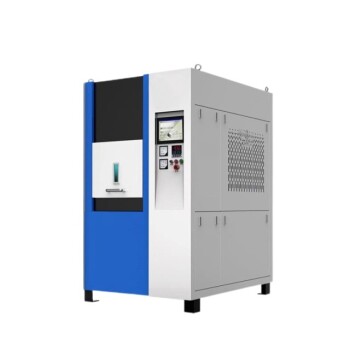
In short, spark plasma sintering (SPS) offers three primary advantages over conventional methods: it is significantly faster, it achieves densification at lower temperatures, and it produces materials with superior final properties. This unique combination of speed and quality is achieved by using a pulsed electric current to heat the material and its die directly, a process known as field-assisted sintering.
Traditional sintering is a slow, high-temperature process that often compromises a material's fine-grained structure. Spark plasma sintering solves this by using direct electrical heating to consolidate powders in minutes instead of hours, preserving delicate nanostructures and yielding denser, stronger final components.
How SPS Redefines the Sintering Process
To understand the advantages of SPS, you must first understand how it fundamentally differs from conventional furnace heating. It isn't just faster heating; it's a different mechanism entirely.
The Principle of Field-Assisted Sintering
SPS, also known as a field-assisted sintering technique (FAST), passes a pulsed direct current (DC) through a conductive die (typically graphite) and, if possible, through the material powder itself.
This direct current flow generates intense Joule heat both in the die and at the contact points between powder particles. This is fundamentally different from a conventional furnace, which relies on slower, indirect radiant heating.
Unprecedented Heating Rates
Because heat is generated internally, SPS can achieve heating rates of up to 1000°C/min. This allows a full sintering cycle to be completed in a matter of minutes, whereas conventional sintering can take many hours or even days.
This rapid cycle time dramatically accelerates research, development, and even small-scale production of advanced materials.
Combining Pressure and Current
Like hot pressing, SPS applies a uniaxial mechanical pressure to the powder via punches. However, the synergy between the mechanical load, the thermal field, and the electric field is what makes SPS so effective. The electric field is believed to clean particle surfaces and enhance atomic diffusion, accelerating the bonding and densification process.
Key Advantages for Advanced Materials
The unique mechanism of SPS translates directly into tangible benefits, enabling the creation of materials that are difficult or impossible to produce with other methods.
Faster Sintering at Lower Temperatures
SPS consistently achieves full densification at temperatures several hundred degrees lower than conventional techniques. This is a critical advantage.
Lower processing temperatures reduce the risk of thermal degradation, unwanted phase reactions, and excessive grain growth, which is vital for temperature-sensitive materials.
Preserving Nanostructures and Refined Grains
Perhaps the most significant advantage of SPS is its ability to preserve delicate microstructures. Many advanced materials derive their properties from a nanocrystalline or fine-grained structure.
The slow, high-heat exposure of conventional sintering causes grain growth, which destroys these carefully engineered features. The short duration and lower temperature of an SPS cycle effectively lock in the refined microstructure, preserving the material's intended properties.
Achieving Higher Density and Fewer Defects
The combination of pressure and enhanced diffusion allows SPS to produce components with higher final density and fewer internal defects like porosity.
This superior densification directly translates to improved mechanical performance, including significantly higher strength and hardness, especially in nano-structured ceramics and composites.
Enabling Novel Material Joining
SPS is also a powerful tool for material joining or welding, particularly for dissimilar materials like ceramic-to-ceramic or ceramic-to-metal.
The electric field enhances self-diffusion across the material interface, creating a strong, monolithic bond without the need for an intermediate adhesive layer. This opens up new possibilities for designing complex, multi-material components.
Understanding the Trade-offs
No technology is without limitations. An objective assessment of SPS requires acknowledging its trade-offs.
Sample Geometry and Size Limitations
The SPS process is constrained by the use of a die set. This means it is best suited for producing simple shapes like discs, cylinders, and rectangular bars. Complex, near-net-shape manufacturing is generally not feasible.
Material Conductivity Challenges
The process is most efficient when the material itself has some electrical conductivity. While the heating of the graphite die ensures even highly insulating ceramics can be sintered, temperature uniformity and heating efficiency can be more challenging compared to conductive materials.
Equipment and Tooling Costs
SPS equipment is more complex and carries a higher capital cost than most conventional furnaces. Furthermore, the graphite dies and punches are consumables that degrade over time, particularly at very high temperatures and pressures, adding to the operational cost.
Making the Right Choice for Your Goal
SPS is not a universal replacement for all sintering methods, but it is an unparalleled tool for specific, high-value applications.
- If your primary focus is preserving nanostructures: SPS is the superior choice for consolidating nanomaterials or powders with refined grains while preventing grain growth.
- If your primary focus is rapid prototyping or development: The speed of SPS allows you to iterate on material compositions and produce dense samples for testing in a fraction of the time required by a furnace.
- If your primary focus is creating high-strength ceramics or composites: SPS's ability to achieve near-full density results in materials with exceptional mechanical properties that are often unattainable with other methods.
- If your primary focus is joining dissimilar materials: SPS provides a unique pathway for creating strong, diffusion-bonded joints between challenging material combinations like ceramics and metals.
Ultimately, spark plasma sintering empowers you to create next-generation materials by overcoming the core limitations of time and temperature inherent in traditional methods.
Summary Table:
| Advantage | How SPS Achieves It | Key Benefit |
|---|---|---|
| Faster Sintering | Direct Joule heating with pulsed DC current (up to 1000°C/min) | Cycle times in minutes vs. hours/days |
| Lower Temperature | Internal heating and enhanced diffusion | Reduces grain growth and thermal degradation |
| Superior Properties | Preserves fine-grained/nanostructures, achieves near-full density | Higher strength, hardness, and fewer defects |
| Novel Material Joining | Electric field enhances self-diffusion at interfaces | Bonds dissimilar materials without adhesives |
Ready to unlock the potential of spark plasma sintering in your lab? KINTEK specializes in advanced lab equipment, including SPS systems, to help you achieve faster prototyping, preserve delicate nanostructures, and produce high-performance materials with superior density and strength. Contact our experts today to discuss how our solutions can accelerate your research and development!
Visual Guide

Related Products
- Spark Plasma Sintering Furnace SPS Furnace
- Vacuum Dental Porcelain Sintering Furnace
- Dental Porcelain Zirconia Sintering Ceramic Vacuum Press Furnace
- Vacuum Heat Treat and Sintering Furnace with 9MPa Air Pressure
- Dental Porcelain Zirconia Sintering Ceramic Furnace Chairside with Transformer
People Also Ask
- Why are Spark Plasma Sintering (SPS) furnaces or hot presses utilized in the preparation of Li3PS4 solid electrolytes?
- What is the mechanism of SPS process? A Deep Dive into Rapid, Low-Temperature Sintering
- What is the difference between spark plasma sintering and flash sintering? A Guide to Advanced Sintering Methods
- What is the theory of spark plasma sintering? A Guide to Rapid, Low-Temperature Densification
- What is the process fundamentals of spark plasma sintering? Achieve Rapid, High-Density Material Consolidation