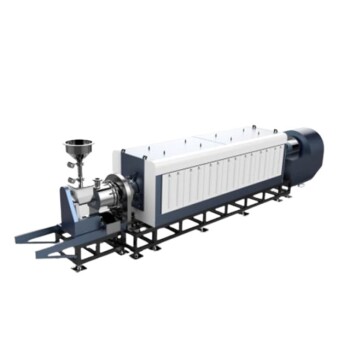
The primary advantage of using 316L stainless steel for rice husk hydrolysis is its ability to withstand the aggressive combination of high temperatures and acidic conditions. This material provides the necessary mechanical strength to operate safely between 160°C and 210°C while resisting corrosion from 0.5% dilute sulfuric acid. By maintaining its structural integrity, 316L prevents metal ion contamination, ensuring the chemical purity required for accurate downstream analysis.
316L stainless steel functions as a critical barrier that withstands the dual stress of high internal pressure and acidic corrosion. Its use is essential for preventing equipment failure and ensuring that the hydrolysate remains uncontaminated for precise scientific evaluation.
Mastering the Corrosive Environment
Resistance to Sulfuric Acid
The hydrolysis of rice husks relies on 0.5% dilute sulfuric acid to break down biomass. This acidic environment is highly aggressive toward standard metals.
316L stainless steel is specifically formulated to resist this type of chemical attack. It prevents the rapid degradation that would occur in lesser alloys, ensuring the reactor remains operational over repeated cycles.
Preventing Metal Ion Leaching
A critical risk in acid hydrolysis is the leaching of metal ions from the reactor walls into the liquid.
316L minimizes this degradation. This ensures the hydrolysate remains pure, preventing foreign metal ions from interfering with the chemical composition of the treated rice husks.
Handling Thermal and Mechanical Stress
Withstanding High Temperatures
The process requires temperatures ranging from 160°C to 210°C to be effective.
At these elevated temperatures, materials often lose tensile strength or become brittle. 316L stainless steel retains its mechanical properties under this thermal load, ensuring consistent performance.
Managing System Pressure
Heating dilute acid in a closed system naturally generates significant internal pressure.
The high mechanical strength of 316L is essential for containing this pressure safely. It ensures the sealing of the reaction process remains intact, preventing hazardous leaks or catastrophic ruptures during operation.
Ensuring Data Integrity
Accuracy of Chemical Analysis
The ultimate goal of hydrolysis is often analysis or further chemical processing.
Because 316L prevents metal contamination, the resulting fluid reflects the true properties of the rice husks. This maintains the accuracy of subsequent chemical analyses, validating your experimental data.
Understanding the Trade-offs
Cost vs. Necessity
316L is generally more expensive than standard grades like 304 stainless steel.
However, for dilute acid hydrolysis, this cost is a mandatory investment. Lower-grade steels may be cheaper initially but will likely fail due to corrosion or ruin samples through contamination.
Limits of Resistance
While 316L is "acid-resistant," it is not "acid-proof" under all conceivable conditions.
It is specifically suited for the dilute (0.5%) concentrations mentioned. If the process requires significantly higher acid concentrations, even 316L may degrade, requiring more exotic alloys.
Making the Right Choice for Your Goal
When designing or selecting a reactor for biomass hydrolysis, align your material choice with your specific operational priorities:
- If your primary focus is Operational Safety: 316L provides the requisite mechanical strength to maintain a high-pressure seal at temperatures up to 210°C.
- If your primary focus is Analytical Precision: 316L is essential for preventing metal ion contamination that would otherwise skew your chemical data.
Selecting 316L stainless steel is the definitive step to ensure both the physical safety of your lab and the scientific validity of your results.
Summary Table:
| Feature | Benefit for Acid Hydrolysis | Performance Metric |
|---|---|---|
| Corrosion Resistance | Resists 0.5% dilute sulfuric acid | Prevents material degradation |
| Temperature Stability | Maintains strength at 160°C - 210°C | Ensures structural integrity |
| Chemical Purity | Minimal metal ion leaching | Protects hydrolysate from contamination |
| Mechanical Strength | High pressure containment | Ensures operational safety & sealing |
| Durability | Long service life in aggressive media | Reduced equipment replacement costs |
Maximize Your Lab's Analytical Precision with KINTEK
Don't let equipment failure or metal contamination compromise your biomass research. KINTEK specializes in high-performance laboratory solutions, offering a robust selection of high-temperature high-pressure reactors and autoclaves engineered from premium materials like 316L stainless steel.
Whether you are performing complex acid hydrolysis or advanced chemical synthesis, our expert team provides the crushing systems, thermal equipment, and specialized reactors needed to ensure safety and data integrity. From high-temperature furnaces to precision hydraulic presses, we equip your facility for excellence.
Ready to upgrade your reactor systems? Contact KINTEK today to discuss your specific application and discover how our advanced materials can enhance your research outcomes.
References
- Yoney López, Carlos Martı́n. Chemical characterisation and dilute-acid hydrolysis of rice hulls from an artisan mill. DOI: 10.15376/biores.5.4.2268-2277
This article is also based on technical information from Kintek Solution Knowledge Base .
Related Products
- Stainless High Pressure Autoclave Reactor Laboratory Pressure Reactor
- Mini SS High Pressure Autoclave Reactor for Laboratory Use
- Customizable Laboratory High Temperature High Pressure Reactors for Diverse Scientific Applications
- Customizable High Pressure Reactors for Advanced Scientific and Industrial Applications
- High Pressure Laboratory Autoclave Reactor for Hydrothermal Synthesis
People Also Ask
- Why is a laboratory high-pressure reactor necessary for synthesizing fly ash-based zeolite? Achieve Pure Crystallization
- Why is a laboratory high-pressure reactor used in the hydrothermal synthesis of hydroxyapatite catalysts?
- What role does a laboratory high-pressure reactor play in the leaching process of spent cathode materials? Optimize Recovery
- What conditions do laboratory high-pressure reactors provide for HTC? Optimize Your Biochar Production Processes
- How are high-pressure reactors used to prepare metaphosphate electrocatalysts? Master In-Situ Precursor Growth