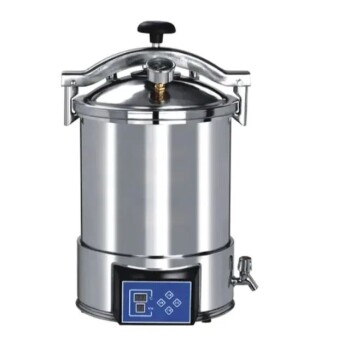
Using a high-pressure hydrothermal synthesis autoclave for $Fe_3O_4$ (magnetite) production provides a controlled, high-energy environment that ensures superior crystallinity and structural uniformity. This method allows the reaction between the iron source and urea to occur at temperatures (typically 180°C) and pressures far exceeding atmospheric boiling points. The result is the formation of pure, high-quality nanospheres with precise particle size distributions that are otherwise difficult to achieve through standard precipitation methods.
The central advantage of a high-pressure autoclave lies in its ability to reach a subcritical state, where the increased reaction activity of water facilitates the slow hydrolysis and oxidation needed for uniform crystal growth. This environment enables precise thermodynamic control over the nucleation process, ensuring high purity and consistent electrochemical performance.
Enhanced Reaction Kinetics and Crystallinity
Achieving Subcritical Water Properties
In a sealed autoclave, water reaches a subcritical state where its dielectric constant changes and its reaction activity increases significantly. This environment accelerates the chemical reaction rate of the precursor solution, allowing solvents to remain liquid at temperatures well above their normal boiling points.
Promotion of Slow Hydrolysis
The high-pressure environment promotes the steady hydrolysis and oxidation reactions between the iron source and agents like urea. This slow, controlled process is critical for the development of $Fe_3O_4$ nanospheres, as it prevents the chaotic precipitation that often occurs in open-vessel synthesis.
Superior Crystal Integrity
High-pressure conditions facilitate the dissolution and recrystallization of catalyst precursors in the liquid phase. This high-energy environment significantly enhances the crystallinity of the nanoparticles, resulting in a more stable and high-performing final product for electrochemical or catalytic applications.
Precise Control Over Nanostructure
Uniform Nucleation and Growth
By maintaining a closed environment, the autoclave induces uniform nucleation across the entire precursor volume. This uniformity ensures that the growth of nanocrystals is synchronized, leading to a narrower particle size distribution.
Morphology Modulation
The internal temperature regimes and pressure levels can be modulated to dictate the specific morphology of the iron nanoparticles. In $Fe_3O_4$ synthesis, this typically results in the formation of uniform nanospheres, which are essential for comparative performance studies.
Enhanced Bonding and Distribution
Under subcritical conditions, hydrothermal synthesis guides the controlled growth of particles, often resulting in smaller grain sizes and more uniform distribution. This is particularly beneficial when synthesizing nanoparticles on carriers like graphene, as it fosters stronger bonding and better structural stability.
Ensuring Chemical Purity and Safety
Prevention of Ion Contamination
The use of a PTFE (Teflon) liner inside the high-pressure autoclave is essential for maintaining purity. This liner is chemically inert and prevents the high-concentration precursor solutions from corroding the metal body of the reactor.
Eliminating External Impurities
By preventing corrosion, the liner eliminates the risk of metal ion contamination from the autoclave shell. This ensures that the synthesized $Fe_3O_4$ maintains high purity and crystalline structural integrity, which are vital for sensitive ecological and electrochemical applications.
Controlled Gaseous Environment
The sealed nature of the autoclave prevents the loss of volatile components and protects the reaction from atmospheric oxygen. This is crucial for $Fe_3O_4$, as uncontrolled exposure to oxygen could lead to unwanted oxidation into $Fe_2O_3$ (hematite).
Understanding the Trade-offs
Pressure Safety and Management
The primary drawback of this method is the inherent risk associated with high-pressure vessels. Operators must strictly adhere to pressure limits and cooling protocols to prevent equipment failure or explosive decompression.
Extended Processing Cycles
Hydrothermal synthesis is often a slower process compared to rapid chemical precipitation. The time required for the autoclave to reach the target temperature (e.g., 180°C), hold for several hours, and then cool down naturally can limit daily production throughput.
Equipment Scaling Costs
While autoclaves offer superior control, scaling up production requires significant capital investment. Large-scale high-pressure reactors are complex to engineer and maintain, making the initial setup costs higher than open-air synthesis methods.
How to Apply This to Your Project
Making the Right Choice for Your Goal
To achieve the best results with $Fe_3O_4$ hydrothermal synthesis, align your equipment parameters with your specific research or production objectives.
- If your primary focus is high crystallinity: Utilize a high-pressure autoclave at 180°C for at least 5 hours to ensure complete recrystallization and phase purity.
- If your primary focus is morphology control: Precisely modulate the internal temperature and stirring frequency to induce the growth of specific nanosphere sizes.
- If your primary focus is material purity: Always use a PTFE-lined reactor to prevent metal leaching and ensure the structural integrity of the magnetite.
The high-pressure hydrothermal autoclave remains the definitive tool for researchers seeking to eliminate the variables of atmospheric synthesis in favor of precise, repeatable nanoparticle engineering.
Summary Table:
| Feature | Advantage | Key Benefit for Fe3O4 |
|---|---|---|
| Subcritical Environment | Increased reaction activity of water | Superior crystallinity & structural uniformity |
| Thermodynamic Control | Precise nucleation & growth rates | Narrow particle size distribution & uniform nanospheres |
| Sealed System | Prevention of atmospheric oxygen exposure | Ensures high phase purity (prevents oxidation to $Fe_2O_3$) |
| PTFE Lining | Chemical inertness & corrosion resistance | Zero metal ion contamination from the reactor body |
| High-Energy Conditions | Enhanced liquid-phase recrystallization | High-performing, stable particles for electrochemical use |
Elevate Your Nanoparticle Research with KINTEK Precision
Achieving superior crystallinity and morphology in $Fe_3O_4$ nanoparticles requires more than just heat; it requires a perfectly controlled environment. KINTEK specializes in high-performance laboratory equipment, providing researchers with the industry's most reliable high-temperature high-pressure reactors and autoclaves.
Our specialized hydrothermal systems, featuring high-quality PTFE liners and robust safety engineering, are designed to eliminate contamination and ensure precise thermodynamic control over your synthesis process. Beyond reactors, KINTEK offers a comprehensive portfolio including:
- High-Temperature Furnaces (Muffle, Vacuum, CVD, and more)
- Hydraulic Presses (Pellet, Hot, Isostatic)
- Advanced Cooling Solutions & Electrolytic Cells
- Precision Consumables (Ceramics, Crucibles, and PTFE products)
Ready to optimize your synthesis yields and ensure material purity? Contact our technical experts today to find the ideal high-pressure solution for your laboratory!
References
- Juti Rani Deka, Yung‐Chin Yang. Fe3O4 Nanoparticle-Decorated Bimodal Porous Carbon Nanocomposite Anode for High-Performance Lithium-Ion Batteries. DOI: 10.3390/batteries9100482
This article is also based on technical information from Kintek Solution Knowledge Base .
Related Products
- High Pressure Laboratory Autoclave Reactor for Hydrothermal Synthesis
- Mini SS High Pressure Autoclave Reactor for Laboratory Use
- Stainless High Pressure Autoclave Reactor Laboratory Pressure Reactor
- Laboratory High Pressure Horizontal Autoclave Steam Sterilizer for Lab Use
- Portable High Pressure Laboratory Autoclave Steam Sterilizer for Lab Use
People Also Ask
- What role does a high-pressure reactor (autoclave) play in the synthesis of NiCuFe-LDH? Master Hydrothermal Growth
- What Role Does a High-Pressure Reactor or Autoclave Play in HA Catalyst Synthesis? Achieve High Surface Area Materials
- What equipment is required for hydrothermal synthesis of Ga0.25Zn4.67S5.08? Optimize Your Semiconductor Production
- What is the function of a high-pressure reactor in the hydrothermal synthesis of boehmite? Expert Process Insights
- What role does an autoclave play in the synthesis of MnO2 nanofibers? Mastering Hydrothermal Growth