The primary advantage of a three-electrode system is its ability to isolate the measurement of potential from the flow of current. By configuring a working electrode (WE), a reference electrode (RE), and a counter electrode (CE), you create a setup where the working electrode's potential is monitored precisely without being distorted by the polarization effects caused by current flow at the counter electrode.
The three-electrode configuration separates the current-carrying circuit from the potential-measuring circuit. This isolation ensures that the data reflects the true intrinsic activity of the corrosion inhibitor, allowing for high-fidelity measurements of polarization curves and impedance spectra in aggressive media.
The Mechanics of Precision
Decoupling Potential and Current
In simpler systems, driving current through an electrode alters its potential (polarization), which corrupts measurement accuracy.
The three-electrode system solves this by assigning specific tasks. The reference electrode (such as an SCE or Silver/Silver Chloride) monitors the voltage but carries negligible current. This ensures the potential reading remains stable and unaffected by the reaction rates occurring in the cell.
Unlimited Current Flow
The counter electrode (typically a platinum wire or sheet) acts as the auxiliary component that completes the circuit.
Because the counter electrode is distinct from the measurement loop, it can be sized to ensure the loop current is not limited. This guarantees that the system measures the limits of the sample material, rather than the limitations of the test equipment.
Data Fidelity in Corrosion Analysis
Accurate Polarization Curves
This configuration is essential for generating reliable polarization curves, particularly in aggressive environments like 1 M HCl.
By precisely controlling the potential, the system allows you to calculate critical metrics such as corrosion current density and breakdown potential. These values provide a scientific basis for evaluating how well a passive film or inhibitor stabilizes a metal surface.
Insights via Impedance Spectroscopy (EIS)
The three-electrode setup provides the standardized environment required for Electrochemical Impedance Spectroscopy (EIS).
This method goes beyond simple pass/fail testing. It allows for the calculation of charge transfer resistance and pore resistance. These specific metrics offer an objective assessment of the active protection provided by the inhibitor layers coating the metal surface.
Critical Considerations and Trade-offs
Component Stability is Non-Negotiable
The accuracy of the entire system relies heavily on the stability of the reference electrode.
As noted in the reference material, using a high-stability electrode (like mercury/mercurous sulfate) is often necessary. If the reference electrode drifts or degrades in the aggressive media, all subsequent calculations regarding the inhibitor's efficiency will be invalid.
Material Compatibility
The system requires an inert counter electrode, such as platinum, to prevent contaminating the solution.
While this ensures accuracy, it introduces a dependency on expensive, high-purity materials. Using lower-grade materials for the counter electrode can introduce foreign ions into the electrolyte, skewing the corrosion data.
Making the Right Choice for Your Goal
To maximize the value of your corrosion testing, align your analysis with specific metrics derived from this setup:
- If your primary focus is analyzing coating integrity: Prioritize EIS metrics (pore resistance) to assess how well the inhibitor seals the metal surface.
- If your primary focus is material longevity in acid: Rely on polarization curves to identify the breakdown potential and corrosion current density.
The three-electrode system transforms corrosion testing from a rough estimation into a precise, quantifiable science.
Summary Table:
| Feature | Advantage | Benefit to Research |
|---|---|---|
| Electrode Separation | Decouples potential monitoring from current flow | Ensures data reflects true material activity without distortion. |
| Reference Electrode | High-stability monitoring (e.g., SCE, Ag/AgCl) | Provides a constant potential baseline for valid calculations. |
| Counter Electrode | Inert auxiliary (e.g., Platinum) | Facilitates unlimited current flow without contaminating the electrolyte. |
| Analysis Capability | Supports EIS and Polarization Curves | Enables calculation of charge transfer resistance and breakdown potential. |
Elevate Your Corrosion Analysis with KINTEK Precision
Don't let measurement drift compromise your research. KINTEK specializes in high-performance laboratory solutions designed for the most demanding electrochemical applications. Whether you are developing next-generation corrosion inhibitors or testing material longevity, our comprehensive range of electrolytic cells and electrodes provides the stability and precision you need.
Our expertise extends beyond electrochemical cells to a full suite of laboratory essentials, including:
- Advanced Electrochemical Tools: High-purity electrodes and specialized electrolytic cells.
- High-Temperature Systems: Muffle, tube, and vacuum furnaces for material processing.
- Sample Preparation: Precision crushing, milling, and hydraulic presses (pellet, hot, isostatic).
- Laboratory Consumables: Durable PTFE products, ceramics, and crucibles.
Ready to achieve high-fidelity data? Contact KINTEK today to discover how our high-precision equipment can enhance your laboratory’s efficiency and accuracy.
References
- E Akroujai, A. Zarrouk. Electrochemical, surface analysis, computational and anticorrosive studies of novel naphthalene derivative on carbon steel surface. DOI: 10.17675/2305-6894-2023-12-4-5
This article is also based on technical information from Kintek Solution Knowledge Base .
Related Products
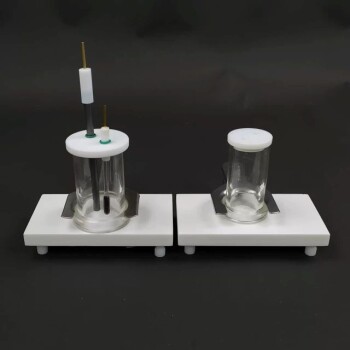
- H Type Electrolytic Cell Triple Electrochemical Cell
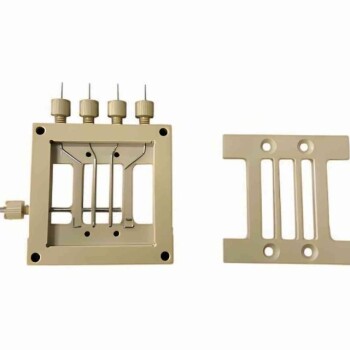
- PTFE Electrolytic Cell Electrochemical Cell Corrosion-Resistant Sealed and Non-Sealed
- Electrolytic Electrochemical Cell Gas Diffusion Liquid Flow Reaction Cell
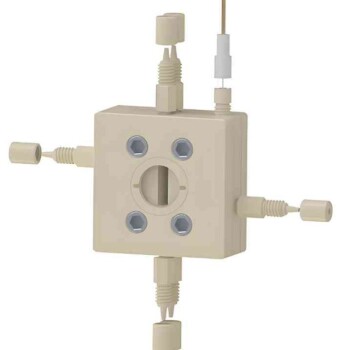
- Electrolytic Electrochemical Cell with Five-Port
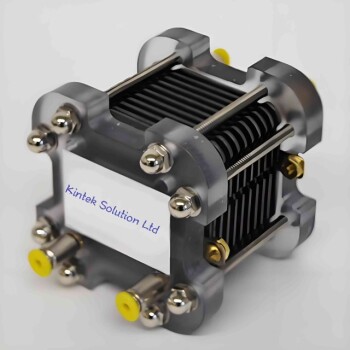
- Customizable PEM Electrolysis Cells for Diverse Research Applications
People Also Ask
- What is a H type cell? A Guide to Divided Electrochemical Cells for Accurate Experiments
- How should the electrolyte be prepared and added to the H-type electrolytic cell? Best Practices for Purity and Safety
- What is the technical necessity of using an H-type electrolytic cell for NO3RR tests? Protect Your Ammonia Yields
- How does the design of an H-type electrolytic cell benefit the neutral water electrolysis process for metal recovery?
- What is the primary function of an H-type electrolytic cell in NitRR? Ensure Accurate Product Yields