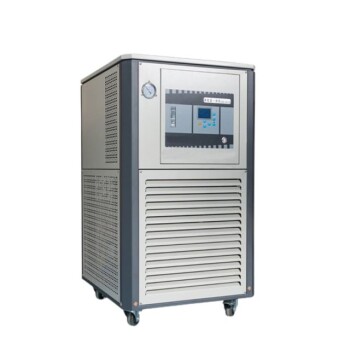
The hydrothermal technique utilizing a high-pressure reactor is essential for creating high-performance Ru@V2O4 nanocomposites. This method creates a subcritical aqueous environment that promotes precise phase transformation and uniform loading of ruthenium (Ru) onto vanadium tetroxide (V2O4) nanowires. By operating at relatively low temperatures under autogenous pressure, it ensures the resulting material maintains stable peroxidase and oxidase activities for sensitive colorimetric applications.
The core advantage of high-pressure hydrothermal synthesis lies in its ability to manipulate precursor solubility and crystallization kinetics simultaneously. This results in a nanocomposite with superior crystallinity and a highly stable interface between the noble metal catalyst and the oxide support.
Precision Engineering of Nanostructures
Achieving Uniform Particle Distribution
The high-pressure environment within an autoclave facilitates the uniform loading of Ru particles across the surface of V2O4 nanowires. This prevents the aggregation of metal particles, which is a common failure point in traditional mixing methods.
Consistent distribution is critical because it maximizes the active surface area available for catalytic reactions.
Morphological Control and Phase Purity
Operating in a sealed reactor allows for temperatures to exceed the atmospheric boiling point of water, which significantly increases the solubility of precursors. This environment provides the necessary kinetic conditions for the growth of V2O4 into specific nanowire shapes.
The autogenous pressure helps in achieving pure phases, ensuring that the vanadium maintains the desired tetroxide state without forming unwanted lithium-deficient or off-target compounds.
Enhanced Crystallinity at Lower Temperatures
The hydrothermal method promotes crystal growth and phase transformation at lower temperatures than solid-state synthesis. This lower thermal budget prevents the uncontrolled grain growth that can degrade the nanostructure of the V2O4 support.
Superior crystallinity directly translates to better electron transport and higher structural integrity during long-term use.
Optimizing the Material Interface
Strengthening Component Bonding
High-pressure conditions facilitate the formation of strong chemical bonds or tight physical contact between the Ru particles and the V2O4 nanowires. This "anchoring" effect is much more robust than simple physical adsorption.
A strong interface ensures that the Ru particles do not detach or migrate during catalytic cycles, which is vital for maintaining stable enzymatic activity.
Improving Reaction Kinetics
In a subcritical state, the dielectric constant of water changes, and its reaction activity increases. This accelerates the nucleation process, leading to a narrower particle size distribution for the Ru deposits.
Faster kinetics allow for the in-situ conversion of precursors, ensuring that the Ru is deposited exactly where the V2O4 surface is most receptive.
Understanding the Trade-offs
Equipment and Safety Requirements
Utilizing a high-pressure reactor requires specialized autoclave equipment capable of withstanding significant internal stress. This introduces higher initial capital costs and requires strict adherence to safety protocols to prevent vessel failure.
Scalability and Batch Processing
Hydrothermal synthesis is typically a batch process, which can limit the throughput compared to continuous manufacturing methods. Achieving identical results across larger volumes requires precise control over thermal gradients within the reactor.
Sensitivity to Reaction Parameters
Small deviations in temperature, pressure, or pH can drastically alter the final morphology of the Ru@V2O4 composite. This sensitivity requires rigorous optimization of the reaction window to ensure consistency between different production runs.
How to Apply This to Your Project
Selecting the Right Approach for Your Goal
The hydrothermal technique is a versatile tool, but its application should be tailored to your specific performance requirements for Ru@V2O4.
- If your primary focus is maximized catalytic sensitivity: Prioritize longer reaction times at moderate pressures to ensure the most uniform distribution of Ru active sites across the V2O4 nanowires.
- If your primary focus is long-term structural stability: Use higher pressure settings to promote stronger chemical anchoring and prevent the detachment of ruthenium during repeated use.
- If your primary focus is high-purity phase formation: Carefully control the precursor concentrations and utilize the autogenous pressure to suppress the formation of secondary vanadium oxide phases.
By leveraging the unique subcritical environment of a high-pressure reactor, you can engineer Ru@V2O4 nanocomposites with the structural precision required for advanced sensing and catalytic applications.
Summary Table:
| Feature | Advantage for Ru@V2O4 Synthesis | Performance Outcome |
|---|---|---|
| Subcritical Environment | Uniform Ru loading on V2O4 nanowires | Maximized catalytic surface area |
| Autogenous Pressure | Precision phase purity & morphology control | Stable enzymatic/sensing activity |
| Low-Temp Processing | Prevents uncontrolled grain growth | Enhanced crystallinity & electron transport |
| Sealed Interface | Strong chemical bonding between Ru & V2O4 | High durability during catalytic cycles |
Elevate Your Nanocomposite Research with KINTEK
Precision in hydrothermal synthesis starts with the right equipment. KINTEK specializes in high-performance high-pressure reactors and autoclaves, engineered to provide the stable subcritical environments necessary for uniform Ru@V2O4 loading and superior crystallinity.
Whether you are focusing on advanced sensing or catalytic applications, our comprehensive laboratory portfolio—including high-temperature furnaces, hydraulic presses, and specialized cooling solutions—ensures your lab has the tools to achieve consistent, high-purity results.
Ready to optimize your synthesis process? Contact KINTEK today to find the perfect solution for your project.
References
- Vy Anh Tran, Van Thuan Le. Recent Applications and Prospects of Nanowire-Based Biosensors. DOI: 10.3390/pr11061739
This article is also based on technical information from Kintek Solution Knowledge Base .
Related Products
- Customizable Laboratory High Temperature High Pressure Reactors for Diverse Scientific Applications
- High Pressure Laboratory Autoclave Reactor for Hydrothermal Synthesis
- Stainless High Pressure Autoclave Reactor Laboratory Pressure Reactor
- Customizable High Pressure Reactors for Advanced Scientific and Industrial Applications
- Mini SS High Pressure Autoclave Reactor for Laboratory Use
People Also Ask
- How do high-pressure and high-temperature reactors ensure the effective treatment of lignocellulosic wastewater in WAO?
- What equipment is required for high-pressure high-temperature reactions? Master Extreme Chemistry Safely
- How do you control high pressure in a reactor? A Guide to Safe & Stable Operation
- Why is argon better than nitrogen for inert atmosphere? Ensure Absolute Reactivity & Stability
- How does initial oxygen pressure affect the wet oxidation of pharmaceutical sludge? Master Your Oxidation Depth