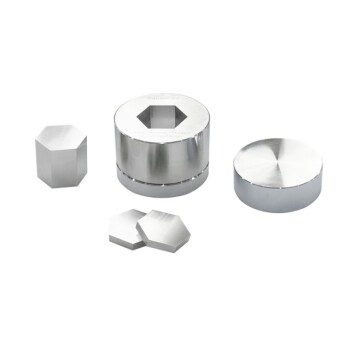
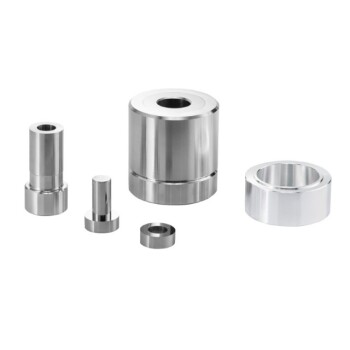
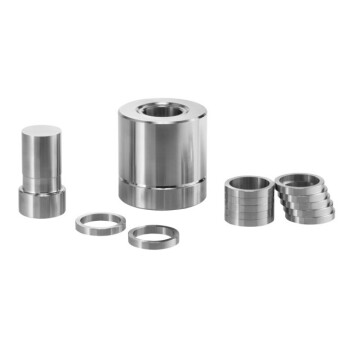
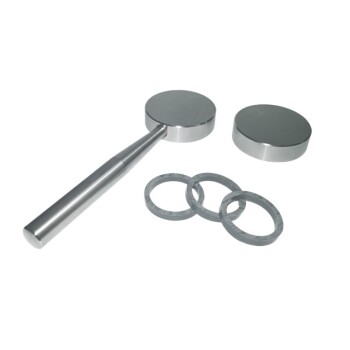
Titanium-Zirconium-Molybdenum (TZM) alloy serves as a critical performance bridge between standard steel and graphite tooling. It is specifically engineered to handle the rigorous processing demands of all-solid-state battery materials, enabling high-pressure sintering in the 700°C to 1100°C range where other mold materials fail.
Core Insight: TZM molds solve the "density-volatility paradox" in solid-state battery fabrication. By withstanding extreme pressures (up to 440 MPa) at moderate temperatures (up to 1100°C), they allow for the full densification of electrolytes like NASICON and LLZ/LCO without causing the lithium loss or structural failure common with steel or graphite alternatives.
Overcoming the Limitations of Standard Tooling
To understand the value of TZM, you must first understand the specific mechanical failure points of traditional mold materials.
The Thermal Limit of Steel
Standard steel molds offer high mechanical strength but suffer from a low thermal ceiling. They generally lose structural integrity at temperatures above 600°C, making them unsuitable for sintering ceramic electrolytes.
The Mechanical Weakness of Graphite
Graphite molds can withstand extremely high temperatures, but they lack mechanical robustness. They cannot support the high mechanical pressures required to densify difficult-to-sinter solids, often fracturing under significant load.
The TZM "Bridge"
TZM occupies a unique operational niche. It maintains high mechanical strength within the 700°C to 1100°C temperature window, effectively bridging the gap between the thermal limitations of steel and the strength limitations of graphite.
Enhancing Material Quality via High-Pressure Sintering
For materials like NASICON or LLZ/LCO, the processing environment dictates the final electrochemical performance. TZM allows for specific conditions that optimize this performance.
Achieving Superior Density
TZM molds can withstand pressures ranging from 300 to 440 MPa. This capability allows you to apply immense force to difficult-to-sinter solid-state electrolytes, resulting in higher material density and better ionic conductivity.
Preventing Lithium Volatilization
Lithium is highly volatile at elevated temperatures. Because TZM allows for high pressure, you can achieve densification at moderate temperatures rather than excessive ones, significantly reducing the rate of lithium loss.
Mitigating Unwanted Reactions
High temperatures often trigger unwanted interfacial reactions in composite cathode materials. By utilizing TZM to sinter at the lower end of the ceramic processing window, you preserve the chemical purity of your material interfaces.
Understanding the Trade-offs
While TZM is superior for specific applications, it is not a universal solution for all molding needs.
Specialized Operational Window
TZM is a specialized alloy designed for a specific thermal and pressure range. If your processing requirements are below 600°C, standard steel is likely a more cost-effective option.
Pressure vs. Temperature Balance
TZM is chosen specifically when both high pressure and moderate heat are required simultaneously. If your process requires heat above 1100°C but does not require high pressure, other refractory materials may be more appropriate.
Making the Right Choice for Your Goal
Selecting the correct mold material is a decision based on your specific processing parameters.
- If your primary focus is High Density at Moderate Temperatures: Choose TZM to leverage pressures up to 440 MPa without exceeding 1100°C, ensuring optimal densification.
- If your primary focus is Cost Efficiency below 600°C: Stick to high-grade steel molds, as they are sufficient for lower-temperature compaction.
- If your primary focus is Avoiding Lithium Loss: Use TZM to substitute high thermal energy with high mechanical energy, allowing you to sinter at temperatures that preserve stoichiometry.
By utilizing TZM, you effectively decouple the need for extreme heat from the need for high density, unlocking superior performance for solid-state battery components.
Summary Table:
| Feature | Steel Molds | Graphite Molds | TZM Alloy Molds |
|---|---|---|---|
| Temperature Range | Up to 600°C | Up to 2500°C+ | 700°C - 1100°C |
| Pressure Limit | High | Low (Fragile) | Very High (Up to 440 MPa) |
| Best For | Low-temp compaction | Ultra-high temp sintering | High-pressure densification |
| Key Benefit | Cost-effective | Thermal stability | Reduces Lithium volatility |
Elevate Your Solid-State Battery Research with KINTEK
Don't let material limitations compromise your battery performance. KINTEK specializes in advanced laboratory equipment and high-performance consumables designed for the most demanding research environments. Whether you are developing NASICON or LLZ/LCO electrolytes, our TZM alloy molds provide the mechanical strength and thermal stability needed to achieve superior material density without lithium loss.
From high-temperature furnaces (muffle, vacuum, CVD) and hydraulic pellet presses to specialized battery research tools, KINTEK is your partner in precision. Our expert team is ready to help you select the right tooling—from PTFE products and ceramics to high-pressure isostatic presses—to optimize your workflow.
Ready to achieve superior densification for your solid-state materials?
Contact KINTEK today for a customized solution!
Related Products
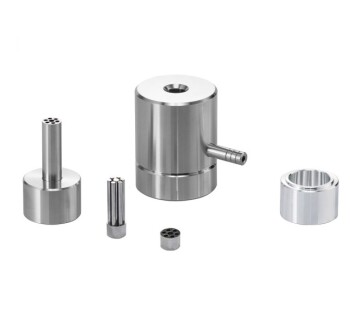
- Special Shape Press Mold for Lab
- Anti-Cracking Press Mold for Lab Use
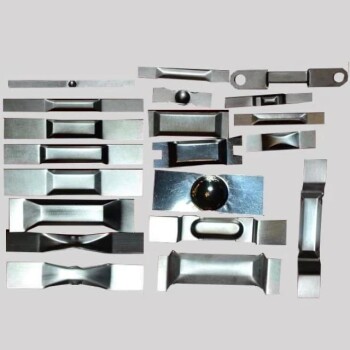
- Molybdenum Tungsten Tantalum Special Shape Evaporation Boat
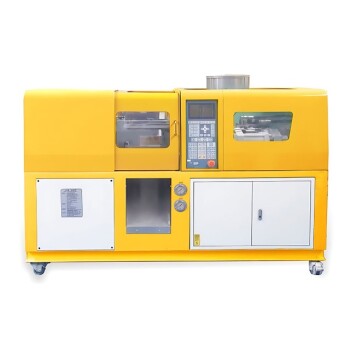
- Small Injection Molding Machine for Lab Use
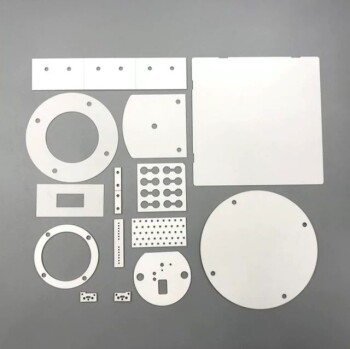
- Custom-Made Alumina Zirconia Special-Shaped Ceramic Plates for Engineering Advanced Fine Ceramics Processing
People Also Ask
- How to use a press mold? Master the Art of Creating Consistent Ceramic Forms
- What is the press mould method? A Guide to Consistent, Detailed Ceramic Forms
- Why are pressure molds with non-conductive resin inner walls required for battery testing? Ensure Data Accuracy
- What is the purpose of specialized pressure devices in sulfide solid-state batteries? Ensure Chemo-Mechanical Stability
- What is the function of press molds during the preparation of SiCf/Ti-43Al-9V composites? Achieve Structural Precision