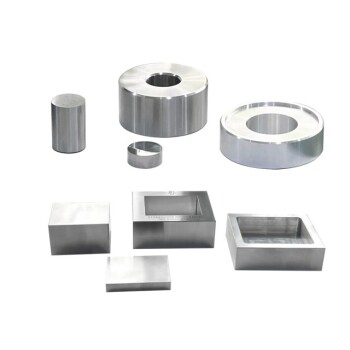
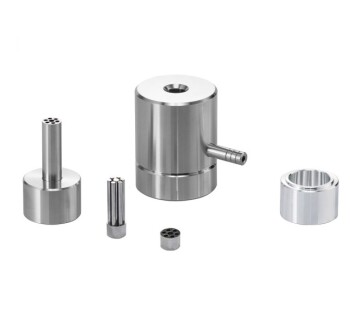
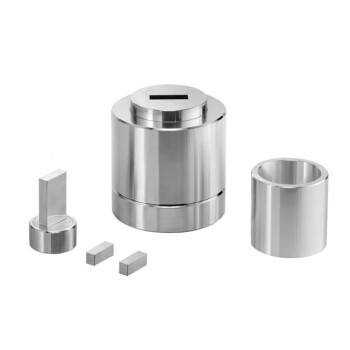
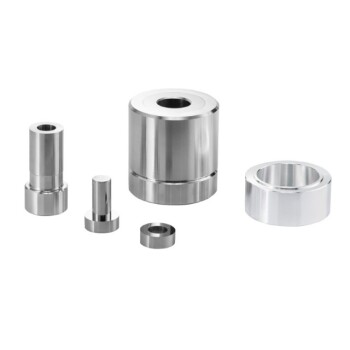
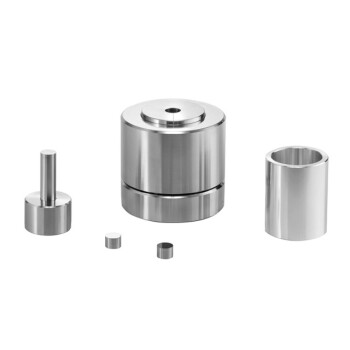
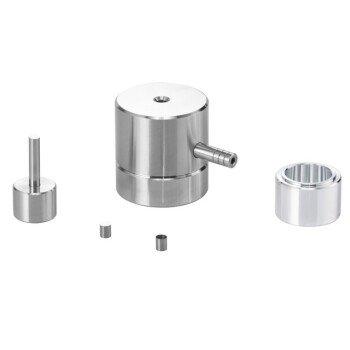
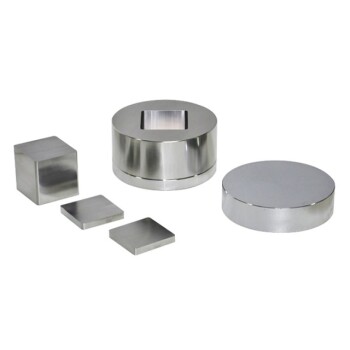
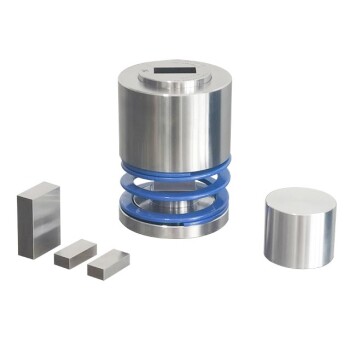
In the fabrication of Ruthenium sheets, molds act as the critical interface for transferring extreme mechanical pressure and thermal energy to the raw powder. Specifically, they facilitate the application of 40 MPa of pressure at temperatures up to 1250°C, forcing irregular Ruthenium particles into the mechanical interlocking required for high-density solidification.
Core Takeaway The mold is not merely a container; it is an active tool that determines the structural integrity of the final Ruthenium sheet. Its ability to maintain rigidity under high heat and pressure directly dictates the material's dimensional accuracy, density distribution, and freedom from macroscopic defects.
The Mechanics of Powder Densification
Transferring Precise Mechanical Pressure
In hot pressing scenarios, the mold serves as the vessel for applying 40 MPa of pressure directly to the Ruthenium powder body.
This pressure is not passive; it forces irregular powder particles into tight, cohesive contact. This contact initiates the mechanical interlocking necessary to transform loose powder into a solid structure.
Facilitating Particle Rearrangement
Before full densification occurs, the mold allows for the initial rearrangement of particles.
By confining the powder within specific diameters during hydraulic pressing, the mold ensures that the particles shift into a packed configuration. This sets the foundation for a uniform internal structure.
Managing Thermal Extremes
Withstanding High Process Temperatures
Ruthenium processing requires environments reaching 1250°C.
The mold material must possess exceptional thermal stability to endure these temperatures without degrading. If the mold softens or reacts chemically at this threshold, the purity and shape of the Ruthenium sheet are compromised.
Ensuring Dimensional Accuracy
The rigidity of the mold at high temperatures is the primary factor controlling the final shape of the "green body" (the compacted powder).
A mold that maintains its exact geometry under heat ensures the final sheet meets precise dimensional specifications. It prevents the warping or distortion that can occur during the transition from powder to solid.
The Role in Hydraulic Pre-Pressing
Air Expulsion and Defect Prevention
In laboratory hydraulic presses, the mold facilitates the compaction of mixed powders into green compacts with specific relative densities (often targeting 75% or higher).
This compression expels the air trapped between powder particles. Removing this air is essential to prevent macroscopic defects and voids in the final product.
Establishing Uniform Density
The mold ensures that pressure is maintained precisely and evenly across the entire surface area of the sheet.
This uniformity leads to a consistent density distribution throughout the Ruthenium sheet. Without this uniform containment, the material would suffer from weak spots or porous zones that undermine its mechanical strength.
Understanding the Trade-offs
Rigidity vs. Thermal Shock
While molds must be extremely rigid to ensure dimensional accuracy, high rigidity materials can sometimes be susceptible to thermal shock.
Selecting a mold material that is too brittle may lead to cracking under rapid temperature changes, whereas a material that is too ductile may deform under the 40 MPa pressure load.
Pressure Uniformity vs. Friction
The mold walls must contain the powder, but friction between the powder and the mold wall can create density gradients.
If the mold design does not account for this, the edges of the Ruthenium sheet may have a different density than the center, leading to inconsistent performance in the final application.
Making the Right Choice for Your Goal
When selecting mold parameters for Ruthenium sheet fabrication, prioritize your specific engineering outcomes:
- If your primary focus is Structural Integrity: Prioritize mold designs that allow for maximum pressure application (40 MPa) to ensure complete particle interlocking and air expulsion.
- If your primary focus is Dimensional Precision: Select mold materials with the highest available thermal stability and rigidity to prevent deformation at 1250°C.
By viewing the mold as a precision instrument rather than a passive container, you ensure the successful transformation of Ruthenium powder into high-performance sheets.
Summary Table:
| Parameter | Role in Ruthenium Fabrication | Impact on Final Product |
|---|---|---|
| Pressure Transfer | Applies 40 MPa mechanical force | Ensures particle interlocking & high density |
| Thermal Stability | Operates at temperatures up to 1250°C | Prevents material warping & chemical impurities |
| Compaction Control | Expels air during hydraulic pre-pressing | Eliminates macroscopic defects and voids |
| Dimensional Rigidity | Maintains precise geometric constraints | Guarantees dimensional accuracy & uniformity |
Elevate Your Advanced Material Research with KINTEK
Precision-engineered Ruthenium sheets require the perfect balance of force and temperature. KINTEK specializes in providing the high-performance laboratory equipment and consumables needed for extreme materials science, including:
- Hydraulic Presses: Pellet, hot, and isostatic systems for uniform density.
- High-Temperature Furnaces: Muffle, vacuum, and atmosphere furnaces capable of exceeding 1250°C.
- High-End Consumables: Precision-machined molds, ceramics, and crucibles designed for thermal extremes.
Whether you are refining battery research or developing high-pressure reactors, KINTEK offers the technical expertise to optimize your workflow. Contact KINTEK today to discuss your laboratory needs and ensure your materials meet the highest standards of structural integrity.
Related Products
- Ball Press Mold for Lab
- Double Plate Heating Press Mold for Lab
- Special Heat Press Mold for Lab Use
- Anti-Cracking Press Mold for Lab Use
- Special Shape Press Mold for Lab
People Also Ask
- What are the advantages of using a laboratory hydraulic press for hot pressing? Achieve Peak Nano-Composite Density
- How to use a press mold? Master the Art of Creating Consistent Ceramic Forms
- What is the press mould method? A Guide to Consistent, Detailed Ceramic Forms
- What is the purpose of specialized pressure devices in sulfide solid-state batteries? Ensure Chemo-Mechanical Stability
- Why are pressure molds with non-conductive resin inner walls required for battery testing? Ensure Data Accuracy