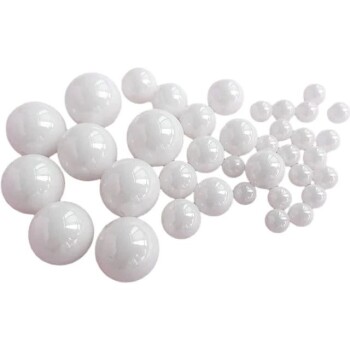
The primary advantages of using zirconia grinding media are its exceptional hardness, density, and superior wear resistance. For the micronization of waste simulants, these properties are essential to generate the high-energy mechanical impact required for refinement while ensuring the sample remains free from equipment-induced contamination.
Core Insight: Zirconia (ZrO2) is the material of choice when the integrity of the sample is paramount. Its combination of high density and extreme hardness allows for efficient particle reduction without shedding material into the sample, thereby preserving the precise chemical composition of sensitive mixtures like Cs-aluminosilicate waste simulants.
The Mechanics of Efficient Micronization
High Density for Maximum Impact
The effectiveness of a ball mill relies heavily on the kinetic energy generated by the grinding media. Zirconia is a high-density material. This physical property ensures that the grinding balls carry significant momentum, generating the intense mechanical impact necessary to break down robust materials efficiently.
Hardness and Shear Force
To refine powder effectively, the grinding media must be significantly harder than the material being processed. Zirconia provides high hardness, which facilitates the generation of strong shear forces during the milling process. These forces are critical for achieving the fine particle sizes required in micronization.
Preserving Sample Integrity
Superior Wear Resistance
One of the most critical challenges in powder milling is the degradation of the grinding media itself. Zirconia exhibits superior wear resistance compared to softer alternatives. This durability prevents the grinding balls and jar interior from degrading during prolonged milling sessions.
Eliminating Contamination
The direct result of wear resistance is purity. Because zirconia does not easily erode, no significant contaminants from the grinding media enter the sample. This is vital when working with Cs-aluminosilicate radioactive waste simulants, where maintaining a precise chemical composition is necessary for accurate experimental results.
Understanding the Trade-offs
Cost vs. Performance
While zirconia offers superior performance regarding hardness and contamination control, it is generally more expensive than common alternatives like stainless steel. You are paying a premium specifically for the chemical inertness and high density that lower-cost materials cannot provide.
Handling and Brittleness
Despite its hardness, zirconia is a ceramic and can be brittle if mishandled. Unlike metal jars which may dent upon impact, ceramic components can crack or shatter if dropped. Care must be taken during the loading and cleaning phases to avoid physical shock to the jars or balls.
Making the Right Choice for Your Goal
To ensure your micronization process yields the best data, consider your specific analytical requirements:
- If your primary focus is Chemical Purity: Choose zirconia to prevent cross-contamination and preserve the exact chemical composition of sensitive simulants.
- If your primary focus is Milling Efficiency: Rely on zirconia’s high density to generate the necessary mechanical impact and shear forces for rapid powder refinement.
Zirconia offers the optimal balance of mechanical power and chemical inertness for high-precision waste simulant research.
Summary Table:
| Feature | Zirconia (ZrO2) Benefit | Impact on Micronization |
|---|---|---|
| Hardness | Extremely High | Generates strong shear forces for fine particle sizes |
| Density | High Mass/Volume | Maximizes kinetic energy and mechanical impact |
| Wear Resistance | Superior Durability | Prevents media erosion and equipment-induced debris |
| Chemical Purity | Inert & Non-reactive | Eliminates contamination in sensitive waste simulants |
| Maintenance | Low Degradation | Long-lasting performance despite high-energy milling |
Elevate Your Milling Precision with KINTEK
Don't let equipment wear compromise your sensitive research results. At KINTEK, we specialize in high-performance laboratory solutions designed for the most demanding powder processing tasks. Whether you are working with Cs-aluminosilicate waste simulants or advanced ceramics, our zirconia grinding jars and balls, crushing and milling systems, and sieving equipment provide the purity and durability you need.
From high-temperature furnaces and vacuum reactors to our precision hydraulic presses and PTFE consumables, KINTEK delivers the reliable tools required for breakthrough material science.
Ready to optimize your micronization process? Contact our experts today to find the perfect milling media and laboratory equipment tailored to your specific application.
References
- Guido Cerri, Antonio Brundu. A Six-Year Hydration Evaluation of Cs-Bearing Materials at Room Temperature and 55% Relative Humidity Simulating Radioactive Waste with Different Crystallinities. DOI: 10.3390/molecules29061302
This article is also based on technical information from Kintek Solution Knowledge Base .
Related Products
- Laboratory Jar Ball Mill with Alumina Zirconia Grinding Jar and Balls
- Precision Machined Zirconia Ceramic Ball for Engineering Advanced Fine Ceramics
- Laboratory Jar Mill with Agate Grinding Jar and Balls
- Laboratory Ball Mill Jar Mill with Metal Alloy Grinding Jar and Balls
- Nature Agate Mortar and Pestle for Grinding and Mixing
People Also Ask
- What are the primary functions of using a ball mill for BZCY72 powder? Achieve High Purity and Enhanced Sintering
- In what way does a laboratory ball mill affect material properties when modifying PHBV/pulp fiber composites?
- Why is a laboratory ball mill required for ultra-fine fly ash? Unlock Nano-Scale Adsorption Power
- What is the function of a laboratory ball mill in the preparation of AMMCs? Optimize Dispersion & Grain Refinement
- What is the function of a laboratory ball mill in the pretreatment of waste tire char (WTC)? Optimize Material Reactivity