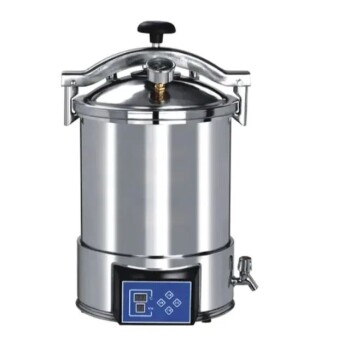
The fundamental advantage of high-temperature high-pressure (HTHP) reactors is their ability to maintain solvents in a liquid state far beyond their atmospheric boiling points. This sealed environment creates a unique thermodynamic landscape that dramatically increases reactant solubility and accelerates reaction kinetics. Unlike standard glass containers limited by solvent evaporation, autoclaves enable hydrothermal and solvothermal synthesis pathways essential for producing advanced nanomaterials and complex intermetallics.
HTHP reactors transcend the physical limits of atmospheric chemistry by leveraging pressure to intensify reactions and control solvent behavior. This leads to higher yields, faster production cycles, and the ability to synthesize highly ordered nanostructures that are impossible to create in open-air systems.
Overcoming the Thermal Ceiling
Maintaining Liquid Phases at Extreme Temperatures
Standard glass containers are limited by the boiling point of the solvent; once reached, temperature plateaus and the solvent evaporates. HTHP reactors use a sealed design to prevent evaporation, allowing the reaction to remain in a liquid phase at temperatures significantly higher than normal.
Enhanced Solubility and Solvent Penetration
High pressure forces the solvent to penetrate deep into the crystalline regions of precursors, such as cellulose or MAX phase layers. This increased solubility allows reactants to dissolve and interact more effectively, facilitating the deconstruction of tough materials or the etching of complex layers.
Managing Solvent Diffusion Kinetics
At elevated temperatures and pressures, the diffusion kinetics of atoms are greatly enhanced. This allows the system to overcome high energy barriers for atomic rearrangement directly within the liquid phase, which is critical for achieving precise chemical compositions.
Catalyzing Kinetic Efficiency and Quality
Accelerating Reaction Rates
Pressure directly boosts the reaction rate by reducing the volume of reactants, which increases concentration and collision frequency. This "process intensification" allows slow chemical reactions to be completed in a fraction of the time required by atmospheric methods.
Direct Synthesis of Ordered Nanostructures
Autoclaves enable the direct synthesis of highly ordered intermetallic nanocrystals without the need for subsequent drying or high-temperature annealing. This "one-pot" approach preserves the specific nanomaterial morphologies and crystal structures that are often destroyed by traditional post-processing steps.
Shifting Chemical Equilibrium
Increased pressure can shift a chemical equilibrium toward the side of the reaction with fewer moles of gas. This allows researchers to manipulate the yield and selectivity of a reaction, ensuring that the desired product is favored over unwanted byproducts.
Understanding the Trade-offs and Risks
Operational Complexity and Safety
Unlike transparent glass containers, HTHP reactors are typically made of stainless steel or alloys, meaning the reaction cannot be observed visually. Furthermore, the extreme internal pressure requires rigorous safety protocols to prevent vessel failure or explosions.
Initial Capital Investment
The cost of an autoclave system is significantly higher than standard laboratory glassware. While they offer cost efficiency in the long run through faster production and higher quality, the initial investment can be a barrier for very small-scale operations.
Material Compatibility and Corrosion
High-pressure environments can accelerate the corrosion of the reactor walls, especially when using halide salts or strong acids. Choosing the correct liner (such as PTFE or PPL) is essential to protect the vessel and prevent contamination of the synthesis.
How to Apply This to Your Synthesis Goals
Strategic Recommendations
When deciding between HTHP reactors and standard glassware, consider your primary objective for the material being synthesized:
- If your primary focus is synthesizing specific nanomaterial morphologies: Use an autoclave to leverage hydrothermal conditions that allow for precise control over crystal growth and shape.
- If your primary focus is increasing production throughput: Choose a high-pressure reactor to accelerate reaction kinetics, significantly shortening the time required for each batch.
- If your primary focus is energy-efficient material processing: Utilize the internal pressure of a reactor to achieve direct synthesis, eliminating the need for energy-intensive secondary annealing steps.
- If your primary focus is simple, atmospheric-temperature screening: Stick with standard glass containers to maintain visual monitoring and minimize equipment setup complexity.
By moving beyond the constraints of atmospheric pressure, you gain the ability to manipulate matter at a fundamental level, unlocking chemical pathways that redefine what is possible in the laboratory.
Summary Table:
| Feature | HTHP Reactor (Autoclave) | Standard Glass Container |
|---|---|---|
| Temperature Limit | Far exceeds solvent boiling point | Restricted to solvent boiling point |
| Reaction Kinetics | Accelerated via process intensification | Limited by atmospheric pressure |
| Solubility | Enhanced; penetrates crystalline layers | Standard liquid-phase solubility |
| Material Synthesis | Direct production of ordered nanocrystals | Often requires post-process annealing |
| Monitoring | Remote sensor tracking required | Direct visual observation |
| Safety/Design | High-strength alloys (Stainless/Steel) | Borosilicate glass (Fragile) |
Elevate Your Synthesis Capabilities with KINTEK
Take your research beyond the constraints of atmospheric pressure. KINTEK specializes in high-performance laboratory equipment, providing researchers with the precision tools needed for advanced material science. Our robust portfolio features high-temperature high-pressure reactors and autoclaves designed for safety, durability, and superior kinetic control.
From hydrothermal synthesis to complex intermetallic production, KINTEK offers a comprehensive range of solutions, including:
- Thermal Systems: Muffle, tube, vacuum, and CVD furnaces.
- Sample Preparation: Crushing, milling, and high-pressure hydraulic presses.
- Lab Essentials: Electrolytic cells, cooling solutions, and premium consumables like PTFE products and ceramic crucibles.
Ready to optimize your production throughput and material quality? Contact KINTEK today to consult with our experts and find the ideal reactor system tailored to your specific synthesis goals.
References
- Huixiang Li, Z. Conrad Zhang. Understanding the Role of Base Species on Reversed Cu Catalyst in Ring Opening of Furan Compounds to 1, 2‐Pentanediol. DOI: 10.1002/cssc.202300880
This article is also based on technical information from Kintek Solution Knowledge Base .
Related Products
- High Pressure Laboratory Autoclave Reactor for Hydrothermal Synthesis
- Customizable Laboratory High Temperature High Pressure Reactors for Diverse Scientific Applications
- Stainless High Pressure Autoclave Reactor Laboratory Pressure Reactor
- Mini SS High Pressure Autoclave Reactor for Laboratory Use
- Customizable High Pressure Reactors for Advanced Scientific and Industrial Applications
People Also Ask
- What role does a high-pressure reactor (autoclave) play in the synthesis of NiCuFe-LDH? Master Hydrothermal Growth
- What Role Does a High-Pressure Reactor or Autoclave Play in HA Catalyst Synthesis? Achieve High Surface Area Materials
- What equipment is required for hydrothermal synthesis of Ga0.25Zn4.67S5.08? Optimize Your Semiconductor Production
- What is the function of a high-pressure reactor in the hydrothermal synthesis of boehmite? Expert Process Insights
- What role does an autoclave play in the synthesis of MnO2 nanofibers? Mastering Hydrothermal Growth