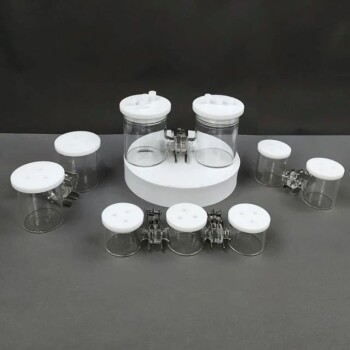
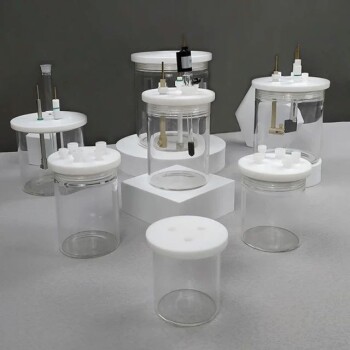
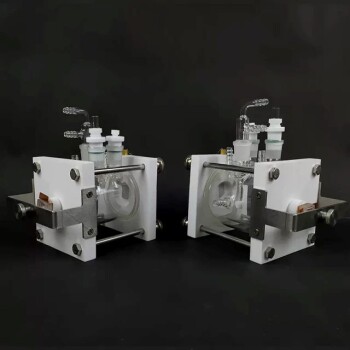
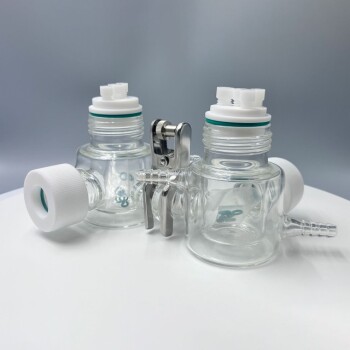
A standard three-electrode electrolytic cell system is the fundamental apparatus used to isolate and evaluate the performance of electrocatalysts with high precision. This setup employs three specific components—a working electrode, a platinum wire counter electrode, and a hydrogen reference electrode—to decouple the measurement of potential from the flow of current.
By stabilizing the electrochemical interface, this configuration eliminates critical errors such as ohmic polarization and potential fluctuations, ensuring that the data reflects the catalyst's true intrinsic properties.
The Three Critical Components
The Working Electrode
This is the site where the reaction of interest occurs. The material being tested (the electrocatalyst) is applied here.
It is the primary focus of the assessment, reflecting the intrinsic activity of the catalyst.
The Platinum Wire Counter Electrode
This electrode serves to complete the electrical circuit. It allows current to flow through the cell without interfering with the measurement at the working electrode.
Using a platinum wire ensures a stable and conductive pathway for the current.
The Hydrogen Reference Electrode
This electrode provides a stable, known potential against which the working electrode is measured.
Because no current flows through this specific electrode, its potential remains constant, providing a reliable baseline for the precise potential control required in the system.
The Mechanics of Precision
Eliminating Ohmic Polarization
In simpler systems, resistance within the solution can distort measurements, a phenomenon known as ohmic polarization.
The three-electrode setup removes this effect from the potential measurement, ensuring the voltage reading is accurate to the interface surface.
Preventing Potential Fluctuations
If the counter electrode were used as a reference, its potential would shift as current passed through it.
By separating these functions, the system eliminates counter electrode potential fluctuations, maintaining a rigid control over the electrochemical environment.
Analyzing Catalyst Capabilities
Measuring Intrinsic Activity
This system allows for advanced techniques like cyclic voltammetry (CV).
This technique provides a direct window into the fundamental efficiency and reaction kinetics of the electrocatalyst.
Assessing Durability and Anti-Poisoning
The precise control enables specific tests such as carbon monoxide stripping (COads-stripping).
These tests reveal how well the catalyst resists degradation over time and its anti-poisoning capabilities when exposed to contaminants.
Common Pitfalls to Avoid
Misinterpreting Uncorrected Data
Without the strict separation provided by this system, data is often skewed by external resistance (iR drop).
If one fails to utilize a proper three-electrode configuration, the resulting data may measure the cell's resistance rather than the catalyst's actual performance.
Compromising the Reference Baseline
Reliability depends entirely on the stability of the hydrogen reference electrode.
If this reference drifts or is not properly maintained, the "precise potential control" is lost, rendering measurements of durability and activity invalid.
Making the Right Choice for Your Goal
To ensure your electrocatalytic assessment yields actionable data, consider the following:
- If your primary focus is determining true reaction kinetics: Ensure your setup specifically eliminates ohmic polarization to isolate the intrinsic activity of the working electrode.
- If your primary focus is long-term stability: Utilize COads-stripping and cyclic voltammetry within this setup to accurately stress-test the catalyst's durability and anti-poisoning properties.
The three-electrode system is not just a tool; it is the prerequisite for separating a catalyst's true potential from experimental noise.
Summary Table:
| Component | Role | Key Benefit |
|---|---|---|
| Working Electrode | Site of Reaction | Measures intrinsic activity of the electrocatalyst |
| Counter Electrode | Completes Circuit | Stabilizes current flow via platinum wire |
| Reference Electrode | Potential Baseline | Provides precise control; eliminates potential fluctuations |
| Three-Electrode System | Decoupled Interface | Eliminates ohmic polarization and iR drop errors |
Elevate Your Electrochemical Research with KINTEK
Precise electrocatalytic assessment starts with high-quality equipment designed for accuracy. KINTEK specializes in high-performance laboratory solutions, providing the robust electrolytic cells and electrodes needed to eliminate ohmic polarization and capture true reaction kinetics.
Whether you are conducting cyclic voltammetry or CO-stripping tests, our comprehensive range—including high-temperature reactors, battery research tools, and precision ceramics—is engineered to meet the rigorous demands of material science.
Ready to achieve superior data precision? Contact our experts today to find the perfect electrolytic system and laboratory consumables for your research goals.
References
- Ilgar Ayyubov, András Tompos. Preparation of Pt electrocatalyst supported by novel, Ti(1−x)MoxO2-C type of composites containing multi-layer graphene. DOI: 10.1007/s11144-021-02138-x
This article is also based on technical information from Kintek Solution Knowledge Base .
Related Products
- H Type Electrolytic Cell Triple Electrochemical Cell
- Electrolytic Electrochemical Cell Gas Diffusion Liquid Flow Reaction Cell
- Electrolytic Electrochemical Cell with Five-Port
- PTFE Electrolytic Cell Electrochemical Cell Corrosion-Resistant Sealed and Non-Sealed
- Super Sealed Electrolytic Electrochemical Cell
People Also Ask
- What is a H type cell? A Guide to Divided Electrochemical Cells for Accurate Experiments
- How should the electrolyte be prepared and added to the H-type electrolytic cell? Best Practices for Purity and Safety
- What is the technical necessity of using an H-type electrolytic cell for NO3RR tests? Protect Your Ammonia Yields
- How does the design of an H-type electrolytic cell benefit the neutral water electrolysis process for metal recovery?
- What is the primary function of an H-type electrolytic cell in NitRR? Ensure Accurate Product Yields