In forensic science, connecting a suspect to a crime scene often depends on analyzing microscopic traces of evidence. X-ray Fluorescence (XRF) is a powerful analytical technique that makes this possible by revealing the elemental composition of materials. It is used to non-destructively "fingerprint" evidence like gunshot residue, glass fragments, soil, and paint chips, providing critical links in an investigation.
The true value of XRF in forensics is its ability to perform rapid, non-destructive elemental analysis. This preserves irreplaceable evidence for other tests while providing immediate investigative leads, often directly at the crime scene.
The Core Principle: Why XRF is a Forensic Game-Changer
XRF operates by bombarding a sample with high-energy X-rays. This causes the atoms within the sample to emit their own secondary "fluorescent" X-rays. Because each element emits X-rays at a unique energy level, the instrument can identify precisely which elements are present and in what relative amounts.
Non-Destructive Analysis is Key
The most significant advantage of XRF is that it does not damage or consume the sample. The evidence remains intact after analysis.
This is critical in forensics, as it allows the same piece of evidence—a paint chip or fabric swatch—to be subjected to other tests later, such as DNA analysis or microscopy.
Rapid, On-Site Screening
Modern portable XRF (pXRF) analyzers are handheld devices that deliver results in seconds.
Investigators can use these instruments at a crime scene to perform immediate triage on evidence. For example, they can quickly screen a wall for the presence of heavy metals indicative of a bullet impact or test soil on a suspect's boot to see if it's consistent with the scene.
Elemental Fingerprinting for Comparison
Every material has a unique elemental signature. Two glass fragments may look identical, but XRF can reveal subtle differences in their trace element composition (like strontium or zirconium).
This allows an examiner to compare evidence found on a suspect with a known source from the crime scene, establishing a powerful associative link. If the elemental fingerprints match, it provides strong evidence that they originated from the same source.
Key Forensic Applications in Detail
XRF's versatility makes it applicable to a wide range of common evidence types encountered in criminal investigations.
Gunshot Residue (GSR) Analysis
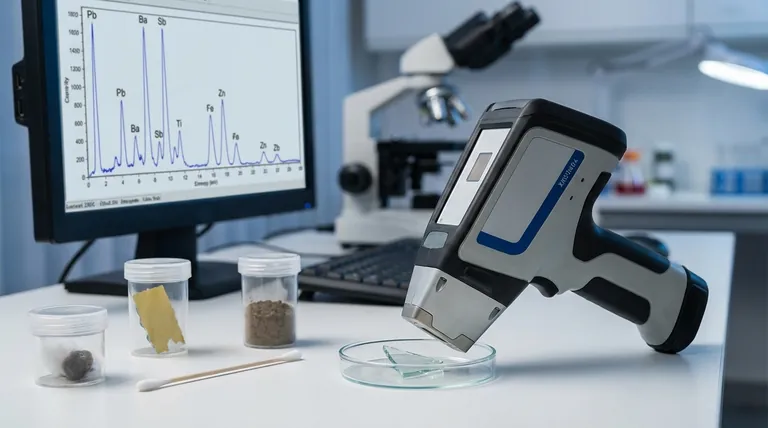
When a firearm is discharged, it expels a cloud of microscopic particles from the primer. XRF can instantly detect the key elements of this residue—lead (Pb), barium (Ba), and antimony (Sb)—on a suspect's hands, clothing, or vehicle interior.
Glass Fragment Comparison
In hit-and-run or burglary cases, XRF is used to compare the elemental composition of glass fragments. By matching the trace elements in glass found on a suspect's clothing to a broken headlight or window at the scene, investigators can link the suspect to the location.
Soil and Mineral Analysis
Soil on shoes, tires, or tools can be a crucial link to a specific location. XRF analyzes the unique elemental profile of the soil, comparing its mineral content to samples taken from a crime scene, body dump site, or alibi location.
Paint Chip Examination
In hit-and-run incidents, XRF helps identify a vehicle by analyzing the elemental composition of paint chips. Different layers of paint (primer, base coat, clear coat) contain distinct pigments and fillers with elements like titanium (Ti), iron (Fe), and zinc (Zn), which can be matched to automotive paint databases.
Questioned Documents and Art Forgery
XRF can identify the specific inorganic elements used in ink pigments. This helps determine if a document is fraudulent by detecting modern ink formulations on a document purported to be historical. The same principle applies to detecting art forgeries by identifying pigments that were not available during the artist's lifetime.
Understanding the Limitations and Trade-offs
While powerful, XRF is not a universal solution. Understanding its limitations is crucial for proper interpretation of results.
A Surface-Level Technique
XRF analysis is surface-sensitive, typically penetrating only a few micrometers to millimeters into a sample. It cannot see through thick layers of paint or contamination. If the evidence is coated in dirt or another substance, that surface layer must be analyzed or removed first.
Limited Light Element Detection
Standard XRF instruments are not effective at detecting very light elements (those with an atomic number below magnesium, such as carbon, nitrogen, and oxygen). Therefore, it cannot be used to analyze many organic compounds, which are the primary focus of other forensic techniques like mass spectrometry.
Not a Standalone Solution
XRF identifies what elements are present but does not typically reveal their chemical structure. For example, it can detect iron but cannot distinguish whether it is pure metal, rust (iron oxide), or part of a pigment. For this reason, XRF is often used as a screening tool, with results confirmed by other methods like Scanning Electron Microscopy with Energy Dispersive X-ray Spectroscopy (SEM-EDS).
How to Apply This to Your Investigation
Your analytical approach should be guided by your primary objective for the evidence in question.
- If your primary focus is rapid field screening: Use portable XRF for on-site triage of evidence like soil, potential bullet holes, or large metal fragments to get immediate investigative leads.
- If your primary focus is linking evidence to a source: Use high-precision lab-based XRF to compare the exact elemental fingerprints of trace evidence like glass, paint, or GSR.
- If your primary focus is preserving evidence for multiple tests: Always use XRF before any destructive methods, as its non-destructive nature ensures the sample remains pristine for DNA or other chemical analyses.
By understanding both its capabilities and its boundaries, XRF becomes an indispensable tool for revealing the silent elemental story told by physical evidence.
Summary Table:
| Forensic Application | Key Evidence Analyzed | Primary XRF Benefit |
|---|---|---|
| Gunshot Residue (GSR) Analysis | Hands, clothing for Pb, Ba, Sb | Rapid, on-site screening |
| Glass Fragment Comparison | Broken windows, headlights | Elemental fingerprinting for source matching |
| Paint Chip Examination | Vehicle paint layers | Non-destructive multi-layer analysis |
| Soil and Mineral Analysis | Soil on shoes, tires | Links suspect to specific location |
| Questioned Documents/Art | Ink pigments | Detects forgeries by identifying anachronistic elements |
Ready to Integrate Non-Destructive Elemental Analysis into Your Forensic Workflow?
As a leading specialist in laboratory equipment, KINTEK provides the precise, reliable XRF analyzers that forensic teams depend on to uncover critical evidence. Our solutions deliver the rapid, non-destructive analysis you need to preserve evidence while building strong, elementally-supported cases.
Let KINTEK empower your investigation:
- Achieve rapid, on-site results with our portable XRF (pXRF) analyzers.
- Preserve priceless evidence for subsequent DNA or chemical testing with non-destructive analysis.
- Gain conclusive comparative data to definitively link evidence to a source.
Contact our forensic equipment experts today to find the perfect XRF solution for your lab's specific needs.
Visual Guide

Related Products
- XRF Boric Acid Lab Powder Pellet Pressing Mold for Laboratory Use
- XRF & KBR plastic ring lab Powder Pellet Pressing Mold for FTIR
- Laboratory Hydraulic Pellet Press for XRF KBR FTIR Lab Applications
- Automatic Laboratory Hydraulic Press for XRF & KBR Pellet Press
- XRD Sample Holder X-ray Diffractometer Powder Slide
People Also Ask
- What is the XRF method of sampling? Achieve Accurate Elemental Analysis with Proper Sample Prep
- How do you prepare a pellet press sample for XRF? A Step-by-Step Guide to Accurate Analysis
- How does a laboratory powder pellet press facilitate the preparation of multi-layered gradient Al2O3/ZrO2 ceramic green bodies? Precision Bonding Techniques
- How does the selection of a pressure mold affect the performance of all-solid-state batteries? Expert Pelletizing Guide
- How to make XRF pellets? A Step-by-Step Guide for Accurate Sample Preparation