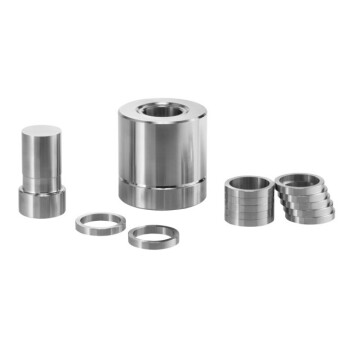
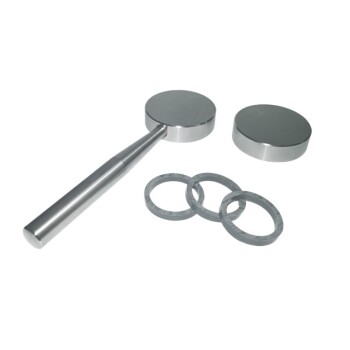
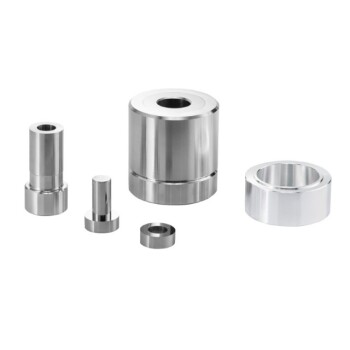
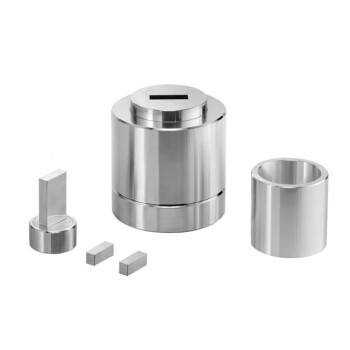
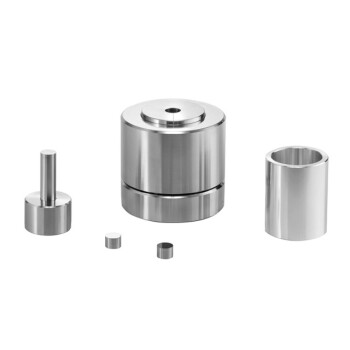
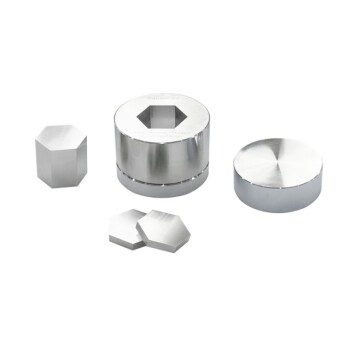
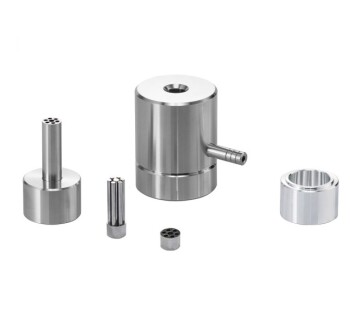
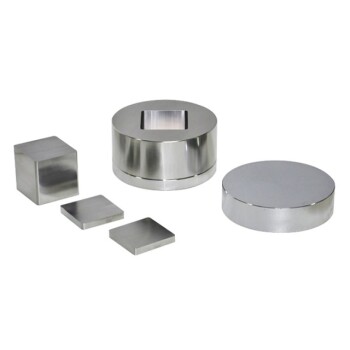
The selection of a pressure mold is a determinant factor in the structural integrity and electrochemical performance of all-solid-state batteries. Because solid-state components lack the wetting properties of liquid electrolytes, the mold must withstand immense pressures—often reaching hundreds of megapascals—to force rigid ceramic and electrode particles into a dense, cohesive pellet.
Core Takeaway To achieve viable battery performance, pressure molds must combine extreme hardness with an impeccable surface finish. These properties are non-negotiable for producing electrolyte layers with high density and uniform thickness, which are the primary defenses against mechanical cracking, lithium dendrite penetration, and internal short circuits.
The Critical Role of Mold Hardness
Withstanding Extreme Compaction Forces
Solid-state battery materials, particularly ceramic electrolytes, are rigid. Unlike liquid batteries, they rely entirely on mechanical pressure to establish ionic pathways.
The mold must possess exceptional hardness to apply pressures often exceeding 300 MPa without deforming. If the mold yields even slightly, the applied pressure becomes inconsistent, leading to porous, unusable pellets.
Ensuring Particle-to-Particle Contact
High pressure is required to reduce interfacial impedance. The mold forces the cathode, solid electrolyte, and anode particles into intimate physical contact.
A robust mold ensures that this contact is maintained across the entire surface area, creating the percolation network necessary for ion transport.
Surface Finish and Uniformity
Eliminating Density Gradients
A mold with a rough or uneven surface will distribute pressure unequally across the powder bed. This creates "density gradients"—areas where the material is tightly packed next to areas where it is loose.
High-quality molds with a smooth surface finish ensure uniform density throughout the pellet. This uniformity is critical because density variations are stress concentrators that often lead to cracking during the sintering or cycling phases.
Preventing Internal Short Circuits
The uniformity provided by a superior mold finish directly impacts safety.
If the pressed electrolyte layer has varying thickness or density, it becomes vulnerable to penetration. Uniform, dense layers effectively block the growth of lithium dendrites, preventing them from bridging the anode and cathode and causing a short circuit.
Impact on Cycle Stability
Optimizing Current Collector Contact
The mold's precision dictates how well the electrode material mates with the current collector.
A high-quality mold ensures a flat, even interface. This maximizes electrical contact, which reduces internal resistance and enhances the consistency of the battery's performance over repeated charge and discharge cycles.
Counteracting Volume Expansion
While the mold is used for initial pelletizing, the quality of that pellet dictates its behavior during operation.
Active materials, such as silicon or sodium sulfide, undergo significant volume changes during cycling. A well-densified pellet, formed by a precision mold, is more resilient to the mechanical stresses caused by this expansion and contraction, preventing material separation.
Understanding the Trade-offs
While hardness is the primary requirement for densification, material compatibility introduces a critical trade-off.
Metal vs. Polymer (PTFE) Molds
Standard high-hardness metal molds are excellent for applying pressure but can introduce chemical risks.
- The Reaction Risk: Metal molds can react with sensitive materials, such as sulfide electrolytes, or introduce metallic impurities that degrade performance.
- The PTFE Solution: For these reactive materials, Polytetrafluoroethylene (PTFE) molds or liners are used. They provide chemical inertness and low friction, preventing powder from sticking to the walls.
- The Compromise: PTFE is significantly softer than steel. While it solves the contamination issue, it limits the maximum pressure you can apply without deforming the mold. You must balance the need for high pressure (density) with the need for chemical stability (purity).
Making the Right Choice for Your Goal
To maximize your battery's success, align your mold selection with your specific material chemistry and performance targets.
- If your primary focus is mechanical density and conductivity: Prioritize hardened steel or carbide molds with a mirror finish to withstand maximum pressure (hundreds of MPa) and minimize interfacial impedance.
- If your primary focus is working with sulfide-based electrolytes: Utilize PTFE molds or liners to prevent chemical side reactions and ensure easy demolding, even if it requires adjusting your pressure parameters.
- If your primary focus is long-term cycle life: Ensure your mold creates perfectly parallel surfaces to maintain uniform stack pressure, which counteracts volume expansion during operation.
The quality of your data is only as good as the density of your pellet; treat the mold as a precision instrument, not just a container.
Summary Table:
| Factor | Key Requirement | Impact on Battery Performance |
|---|---|---|
| Hardness | >300 MPa Resilience | Ensures particle-to-particle contact & high ionic conductivity. |
| Surface Finish | Mirror/Smooth Finish | Eliminates density gradients; prevents cracking and lithium dendrites. |
| Material Choice | Metal vs. PTFE | Balances mechanical compaction force against chemical purity/inertness. |
| Precision | Parallel Surfaces | Optimizes current collector contact and manages volume expansion. |
Precision Engineering for Your Battery Research
At KINTEK, we understand that the integrity of your research depends on the quality of your materials. Our range of specialized hydraulic pellet presses, high-hardness pressure molds, and PTFE consumables are designed to meet the rigorous demands of all-solid-state battery fabrication. Whether you are working with sensitive sulfides or rigid oxides, our experts provide the tools necessary to achieve uniform density and superior electrochemical performance.
Ready to elevate your lab's output? Contact KINTEK today to find the perfect crushing, milling, and pressing solutions for your next innovation.
Related Products
- XRF Boric Acid Lab Powder Pellet Pressing Mold for Laboratory Use
- XRF & KBR steel ring lab Powder Pellet Pressing Mold for FTIR
- XRF & KBR plastic ring lab Powder Pellet Pressing Mold for FTIR
- Ring Press Mold for Lab Applications
- Round Bidirectional Press Mold for Lab
People Also Ask
- What is the purpose of using a mold for pellet pressing when preparing catalyst test samples? Ensure Data Consistency
- What is the XRF method of sampling? Achieve Accurate Elemental Analysis with Proper Sample Prep
- What is the XRF pressed pellet method? A Fast, Cost-Effective Sample Prep Guide
- How are samples prepared for XRF analysis? Achieve Accurate and Reliable Results
- How do you make XRF pellets? A 4-Step Guide to Flawless Sample Preparation