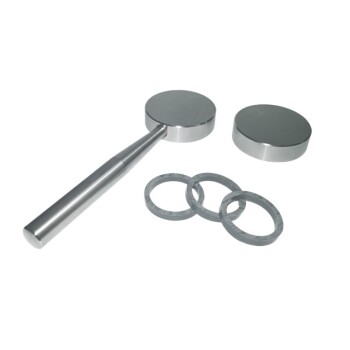
The application of controlled, uniform pressure is the deciding factor in successful solid-state synthesis. A laboratory hydraulic press is essential for compacting mixed Ca3Co4O9 powders into solid "green bodies" that possess the necessary structural integrity for handling. By significantly reducing the physical distance between particles, this pelletizing step creates the specific conditions required to facilitate mass transport and grain growth during high-temperature atmospheric sintering.
The transformation of loose powder into a high-performance material relies on particle proximity. The hydraulic press eliminates voids and maximizes contact points, ensuring that diffusion mechanisms function efficiently to create high-quality pre-sintered blocks suitable for advanced processing.
The Mechanics of Densification
Bridging the Particle Gap
The primary function of the hydraulic press is to mechanically reduce the space between individual powder particles.
In a loose state, mixed and ground powders contain significant voids that act as barriers to chemical interaction.
Compaction forces these particles into tight contact, establishing the physical connectivity required for reaction.
Creating "Green Body" Integrity
Before heating, the material must exist as a cohesive solid, known in ceramics as a "green body."
Without sufficient pressure, the powder compact would lack the structural integrity to maintain its shape.
The press ensures the material can be transferred to a muffle furnace without crumbling or deforming.
Enhancing the Sintering Process
Facilitating Mass Transport
Sintering is fundamentally a process of atomic diffusion and mass transport.
By minimizing inter-particle distance, the hydraulic press lowers the energy barrier for atoms to move across particle boundaries.
This efficient mass transport is critical for densifying the Ca3Co4O9 structure during the atmospheric pre-sintering stage.
Promoting Grain Growth
The close proximity established during pelletizing directly influences the microstructure of the material.
It enables effective grain growth within the material matrix as it is heated in the muffle furnace.
This microstructural evolution is necessary to achieve the desired physical properties of the ceramic.
Understanding the Trade-offs
The Necessity of Uniformity
While pressure is vital, it must be applied uniformly to ensure consistent results.
A laboratory hydraulic press provides uniform pressure, which is critical for creating pellets with regular shapes and consistent internal density.
Uneven pressure can lead to density gradients, which may cause warping or cracking during the heating phase.
Eliminating Interferences
Failing to achieve sufficient density does more than just compromise structure; it affects data reliability.
Loose powders or poorly compacted pellets can cause electrical interference due to poor particle contact.
Proper pelletizing eliminates these gaps, allowing for more accurate data collection regarding resistance changes and material sensitivity.
Optimizing Your Sintering Workflow
To ensure the best results during the synthesis of Ca3Co4O9, consider your specific end-goals when utilizing the hydraulic press.
- If your primary focus is Structural Integrity: Prioritize applying sufficient pressure to maximize mechanical strength, ensuring the pre-sintered block is robust enough for subsequent hot-pressing treatments.
- If your primary focus is Data Accuracy: Focus on achieving high and uniform density to eliminate electrical interference, ensuring precise resistance and sensitivity measurements.
By treating the pelletizing stage as a critical variable rather than a mere preparatory step, you ensure the fundamental quality of your final thermoelectric material.
Summary Table:
| Feature | Role in Ca3Co4O9 Synthesis | Benefit for Pre-Sintering |
|---|---|---|
| Particle Proximity | Reduces voids between mixed powders | Facilitates efficient mass transport & diffusion |
| Green Body Integrity | Creates cohesive solid pellets | Prevents crumbling/deforming during furnace transfer |
| Uniform Pressure | Ensures consistent internal density | Prevents warping or cracking during grain growth |
| High Densification | Eliminates inter-particle gaps | Minimizes electrical interference for accurate data |
Elevate Your Material Synthesis with KINTEK Precision
Precision in the pelletizing stage is the foundation of high-performance thermoelectric materials like Ca3Co4O9. KINTEK specializes in advanced laboratory equipment designed to meet the rigorous demands of solid-state synthesis.
Our comprehensive range of manual and automatic hydraulic presses (pellet, hot, and isostatic) ensures perfectly uniform compaction for your green bodies. Beyond pressing, KINTEK supports your entire workflow with high-temperature muffle and tube furnaces, crushing and milling systems, and essential consumables like high-purity ceramics and crucibles.
Ready to achieve superior structural integrity and data accuracy? Contact KINTEK experts today to find the ideal pressing and sintering solutions for your laboratory research.
Related Products
- Automatic Laboratory Hydraulic Pellet Press Machine for Lab Use
- Laboratory Hydraulic Pellet Press for XRF KBR FTIR Lab Applications
- Automatic Laboratory Hydraulic Press for XRF & KBR Pellet Press
- Laboratory Manual Hydraulic Pellet Press for Lab Use
- Laboratory Hydraulic Press Lab Pellet Press Machine for Glove Box
People Also Ask
- What is the role of a laboratory hydraulic pellet press and stainless steel molds in the fabrication of RuO2/NbC anodes?
- What role does a laboratory pellet press play in the enhancement of biomass energy products? Optimize Fuel Efficiency
- What is the purpose of using a laboratory pellet press when evaluating the electronic conductivity of carbon powders? Guide
- How does a laboratory hydraulic pellet press contribute to SiCw/2024 aluminum composite preforms? Optimize Densification
- What is the significance of applying 200 MPa of pressure with a laboratory hydraulic pellet press for composite ceramics?