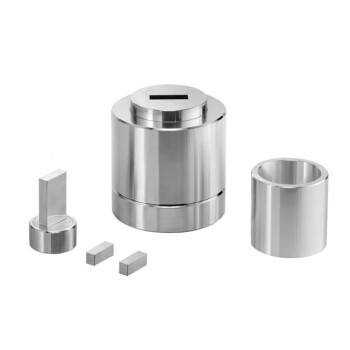
Laboratory hydraulic presses serve as the fundamental molding tool for integrating aluminosilicate additives into biomass fuel matrices, such as wheat straw or miscanthus. By applying high-precision vertical pressure, these presses mechanically compress loose mixtures into high-density pellet fuels. This process transforms variable raw materials into uniform samples, setting the stage for efficient thermal conversion.
The primary function of the press goes beyond simple compaction; it facilitates the uniform distribution of additives required to chemically alter ash properties and prevent slagging during combustion.
The Mechanics of Pelletization
Achieving High-Density Compaction
The hydraulic press utilizes mechanical force to reduce the volume of the biomass-additive mixture significantly.
By applying vertical pressure, the press eliminates air voids and forces the distinct materials to bind together. This results in a high-density fuel pellet that retains its shape and structural integrity.
Ensuring a Consistent Density Gradient
Consistency is vital for accurate analysis. The press ensures that the density gradient across the pellet remains uniform.
This mechanical consistency ensures that subsequent tests regarding combustion rates or calorific values yield repeatable, industrially relevant data.
The Chemical Impact: Preventing Slagging
Homogeneous Distribution
The most critical role of the hydraulic press in this context is ensuring uniformity.
The molding process forces the aluminosilicate additives to disperse evenly throughout the biomass fuel matrix. Without this mechanical integration, additives might clump, leading to inconsistent reactions during burning.
Facilitating In-Situ Reactions
Because the press creates close contact between the biomass and the additives, distinct chemical benefits occur during thermal conversion.
The uniform distribution allows aluminosilicates to interact directly with low-melting-point components found in the biomass ash.
Mitigating Fouling Issues
This intimate contact drives the in-situ formation of high-melting-point minerals.
By raising the melting point of the ash minerals, the process effectively prevents the ash from melting into slag. This protects combustion equipment from fouling and severe operational damage.
Understanding the Trade-offs
Laboratory Precision vs. Industrial Scale
While laboratory presses provide high precision, they produce pellets in batches rather than continuous streams.
The data derived is excellent for establishing baselines and proving concepts, but you must account for the variability introduced when scaling up to continuous industrial pelletizers.
Dependence on Pre-Mixing
The press fixes the materials in place, but it does not actively mix them.
If the initial mixture of biomass and aluminosilicates is poorly blended before entering the press, the resulting pellet will still have uneven distribution. The press locks in the uniformity (or lack thereof) present at the moment of compression.
Making the Right Choice for Your Goal
To maximize the effectiveness of laboratory hydraulic presses in biomass research:
- If your primary focus is preventing slagging: Ensure the pre-compression mixing phase is thorough so the press can lock in a truly homogeneous matrix for optimal chemical reaction.
- If your primary focus is data reproducibility: Maintain strict control over the vertical pressure settings to ensure every sample possesses an identical density gradient.
By using the press to achieve uniform density and distribution, you bridge the gap between raw biomass potential and reliable fuel performance.
Summary Table:
| Feature | Laboratory Press Function | Key Research Benefit |
|---|---|---|
| Compaction | Eliminates air voids via high vertical pressure | Creates durable, high-density fuel pellets |
| Distribution | Forces uniform dispersion of additives | Prevents additive clumping for reliable results |
| Consistency | Maintains precise pressure settings | Ensures repeatable data for combustion rates |
| Chemical Impact | Facilitates close contact for in-situ reactions | Raises ash melting points to prevent slagging |
Elevate your biomass research with KINTEK’s high-precision laboratory hydraulic presses. Our systems are engineered to produce uniform, high-density pellets that ensure consistent chemical interaction and reliable thermal conversion data. Beyond pelletization, KINTEK offers a full suite of laboratory solutions—from high-temperature furnaces and crushing systems to advanced reactors and cooling equipment. Contact our experts today to find the perfect hydraulic press for your material research and streamline your laboratory's efficiency!
References
- Izabella Maj, Krzysztof Matus. Aluminosilicate Clay Minerals: Kaolin, Bentonite, and Halloysite as Fuel Additives for Thermal Conversion of Biomass and Waste. DOI: 10.3390/en16114359
This article is also based on technical information from Kintek Solution Knowledge Base .
Related Products
- Automatic Laboratory Hydraulic Pellet Press Machine for Lab Use
- Automatic Laboratory Hydraulic Press for XRF & KBR Pellet Press
- Laboratory Manual Hydraulic Pellet Press for Lab Use
- Laboratory Manual Hydraulic Pellet Press for Lab Use
- Laboratory Hydraulic Press Lab Pellet Press Machine for Glove Box
People Also Ask
- What is the role of a laboratory hydraulic pellet press and stainless steel molds in the fabrication of RuO2/NbC anodes?
- What role does a laboratory pellet press play in the enhancement of biomass energy products? Optimize Fuel Efficiency
- What is the purpose of using a laboratory pellet press when evaluating the electronic conductivity of carbon powders? Guide
- How does a laboratory hydraulic pellet press contribute to SiCw/2024 aluminum composite preforms? Optimize Densification
- What is the significance of applying 200 MPa of pressure with a laboratory hydraulic pellet press for composite ceramics?